While in college, I did work study in the university’s scene shop, building sets for the school’s mainstage productions. This was a really beneficial experience– I learned a ton and developed a lot of really useful skills– but it was also just a ton of fun. Here are some humorous memories I look back on fondly:
Continue readingCategory: technical theatre
5 Ways Working in the Scene Shop made me a Better Theatre Artist
I made extra money during college as a work-study scenic technician for the university’s theatre and dance department. The experience was a lot of fun, and it was instrumental in helping me develop into the creative thinker and problem-solver I am today.
I often say that I think every actor should try out tech and design opportunities. Why? Here are a few ways working in the scene shop helped me, and can help you, too:
Continue readingProp-Making Fun: Building Wellington the Dog for “The Curious Incident of the Dog in the Night-Time”
(Featured image by Pittsburgh Performance Photography. The Curious Incident of the Dog in the Night-Time, directed by Jessica Zack, 2024. Lighting design by Craig Soich.)
A few months back, I was asked to build a prop dog for my friend’s production. This prop can be a bit of a challenge– as I was searching forums and Facebook groups for inspiration, I found a number of people looking for advice on how to approach it– so I thought others might find an explanation of my process useful.

(A photo of the finished prop, in the performance space.)
I had not read the play prior to being asked to construct this prop. The director gave me creative freedom to approach it as I saw fit. I started by looking for some inspiration photos online. One of our friends informed us that the original source material, the novel, says that the dog is a poodle– I wasn’t very keen on trying to create poodle fur (or spend the money to purchase it), so I decided to go another direction. I thought a border collie color scheme, with distinct black-and-white patches, might be striking and more easily readable on stage. This ended up being a convenient choice, as it made purchasing fur from Joann Fabrics much cheaper in the long run (more on that in a bit).
As is my favorite way to start constructing many props, I began with trash! The “core” structure of the dog was several bunches of plastic grocery bags filled with other grocery plastic bags. I arranged these into a roughly dog-shaped form, and then taped them together with masking tape, and then painter’s tape when my tape roll ran out. On a whim, I threw bits of tree branches from my yard into the legs to serve as some more solid supports– In hindsight, I’m not sure this really served any good purpose, but it seemed like a good idea at the time and certainly didn’t hurt anything. I just stabbed four sticks into the underside of the bag-dog, wrapped additional bags around them, and taped everything together.
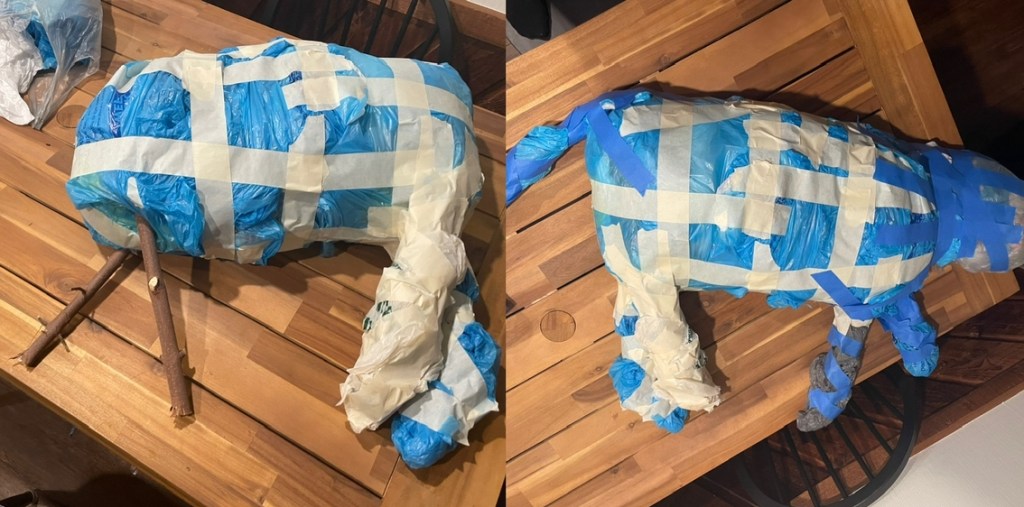
(Bag-dog in all its glory.)
The result was a dog form that was extremely lightweight, but also held its shape surprisingly well for nothing but plastic bags, tape, and a couple sticks. There was no exact science to taping it together, I just threw tape anywhere where it seems like it would help unify the bags. It’s helpful to stuff a ton of bags into one bag, do the same for another, and then sort of mash the open ends of these together to “marry” them into one, and tape them together this way– I think this helped create a more solid structure.
It is worth noting that the plastic bags, cheap and plentiful as they were for crafting, did make it so that the dog made a distinctive crinkling sound when moved. So, if this is a problem for you, you may want to find another material, or maybe experiment with using additional tape to help deaden the sound/eliminate extra movement that would create the sound.
After this, traced the shape of the dog form on some old fabric, cut out the shape twice, and hand-sewed these together to make a fabric pocket to cover the plastic bags. I have really never sewn anything before, but this was meant to be an unseen interior piece anyway, so I didn’t stress about it and considered this good, low-stakes practice.
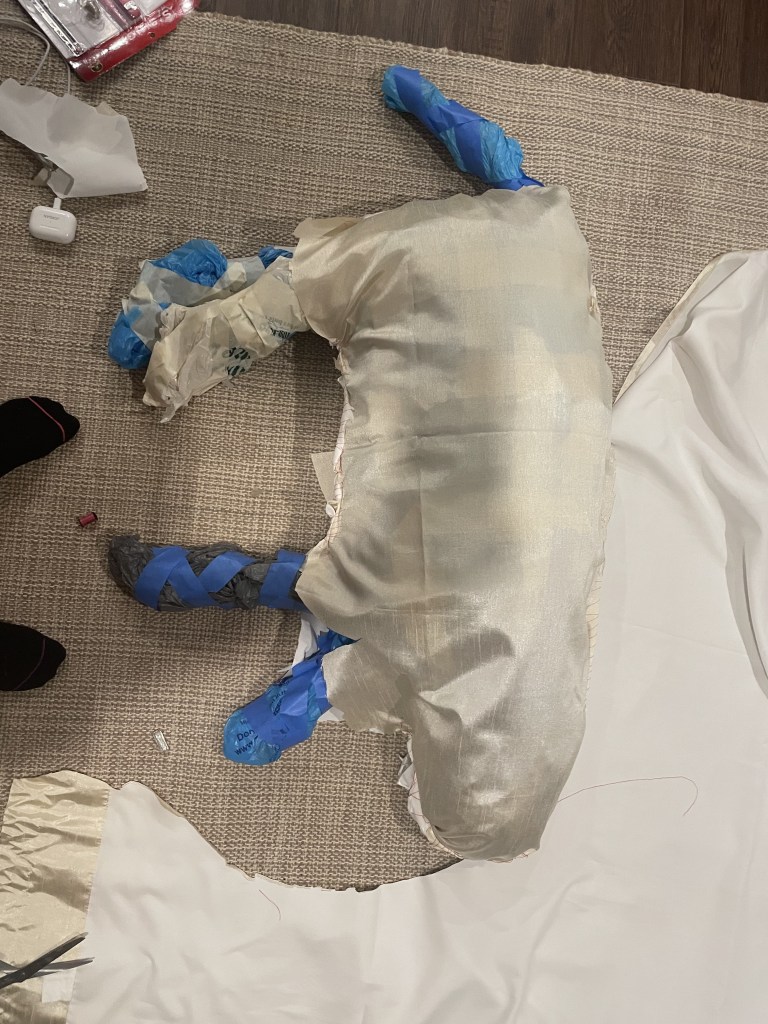
(I did eventually also cover the legs and tail with fabric, too– I guess I didn’t take a photo at that stage!)
Once the entire form was covered in fabric, I used that fabric as a surface to sew fur onto. For a brief time, I wondered if I could just sew the fur directly to the bags, but I don’t think that would’ve worked.
I purchased my fur in 9in x 12in sheets from Joann Fabrics. The POP! Brand fabric sheets were cost-effective compared to regular fake fur, and conveniently available in black and white. At time of purchase, these were only $4 each. I ended up buying 7 black sheets (which was the store’s full inventory of them, so I’m glad it was enough!) and 4 white sheets, and I had an extra white sheet left over when I was done. I ended up spending $35 on fur, whereas actual faux fur fabric would’ve run $30-50 per yard, AND I would’ve needed two different colors.
I used black and white thread to sew down the black and white fur pieces, respectively. In hindsight, it probably would’ve made some more sense to sew the inner fabric “pocket” together over the dog form after sewing on the fur? But I wasn’t confident in my ability to do that correctly, it seemed a bit more complicated. I had some trouble sewing at the angle I needed to because of the paper bags inside the form, though. In the end, I also added some hot glue under each of the fur panels just in case. This helped them feel a lot more solid. (I really don’t know how to sew, it was very humbling!)
I cut the fur panels into the appropriate shapes, paying attention to the direction the fur on the pants was pointing, so that the fur looked continuous. I applied the patches carefully to the face to help sell the illusion that it was a dog– the shapes here ended up needing a bit more precision than I had expected.
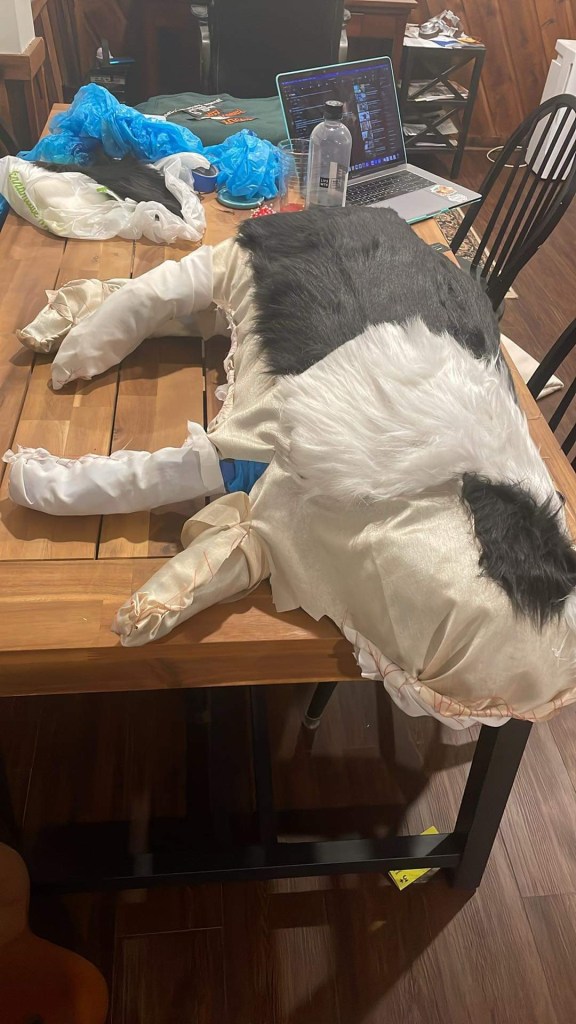
(A photo during the fur process– I was getting pretty nervous around this point. The EPITOME of “trust the process.”)
I ended up running out of black fur, but I had enough to cover the side of the dog that would be visible– I decided I wanted the dog’s back to be to the audience, since that seemed easier to sell an illusion of. Trying to make very realistic looking legs and paws seemed more challenging. I still included the legs just in case someone was sitting at an angle where they would be visible– to camouflage the fact that I ran out of black fur, I just sewed some scrap black fabric over the spots I would have covered in fur. In the end, this saved me money on fur, anyway, and the difference from the audience was really not visible at all.
Shoutout to my mother, who noted upon seeing my work-in-progress that the dog really needed an ear– I added a flap of black fur to the head, sewed down the part where it attached to the head, and put a single stitch at the other end, taking care to position it so there was a small kink in the center. It really looked like a dog’s ear! I was pleased, and I think it made a big difference to the final product.
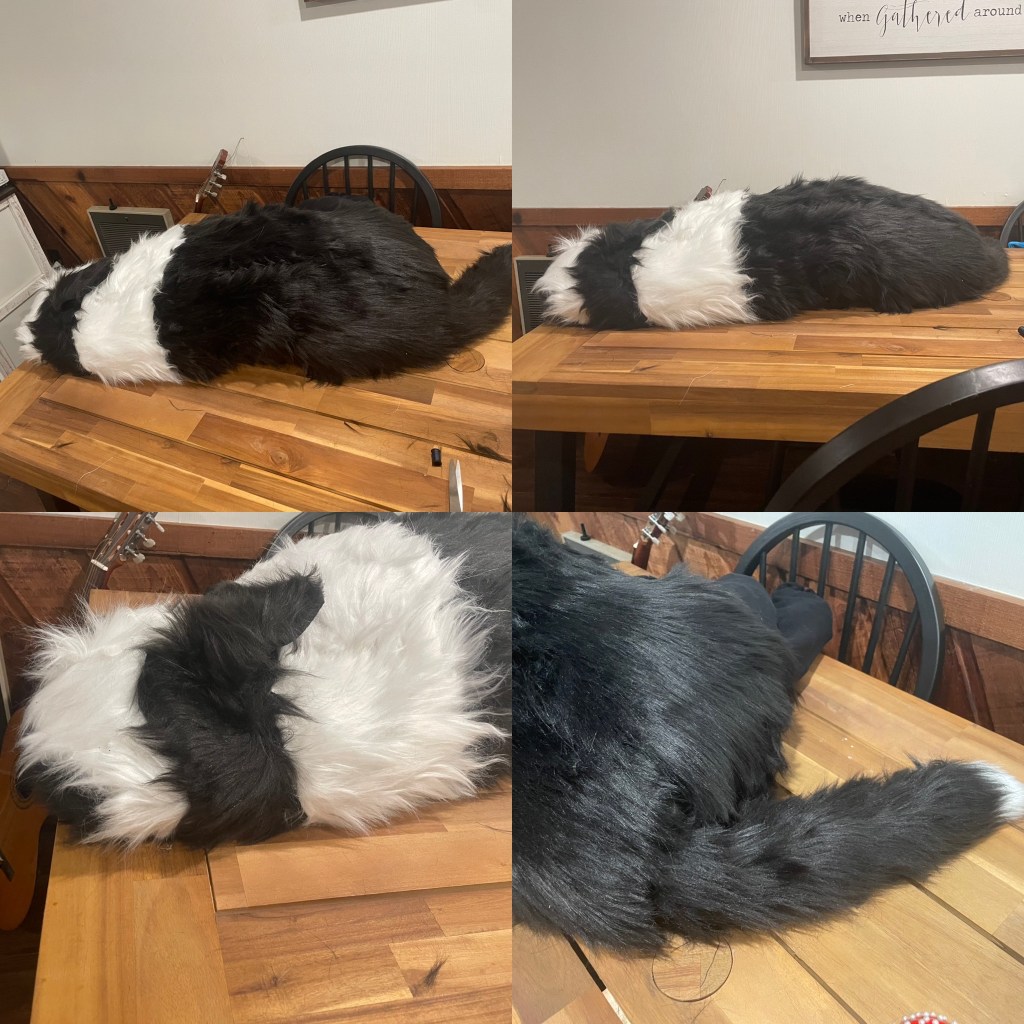
(The finished dog prop.)
Once the dog was done, I had to set my attention to the second part of this prop– the cause of its death. Wellington the dog is stabbed with a garden fork, and that garden fork is meant to be sticking out of its body when the lights first come up.
I debated just buying an actual tool or borrowing one from a friend, but I feared this might be a safety hazard on account of the pointy ends, plus I wasn’t sure how much work it would require to make such a heavy object stand upright. And, frankly, I didn’t want to spend the money.
I did have some EVA foam materials lying around from a previous crafting project… that I ended up deciding not to use EVA foam for. So, I decided to try a second thing for the very first time with this project and build the garden fork out of EVA foam.
This process was rather quick and haphazard– I spent a bit longer than anticipated on the dog itself, so I finished up the garden fork in the hours before leaving for the theater to drop the prop off! I used some triangle-shaped EVA foam dowels attached to a square-shaped dowel to make the fork end of the tool. (I can’t find the exact dowels I purchased, but they were similar to these.) I cut the dowels to length and applied a bit of white glue to fit the pieces together. Once this was sufficiently dry, I covered the joints with foam clay. I applied the clay all around the joint, then dabbed my fingers in a tiny bit of water to shape it. Some of this shaping was on a very small scale, so I used the rounded head of a straight pin to get into areas I was struggling to reach. This ended up being a surprisingly useful sculpting tool!
I used a larger foam dowel for the shaft of the fork. I attached this piece to the “fork” part in the same way that I attached the fork tines. I used some flat cuttings of an EVA foam sheet for some detailing, and for the handle on the very top. Anywhere where I had an awkward edge I wanted to smooth over, I applied more foam clay.
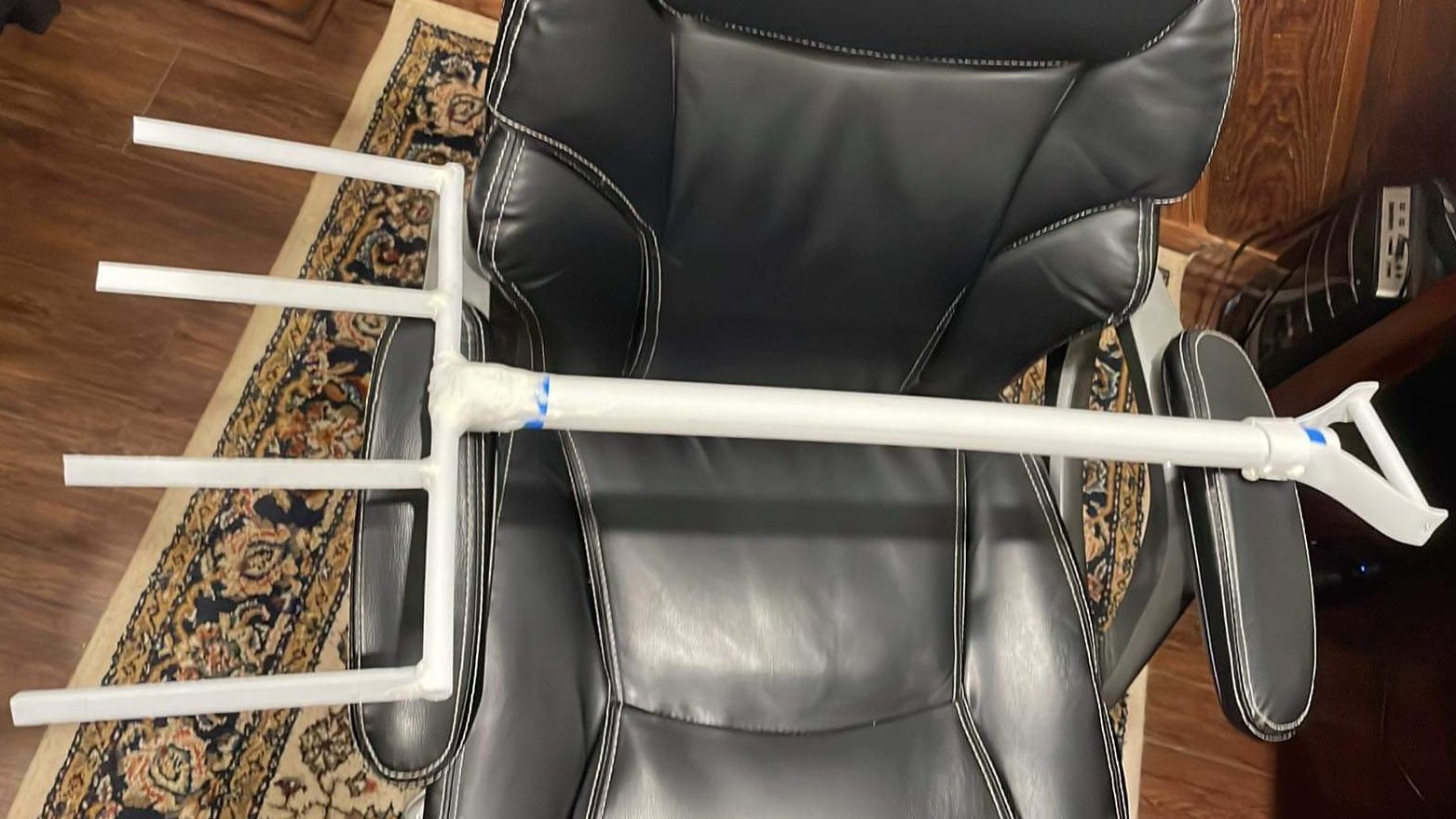
(I’m not saying it was stellar work, but it definitely did the job I needed it to do!)
To get the fork to stick out of the dog, I used tape to attach a thin, straight stick to the back. Literally, just a stick from my yard! I had been looking for something more like a garden spike, but I didn’t have any of these on hand and figured a stick was just fine.
After waiting a bit for the foam clay to dry, (and admittedly, I should’ve waited longer– more like 24 hours instead of 2!) I spray painted the entire thing with a mix of black, silvery gray, and some red for the handle. The spray paint really brought the whole thing together. I spray painted the stick that would hold the fork upright black, so that it really wouldn’t be visible with the black set behind the prop.
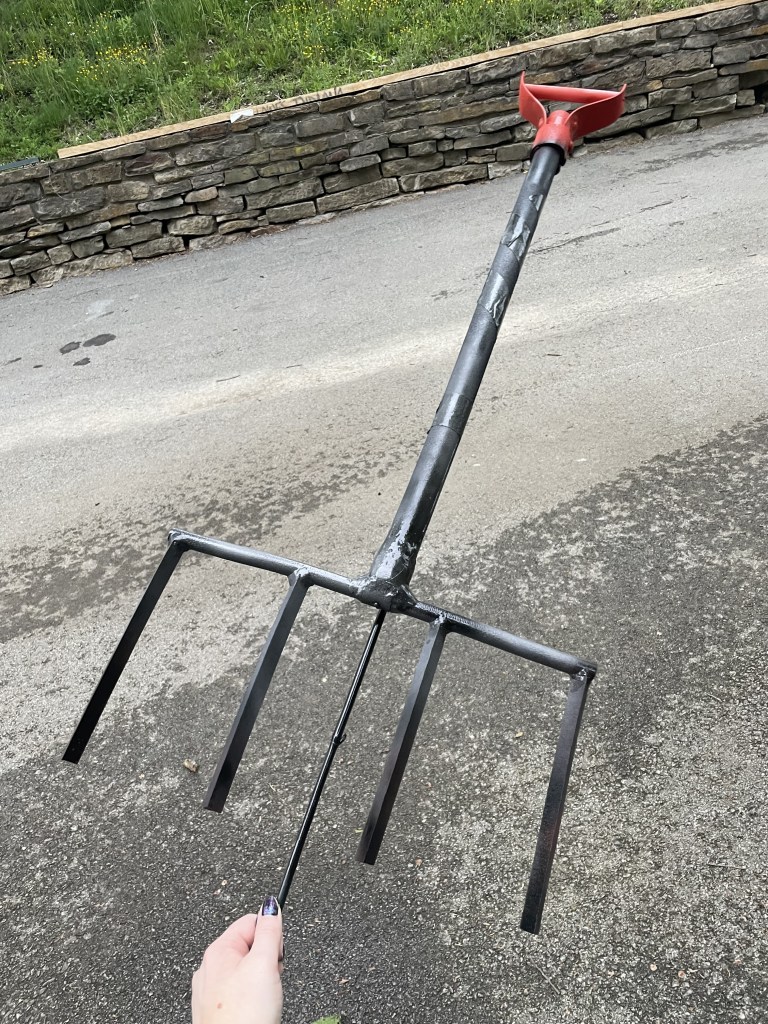
(The fork after painting. I loved how the sort of uneven job with the foam clay made the joints look like they were welded together. I was afraid it would just look sloppy!)
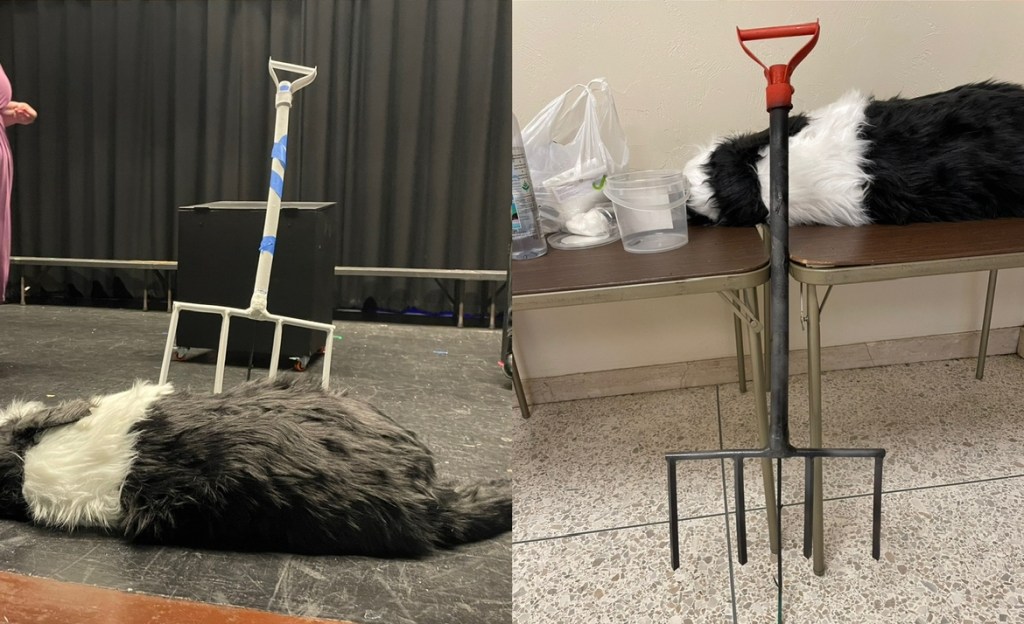
(A good before-and-after comparison. It went from a little silly looking to actually looking pretty lethal, in my opinion!)
I had left a gap on the dog’s stomach when I sewed the fur, so I just stuck the stick down into this gap. I still struggled to get the fork to stand upright, it kept flopping over a bit, so I went with the extremely elegant solution of just pumping a ton of hot glue into the gap in the fur until I could get it to stand upright. If it works, it works, I guess.
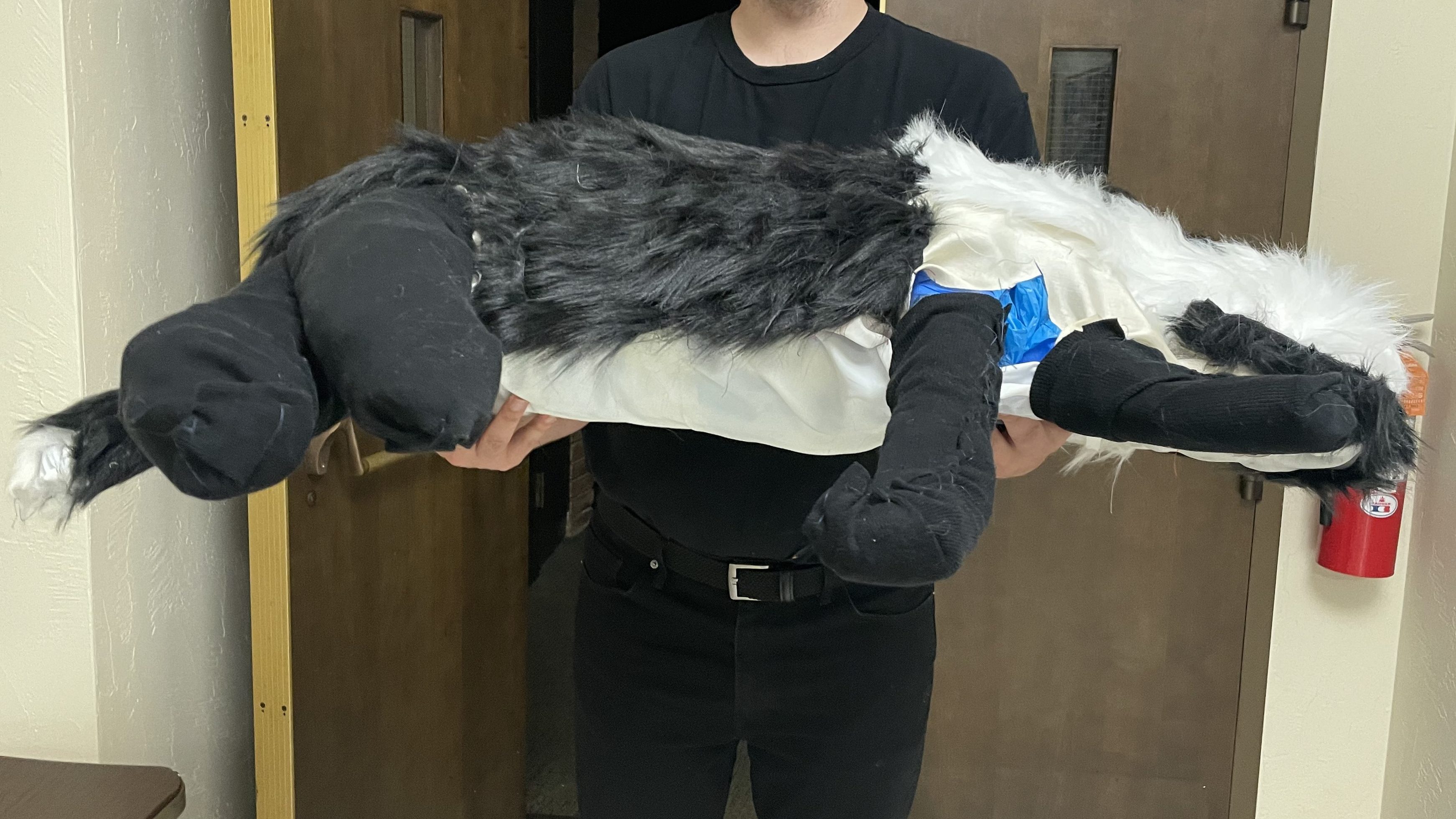
(A photo from the angle the audience WOULDN’T see– theatre is all about angles and illusions, after all!)
Not counting supplies I already had (scrap fabric; sewing thread, pins, and needles; lots of EVA foam materials, trash bags and sticks, spray paint, hot glue), I spent $35 total to make this prop. If you were to buy everything, this would probably cost a lot more, but many of these supplies are materials the average crafty person would have on hand, anyway. The EVA foam would arguably be the priciest part of this project– if you were buying all of that, I’d estimate adding another $40. You could probably avoid that cost if you used some other materials, I just used what I had on hand.
That covers my process! I hope this might be useful knowledge to some other crafters. If I can do it, you certainly can– I figured out how to work with most of these materials on the fly. Happy crafting!

40 Reasons Every Actor Should Try Theatre Tech
I pride myself on being a multi-talented actor. I have had the good fortune to experience theatre in a number of on-stage, off-stage, and backstage positions, and I have really treasured these opportunities! In fact, I value them so much, that I think every actor should try them out for themselves.
Here are 40 miscellaneous reasons you should:
- You learn practical life skills. Almost every skill you’ll pick up in theatre tech– whether it’s a hard skill like design, construction, and electrics, or a soft skill like teamwork, critical thinking, and problem solving– can be used in other domains.
- You get to experiment with tools you’ve never used before. Learning to use new power tools and other technology can be both fun and extremely useful even outside the theatre. I learned how to weld because I decided to try a position as a work-study tech in college!
- You make new connections. You’ll likely work with different people than you do as an actor, and that networking can translate to new opportunities.
- You become more marketable as an actor. Tech skills are a nice addition to a resume. If you do community theatre, this skill is extra useful, since much of the tech crew will be volunteers anyway.
- You develop your problem-solving skills.
- You develop your mathematical and technological skills. Essentially every role you’ll take on in theatre tech will involve some measure of either math or technology, or both. This can be a valuable way to practice these skills.
- You discover new ways to participate in and enjoy theatre. I’ve known many actors who have tried tech theatre and discovered they actually enjoy it much more than acting!
- You deepen your understanding of theatre as a whole. Understanding “how the sausage gets made” so to speak can help you better understand the art of theatre. You’ll be surprised at how this can shape your understanding of performance.
- You can find new hobbies. Theatre tech integrates a number of different trades and skills. You may find that painting sets or making props becomes a source of creative inspiration for you!
- You can pick up skills that can be useful for a professional career. As I said before, both the hard and soft skills of theatre tech can be practical in many other domains– including professional ones! For a time, I seriously considered looking into taking formal welding lessons to shore up the welding skills I learned doing theatre tech in order to get a new vocation. You never know how useful the skills you learn may be: you might even be able to build a life out of them.
- Or pick up a new professional career itself! Theatre tech is a career, and one that can be highly satisfying. If you experiment and find the work exciting, you might have a new career aspiration on your hands.
- You hone your teamwork skills.
- You become more well-rounded.
- You stay active. Theatre tech can be a decently physical job, though it also doesn’t always have to be.
- You learn useful safety principles. You’ll learn the importance of and how to operate useful safety equipment, and learn important rules for keeping yourself safe while working.
- You learn useful design principles. You’ll learn about artistic ideas that can be used in many other domains of design and decor, not just for the stage!
- You get to flex different creative muscles. If you’re used to acting, trying set construction, prop design, or scenic painting can be a good way to try something new and develop new artistic skills.
- You can become known for some niche skills. I became known as a good “strange props” person in my local theatre communities after I made a prop dog for The Curious Incident of the Dog in the Night-Time. This has made for some cool opportunities! If you have an interest in puppet-making, handcrafting, and mixed-media art, you can find a really sweet way to put those skills to work in tech theatre.
- You find joy in supporting others. I’ve found working backstage to be incredibly rewarding– getting to support a performance in a different kind of way can be a lot of fun.
- You’ll always find opportunities. Theaters always need volunteers (and/or paid professionals!) to run light or sound boards, work backstage, or build sets! Once you have some of these skills, they can be a great way to get your foot in the door with different groups of people.
- You can lend a helping hand, and maybe even save the day. It often happens that productions suddenly discover they need an extra dresser backstage, or their light board operator has suddenly become unavailable. Sometimes, theaters need a volunteer to step up right away. Stepping in and saving the day in situations like this can be super rewarding!
- You learn to work under pressure. Theatre techs often work with challenging time constraints put on their work. They need to find solutions for big problems, sometimes while a whole room full of actors are waiting around for you to find a fix. The work isn’t always high-pressure, but working in these conditions when they arise can be a valuable learning experience.
- You can discover a new sense of purpose. If you become talented with these skills and develop a good reputation, you can find yourself becoming indispensable within certain theatre communities for your skills. You may find yourself becoming hard to replace!
- You can hang out with friends who aren’t actors. If you’ve been trying to get some of your friends to try theatre, but they’re nervous about acting, consider getting them to volunteer for set builds or run crew with you. Or you may already have friends working backstage– join them!
- You might be able to find paid opportunities more easily. Finding paid acting work is notorious for how challenging it is. Some shows require more technicians than on-stage talent! Finding paid work as a technician can be easier than doing so as a performer.
- You’ll engage different parts of your brain. We often say that some people are “good with their hands,” or “book smart”– these are just ways that certain people have become accustomed to working. Some people develop different areas of the brain more than others as a result of the things they find interesting and fun. Actors who are more accustomed to academic skills may find experimenting with more physical and technical skills to be a fun challenge.
- You develop dexterity on both small and large projects. From gluing tiny rhinestones to a prop you’re making to building massive set pieces, theatre tech trains a number of unique muscles both physical and mental.
- You refine your eye for detail-oriented work. Being “detail-oriented” is a soft skill many employers praise.
- You learn to be more adaptable. You have to be when working backstage! Lots of tech tasks don’t go the way you expect them to at first, and that’s okay. You learn to work around this.
- You build communication and collaboration skills. Almost nothing in tech theatre is a solo endeavour– you will always be working with others, asking others for feedback, or working with others’ ideas. These skills are a must!
- You’ll discover greater confidence with all things theatre. Once you’ve worked backstage and you understand the theatrical process better, working on stage feels surprisingly different. The greater understanding of the art and craft can do wonders for your sense of confidence, and for banishing the dreaded imposter syndrome.
- You test your time management skills. If you’ve been tasked with building a prop, designing a set, or doing some other independent task, you’ll have to plan accordingly to ensure your work can be completed before any deadlines set for you. Learning to manage your time well is a must!
- You can make some friends in high places. I have found that taking positions as a stage manager, ASM, or volunteer scenic technician can be valuable for meeting new directors and tech directors. These people can then help get you more opportunities going forward. Who you know is definitely important!
- You’ll appear more dependable. Showing up at set builds and working hard is a great way to show a production staff your work ethic. People will notice!
- You learn to think in different ways. Working with new people and learning new skills forces your brain to discover new patterns of thinking.
- You’ll understand how to interact with techs better. Being a technician and working backstage can be humbling. Many actors can be quite rude to techs! Working as one can teach you a lot about how to treat others, and the impression you make by interacting with techs positively and helpfully can help open doors for you.
- You get to participate in theatre with less of a time commitment. Okay, this one is admittedly very situational depending on the tech position. Many theatre tech positions do not spend nearly as much time working on a production as actors do. Instead of attending weeks or months of rehearsal, many techs will only participate in a fraction of the process. If you enjoy theatre but don’t have the time to commit to a whole production, tech may be a great option for you!
- You learn to be inventive. I have a friend who calls theatre tech work “making gold out of trash.” You’ll often find yourself working with odd materials, on a low budget, with minimal assistance– the process can be very freeing, and a little crazy in the best way.
- You may find the experience useful to include on a professional resume. As I’ve said before, theatre tech is a great opportunity to learn both hard and soft skills. Listing your tech experience on a professional resume can help you resume stand out– unusual skills can provide interesting discussion in an interview! When I told a hiring manager at a retail chain that I had learned how to weld, we had a spirited conversation about it because it turned out she was also a welder… I ended up getting the job.
- You’ll have fun! Tech is hard work, but
What reasons have you found to enjoy technical theatre work? I would love to hear about peoples’ experiences in the comments!
Costuming a Cadre of Creatures for “She Kills Monsters”
I made my directorial debut for community theatre doing Qui Nguyen’s She Kills Monsters. This is my absolute favorite play, I had long been hoping to put it on one day. When I finally got the opportunity, I was absolutely thrilled– and startled by the sheer amount of work this meant I needed to start on, pronto!
She Kills Monsters is about two sisters getting to know each other (with a twist) through playing Dungeons and Dragons. Like many of Qui Nguyen’s plays, this one is action-packed, full of fighting and off-color humor. The main character, Agnes, and the rest of her party fight against swarms of classic D&D baddies. Creating these monsters can be a real challenge.
Since the show is so popular, I thought others might find it helpful to hear about my process!
First Trial
Initially, I wasn’t sure how exactly I would pull off these monsters… but I’ve always been a crafty person, and I started making plans for my monsters early on (before I even officially knew I’d be directing the show!).
Discovering Wintercroft LLC marked the moment that I knew I could put this show on, even if I didn’t have a dedicated costumer.
Wintercroft designs papercraft templates for masks, jewelry, and home decor. Their masks are really remarkable. The templates are mostly quite easy to assemble (the site provides a difficulty rating and crafting time estimation for each mask– some are harder than others), and very cost effective. The templates generally sell for under $10, and once you own the template, you can print it as many times as desired. The masks themselves are constructed out of thin cardboard (think cereal box material) and glue.
Instead of buying Halloween monster masks at $10-30 bucks a piece (or more), you could hypothetically craft a whole group of monsters for no more than $15 (one template printed multiple times, made with some cereal boxes you scavenged from your pantry, and add the price of some glue sticks).
To test out the process, I decided to use Wintercroft’s Dragon V2 mask as a trial. The process was a lot of fun, and turned out looking pretty good. My mistakes with this first test were using cardstock instead of thin cardboard, and opting for the “untabbed” construction method (explained in the template files), which both created a much floppier final product than I was hoping for.
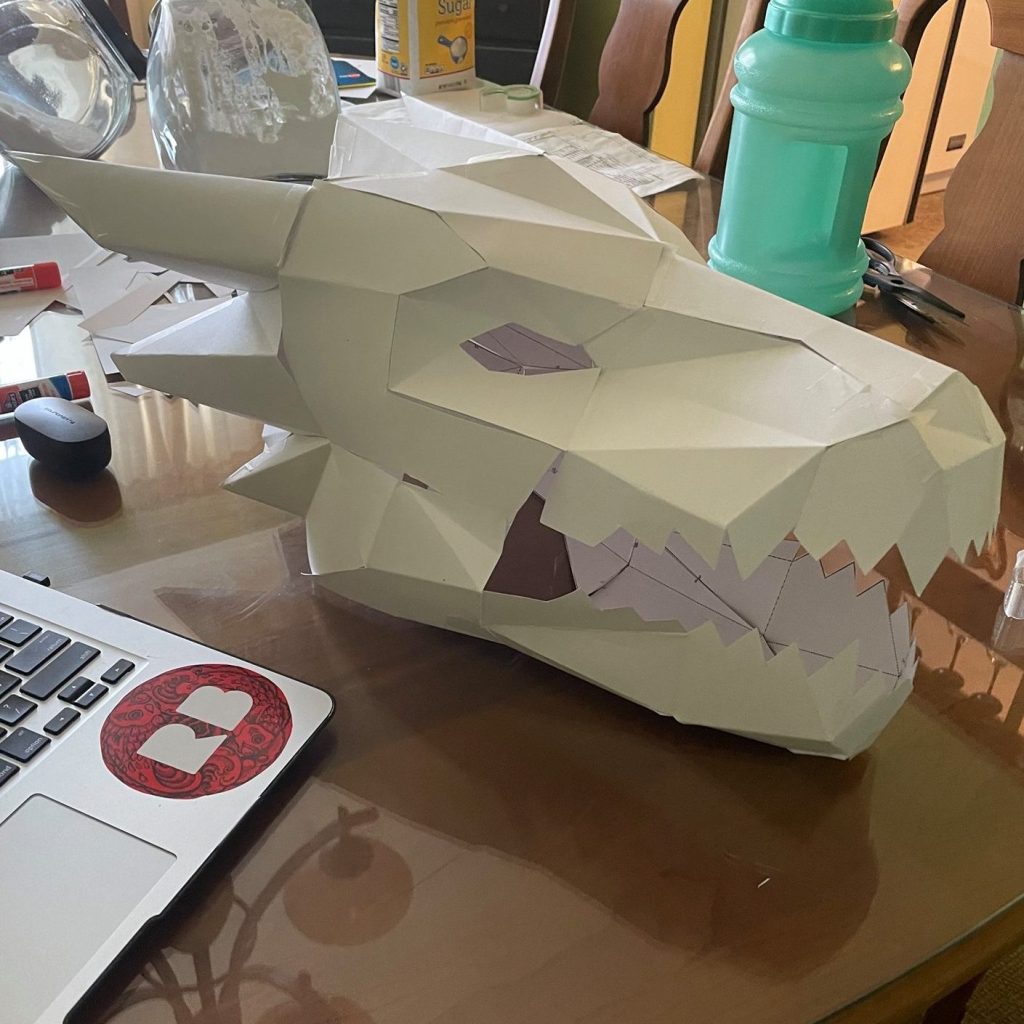
(My first trial went pretty well, and looked pretty cool, but I had hopes that switching up my method would have even better results.)
So, I went back in for a second test-run, this time using cardboard and trying the “tabbed” construction method.
The basic process, in a nutshell: You print the templates on paper, cut them out, glue them to the cardboard, cut those out, and fold all the pieces on the dotted or dashed lines as appropriate (the templates explain all this, too). Then you use the matching numbers on the edges of the pieces to put the whole thing together, like a puzzle, gluing as you go.
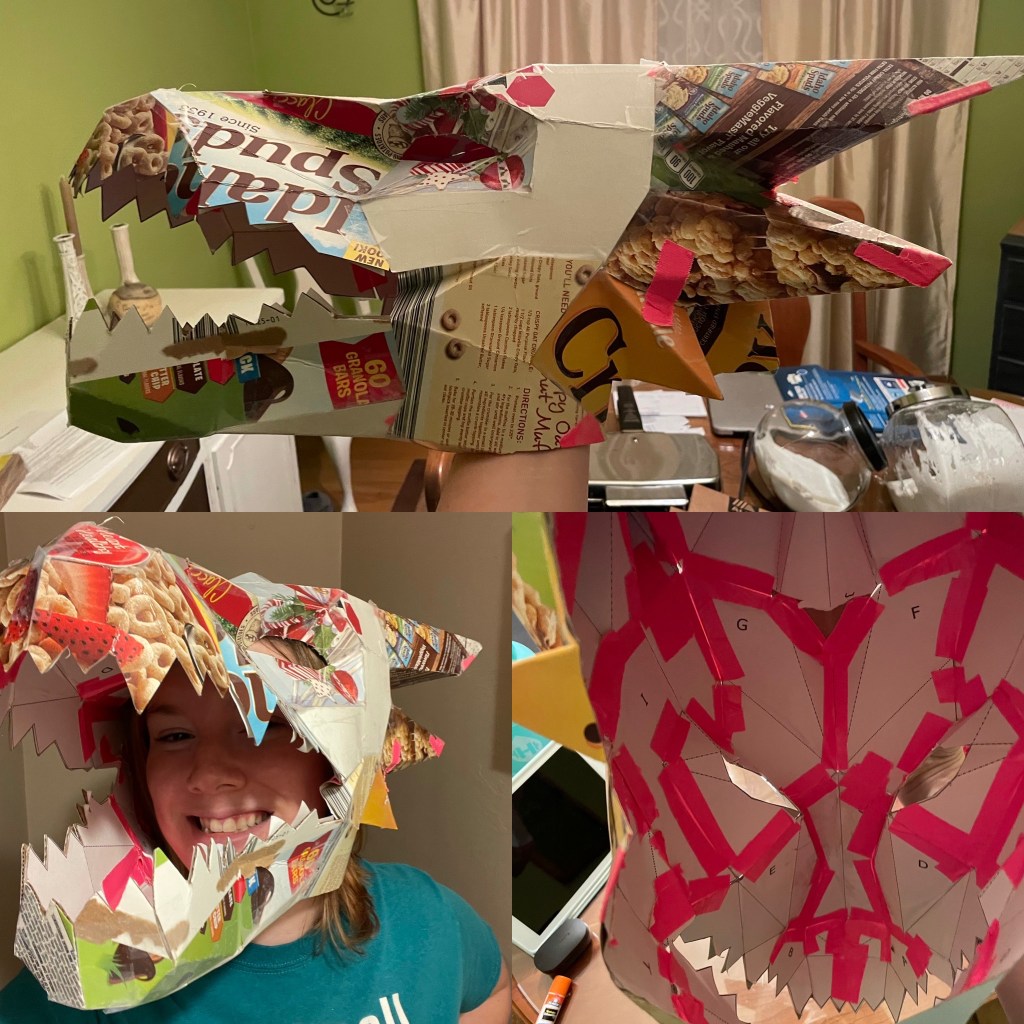
(Some pictures of my second attempt. I used card for this one and had some help from duct tape. Bottom right shows you what the inside of the templates look like– there’s tape over the numbers that show you what piece goes where, but as you can see, the pieces are also lettered.)
This version was a lot sturdier, but I was still a bit unsure of how this would hold up for performance, especially during fight scenes or in the dark backstage. I had horrible visions of someone dropping their mask and stepping on it in a rush.
In searching for solutions, I found this video from Ultimate Paper Mache, explaining the process for super sturdy, quick-drying paper mache using brown paper bags and a specific brand of wood glue. It seemed like exactly what I needed! I’d never done paper mache, but the process seemed really simple (and fun), so I decided to give it a try.
I invested in some wood glue, ripped up some paper bags, and got to work. The process was easy, I just did exactly what the video said– the most time-consuming part was just waiting for the paper mache to dry. I found it seemed the most sturdy after about 24 hours of drying. Materials-wise, I found heavy paper bags (think grocery bags or food delivery bags, like you get from Chipotle or McDonald’s) to be better than paper lunch bags.
One coat of paper mache was pretty solid, but I decided to try doing more to see how sturdy it could get. I did a test with one coat of paper mache on the interior of the mask and two coats on the exterior, and the result was SO sturdy that these masks felt borderline indestructible. For good measure, I sealed everything in with a clear coat of mod podge.
With these tests done, I figured Wintercroft was a really good option for my monster needs. I sent the company an email to ask if it was okay to use their masks in a theatre production, and they gave me the go-ahead! On to phase two…
Plans, Designs, and Further Tests
I started searching for Wintercroft templates that I could use to create the various monsters for the show. Of course, Wintercroft didn’t really have the specific creatures I was looking for, but I was excited about the prospect of using additional cardboard, paper, and mixed media details to really make the templates my own. Using Procreate on my iPad, I started drawing up some plans.
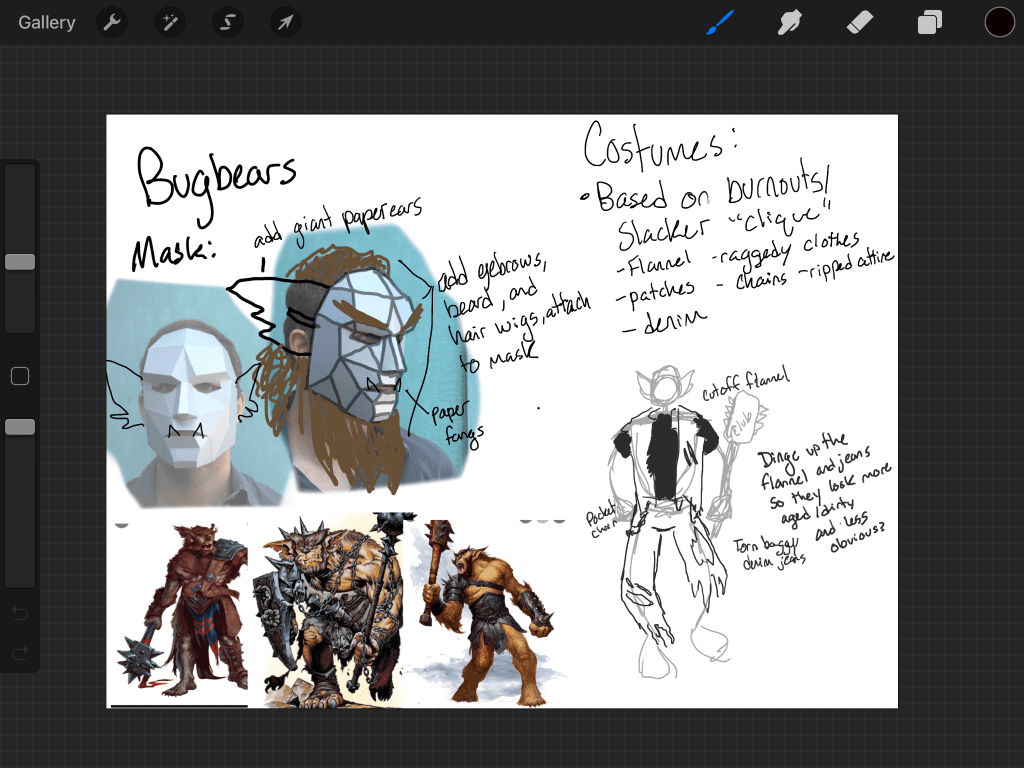
(As a sample, this was the plan for the Bugbears, which ended up being my favorite monsters! I ended up simplifying/changing quite a few elements from this first design, but those mask add-ons are exactly how the final product turned out.)
I decided to try out the process of modifying the masks, so I got started on some Bugbears.
I repeated the same process I did with my test dragon. I made the masks, covered them in paper mache, and sealed everything with mod podge. Then I painted them, sealed the paint with more mod podge, and got started adding some additional details. The teeth were as simple as cutting triangles out of extra cardboard and glueing them into the mouths. I decided to make the ears out of EVA foam (not really sure why when cardboard would’ve worked just as well… but that was also as easy as cutting out shapes and painting them, for the most part).
I decided to get a little more ambitious with the hair pieces. I bought a number of crappy “ponytail extensions” on Wish, all slightly different textures and colors. I handmade a wig for the mask by cutting locks of hair off these extension and gluing these individually to a strip of fabric. I alternated different styles and colors of hair to make the wigs more “wild” and unkempt looking. I also added some lengths of twine (and put some beads on some of these, just for fun) and some strips of different fabrics, to help break up the texture. I liberally applied more glue over all of this and put another piece of fabric down over the top, so I had a sort of hair-fabric sandwich– then, once this was dry, I attached it to the top part of the mask using velcro pieces. I wanted the wigs to be removable, just in case. I repeated this process but with shorter pieces to create beards.
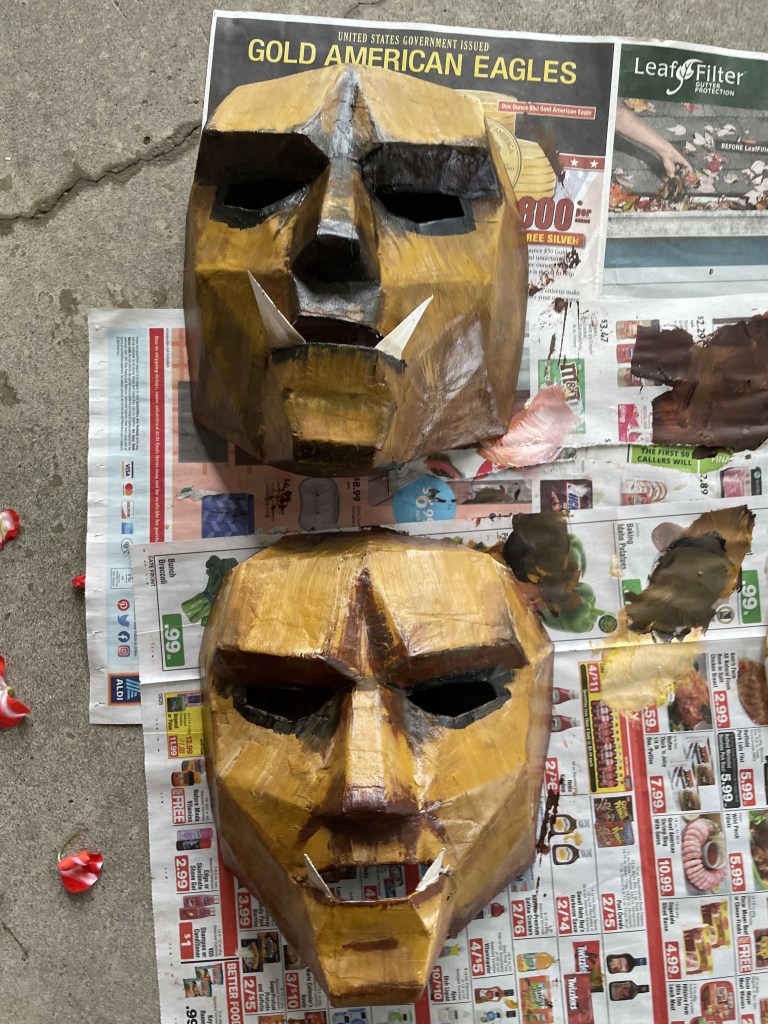
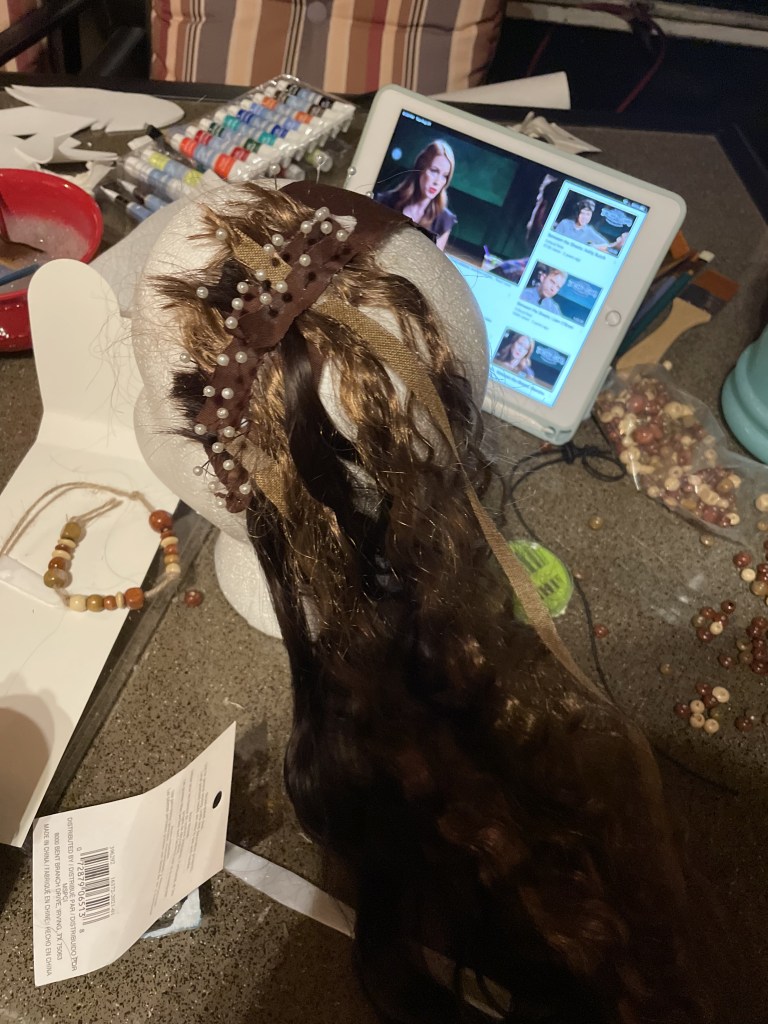


(Miscellaneous process photos of my Bugbears. These were SO FUN. The wigs took a stupid long time, but it feel like the final result was so worth it.)
These turned out pretty much exactly how I’d pictured them, so I was confident that my plans were going to work out. Now I just had to make a whole lot more.
Lots and Lots and Lots of Mask-Making
I finished my planning/designing process and tallied up my monster count: 3 goblins, 3 kobolds, 3 bugbears, 4 liches, 2 mindflayers, a cyclops, and a beholder. I also needed 5 dragon heads for Tiamat (which will be its own post in the future). This was a total of 22 Wintercroft masks. Wintercroft’s website suggests that their masks take somewhere between and hour (for easy masks) to 8+ hours (for hard masks) to build… and that was just to build the mask itself, leaving aside time to paper mache, paint, and adapt the masks to suit my needs. AND that also didn’t account for the rest of the monster’s costumes: the mask was only supposed to be one part of the whole outfit!
Mask-making became a pastime not just for me, but for my whole family, and on a few occasions for some of my co-workers, too. The process of cutting the templates out, gluing them to cardboard, and then cutting the cardboard pieces was so simple that anyone could do it. I was lucky to have a number of helping hands for this step.
The actual assembling of the masks was time-consuming and lot more complicated, so I primarily did this myself. (I had some help to finish assembling the last 2 or 3 at a set build during the rehearsal process– big thanks to my volunteers!) This step took me about a year. My bugbear tests were in September 2021, and I continued to work on masks until the month of the show, November 2022. To be fair, a lot of the construction happened after summer 2022 and was crammed into those few final months, so it’s not like I was crafting nonstop for 14 months.
Some tips and tricks for working on Wintercroft templates I picked up during this time:
- If you’re making a lot of creatures, be prepared to gather a LOT of card. You can scavenge this from a LOT of food and household products. Cereal boxes, frozen pizza boxes, tissue boxes— anything along those lines. You want the boxes to be in good shape (not crumpled up/folded). I explained to my coworkers what kind of cardboard I was looking for and asked them to save theirs for me— I ended up with a ton!
- I said above that the “card” the templates call for is NOT the same as cardstock. Cardstock could possibly be used for some small details, though— just not for big, structural shapes. If you’re really struggling to collect enough card, you could possibly experiment with this.
- I found wood glue to be a really good adhesive when glueing the pieces together. It dries fast and solid. You only need a tiny bit. Use less glue than you think you need, and use your finger to smear it flat on the tabs, so it doesn’t take so long to dry. Glue sticks also work, but maybe not as well.
- You have to hold the pieces together while they dry. I found paperclips and chip clips really useful for this— you could glue a piece, throw a chip clip or paper clip onto the spot you’re trying to get to stick together, and set that aside for a minute to dry while you worked on a different piece.
- I found a combo of glue and tape to be useful— the tape helped to keep the pieces solid while the glue was still drying down. When I started getting really impatient, I tried to use a stapler when sticking pieces together. I feel like glue and tape/staples together work better than just staples or just tape. I wouldn’t use staples on a mask that has to fit close to the face, though, for fear of someone getting scratched or poked!
- In general though, a lot of the mask-making process is just waiting for glue to dry. Podcasts and 8-hour YouTube videos were my best friends during all-nighter crafting sessions.
- These templates are very adaptable! You can modify elements of the templates, or Frankenstein some together in some interesting ways. You can also get creative with mixed-media experiments to create some really cool results, like I did with my bugbears. Don’t be afraid to experiment and work with your own ideas. Even a good coat of paint can totally change the vibe of a mask.
Here are some photos of all of my finished Wintercroft monsters:
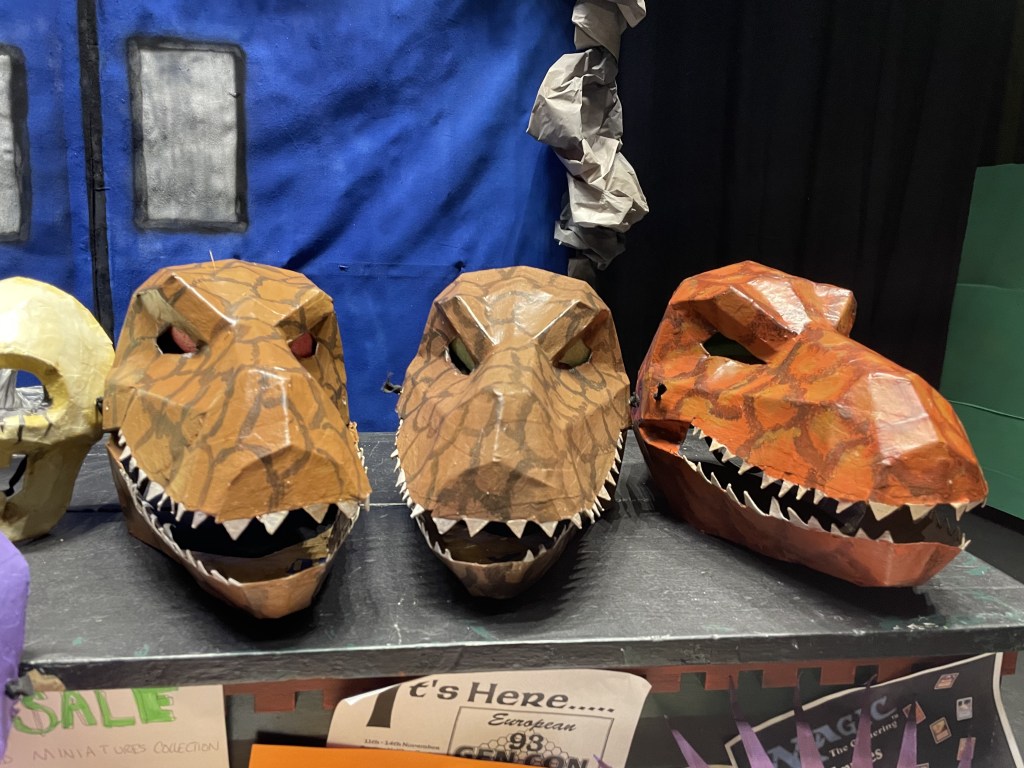

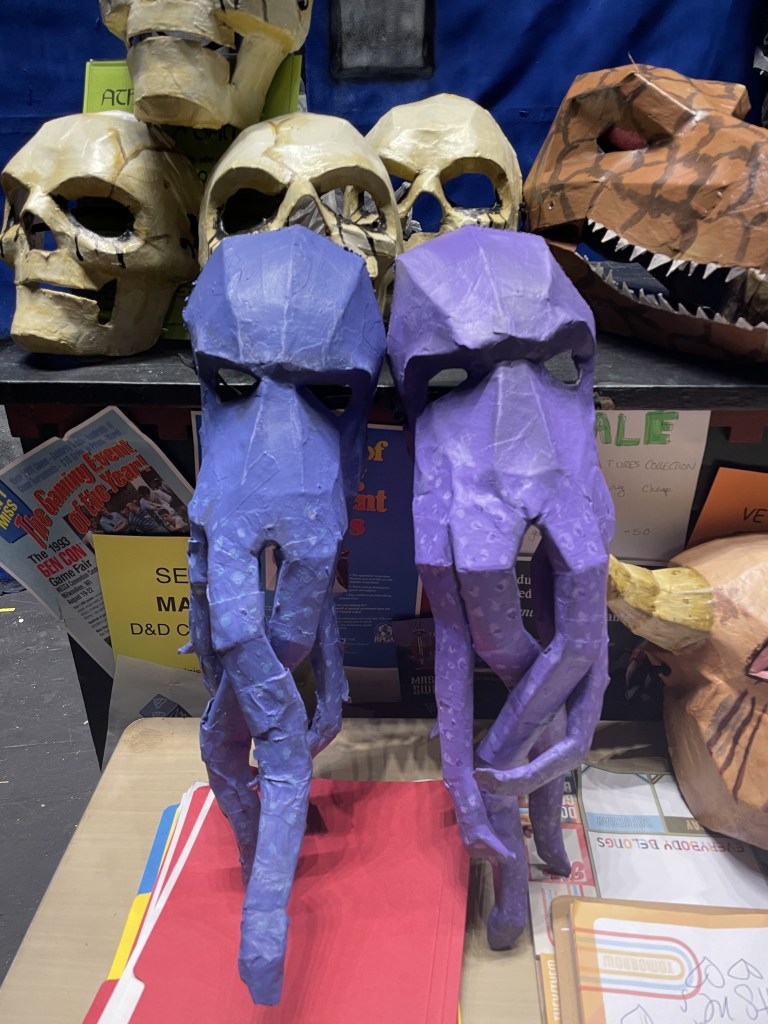
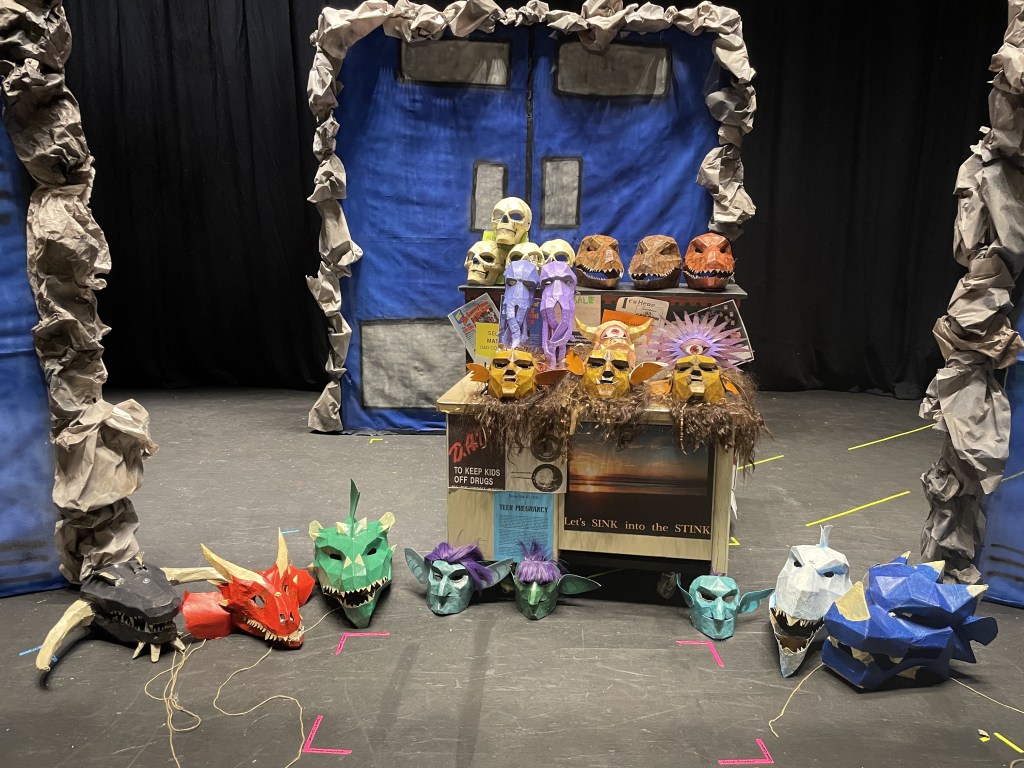
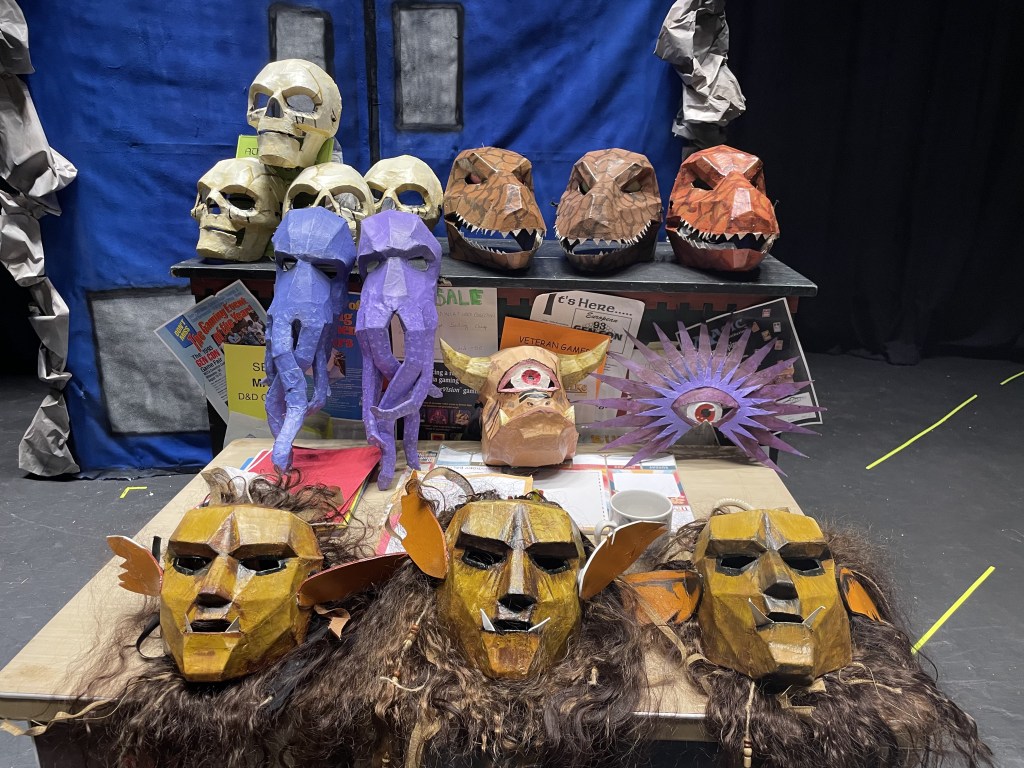
Here are links to each of the templates used:
- Liches – Death skull (hood piece omitted) x3
- Kobolds – Velociraptor x3
- Bugbears- Polygon face mask v2 (with wigs, ears, and fangs added) x3
- Goblins- Witch mask (with wigs and ears added) x3
- Mindflayers- Cthulhu x2
- Cyclops x1
- Vera the Beholder- All-seeing eye x1
- Blue dragon- Dragon v1 x1
- Green dragon- Dragon v2 x1 (with an added head-fin)
- Black dragon- Crocodile (with modified horns from Kapros added!) x1
- Red dragon- The awakener dragon skull x1 (with added fins)
- White dragon- T-Rex x1 (lots of slight modifications to the template for this one)
This was a boatload of work. I can’t say I regret it– I did have fun assembling all these! If I were to do it all again, I would finish more of the construction in advance (cramming most of the work into the last few months before the show was a bad call, lol) and probably enlist some more help.
Garments and Final Touches
Masks were not the extent of my monster plan. Unfortunately, they were much more time consuming than I was expecting them to be, so I SORT OF ran out of time for the rest of the costumes.
My plans for the rest of the monster costumes weren’t elaborate, anyway. Many of my monsters would need to make some pretty quick changes (I planned my cast so Evil Gabbi and Evil Tina played 5 different creatures each through the course of the show), so I wanted to go pretty basic, anyway. I simplified my original plan so that, generally speaking, each monster costume was a mask plus one or two other garments at most. The “base” for each monster costume was a plain black shirt and black pants so that other elements could be added on top.
Since Tilly draws on her high-school trials and tribulations to create her adventure (the Succubi are her cheerleader nemeses, and her guidance counselor appears as a Beholder), I decided to lean into this and make give each group of monsters a classic teenager archetype. As it happens, I work at an escape room that was getting rid of a locker room themed game, so I scored a number of sports jerseys that they were going to throw out. Pretty much every other garment we used came from either Goodwill or clearance Halloween stores. We got a few finishing touches from Amazon.
The kobolds, pack-hunter lizard folk generally considered to have less-than-average intelligence, were a perfect fit for the “jock” stereotype. I cut apart the football jerseys I got from the escape room so that they resembled basketball jersey-tanks. The kobolds also got sweatbands for their wrists. Since I had the football jerseys, I decided to make my cyclops into a football player– it seemed appropriate, since I planned on making the cyclops the “big boss” of the fight montage at the end of scene 5.
The big, hairy bugbears were grungy burnouts, a la Judd Nelson in The Breakfast Club. They got some flannel shirts from Goodwill. The skull-faced liches made perfect goths– long black cloaks for them. We made the goblins punk-rockers and gave them each a denim vest.
All the garments got some artificial aging with the help of some sandpaper and spray paint.


(These are the best two photos I have of my monsters– Vera the Beholder and the cyclops. Photos by KGTunney Photography. I have a few other photos, but they’re just low-quality rehearsal snaps. You can see the football jersey I got from the escape room on the cyclops.)
22 monsters down, I decided I wanted to add one more. This allowed me to add DM Biggs to the fight montage, and I thought it would be more fun if everyone got a turn to fight… so at our final few set build days, we speed-built a silly mimic costume out of a cardboard box. It figures that the monster we spent the least time on was probably the biggest crowd favorite.
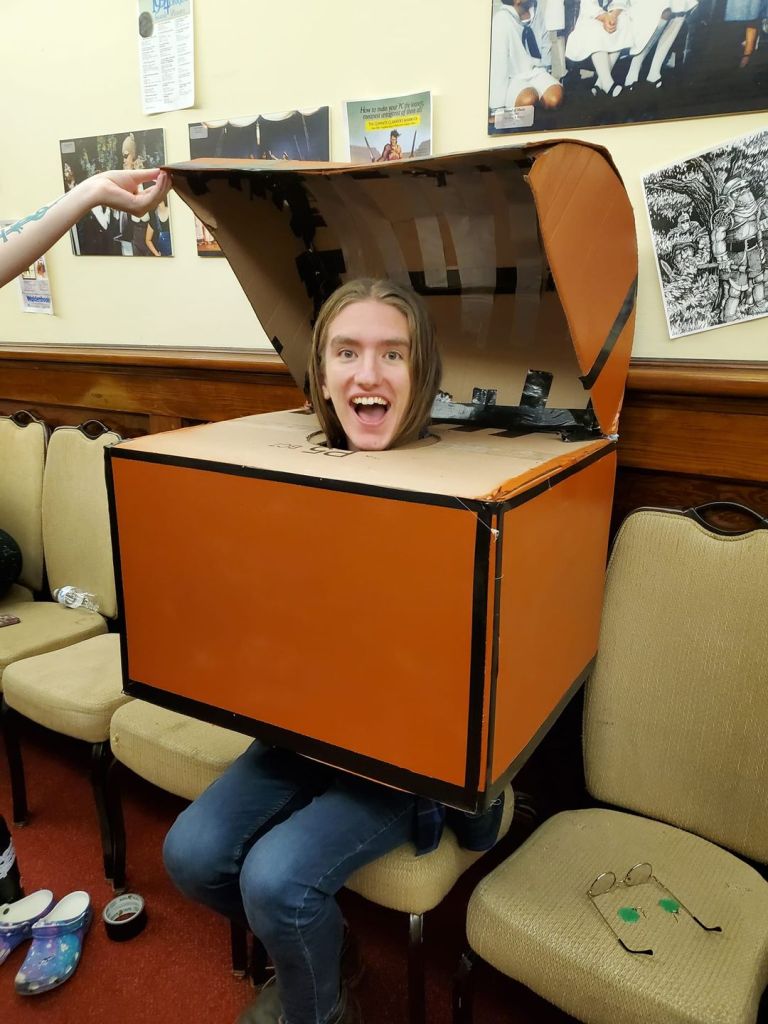
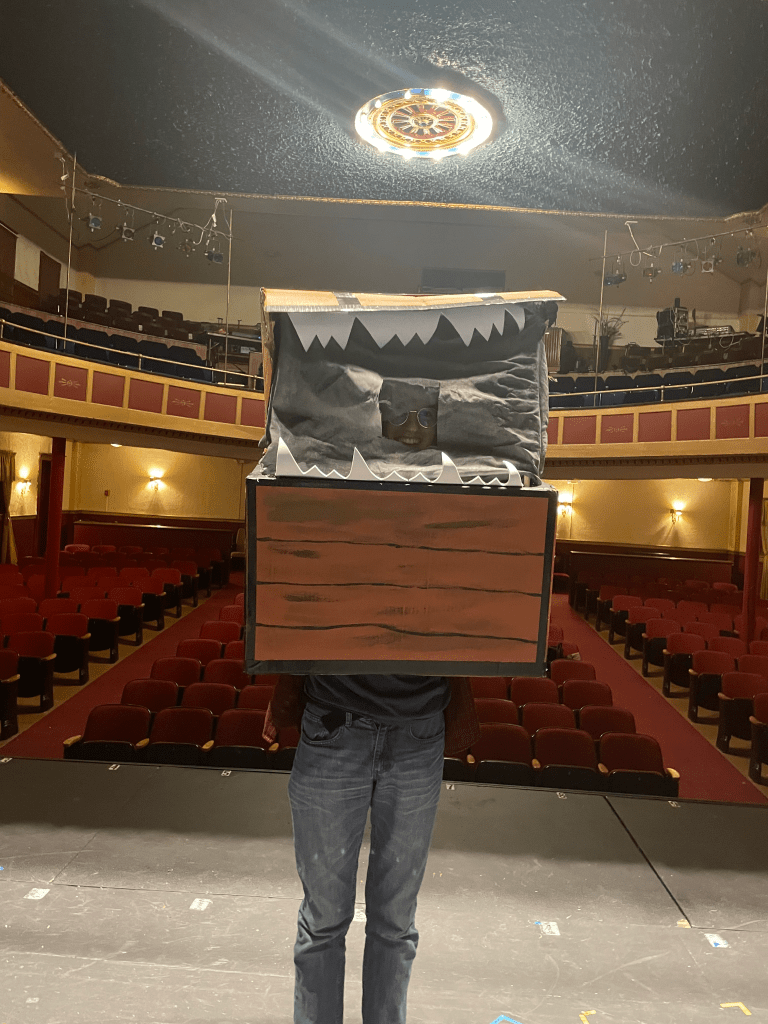
(A work-in-progress pic of the mimic, and a photo of it more or less completed. I had almost nothing to do with the construction of this one besides saying I wanted it and bringing a box. Thanks, volunteers!)
The mimic was such a hit that I do wish I’d been a bit more creative with the rest of the monsters. The masks were really cool, but a lot of work, and a cardboard box with legs delighted the audience just as much if not more!
Final Thoughts
I still can’t bring myself to regret all the time I spent frantically building monsters. It was a lot of fun! If I did it all again, I’d get more creative– and either start a lot earlier, or get a dedicated costumer instead of trying to do it while also directing. (Or start a lot earlier and with a dedicated costumer… both is good!)
If you’re looking for a resource for making cheap and impressive monsters, Wintercroft is such a great resource– I can’t recommend them enough. Besides the theatrical applications, they’re just fun art projects, and they also make great halloween costumes. If you want to use their masks in a production, just email their support to ask for permission, and be sure to give them the credit that is due!
Happy monster-making!– I’d love to see some monsters others have made in the comments.
Tips and Ideas for Organizing a Better Set Strike
If you are not a technically inclined director (or even if you are), figuring out how to organize an efficient post-production strike can be a nightmare. Ideally, strike gets done quickly and with minimal strife. Everyone is so tired by the time strike rolls around that the thought of a long, drawn-out teardown is demoralizing. As always in live theatre, we can’t avoid every disaster, but some pre-planning is very helpful to keep the process as painless as possible.
Here are a number of tips and ideas to help keep things moving smoothly.
Read more: Tips and Ideas for Organizing a Better Set StrikeMake a General List of What Needs Done
A list is a pretty common sense starting point. Double check if there’s a post-production checklist that your theater organization requires all productions to complete before the end of strike— this is a good starting point. If there isn’t one, make your own! Here are some common line items included in such a policy:
- All on-stage set pieces must be deconstructed. All materials and tools must be put away in their proper places.
- Backstage areas and wings should be checked for trash, props, or costume pieces, and should be cleared of anything unnecessary.
- Storage areas (for tools, lumber, props, costumes, etc) should be organized properly according to existing rules, and tidied up.
- Light and sound booths should be restored to the condition they were found in (or better).
- The greenroom and dressing rooms should be clean: Leave behind no trash. All props and costumes should be removed and returned to their proper places in storage. Any personal items left behind should be taken to the lost and found. Surfaces should be disinfected, floors should be vacuumed, etc.
- If they are in your purview, the house and lobby should also be cleaned: trash picked up and taken out, floors vacuumed, any decorations specific to the show should be removed.
These are broad strokes. You’ll notice that this list sorts neatly into different areas of the theatre— breaking down the overall list of task into lists for general areas can be helpful to keep on top of things. You can use these separate area lists to organize groups for strike.
Plan Out Some Groups
You have the option of leaving actors the option of joining groups as they desire, or just assigning actors to groups. The latter option is a bit less fun, but I find that it’s really helpful, especially with casts of young actors. Assigning everyone to a spot ensures every group has enough people to get done what needs to get done.
At many strikes I attend, we end up with four to five groups. One works on stage, deconstructing and cleaning. Another collects lumber and hardware discarded by the stage team and runs it to storage to put it away (or pass off to a separate storage-area team). One group is typically responsible for returning props and costumes to their proper places in storage, and another is responsible for general cleaning, especially of the green room. You may need more or less groups based on the scale of your space.
It could be helpful to distribute some sort of survey (like a google form) to your cast and crew ahead of strike to gauge everyone’s comfort with different activities. You can then use this to form your groups. This could also be useful to hand out at the beginning of the rehearsal process, for set build purposes. Some possible questions:
- Please indicate your comfort level with using power tools, 1-5
- Are you physically able/willing to lift heavy objects
- Are there any particular tasks you feel especially suited for?
- If you cannot stay for all of strike, please note the time you have to leave.
Appoint a leader for each team, too. This should be someone responsible and reliable, who won’t flake out before the end of the event, and who will make sure all tasks are completed appropriately by their team. The team leader will be in charge of making sure everything their group is assigned gets done, and will also field questions on your behalf.
Then, Get Nitty-Gritty
Once you have a broad list of tasks for each area, and a general idea of how much man power you’ll have for each team, add much more specific items to the lists for each area based on the needs of your theatre organization or individual production. Don’t be afraid to shoot for the moon! You’ll find that you’re more likely to have people run out of things to do than have too much to do, especially if they’re only cleaning or organizing. When people run out of things to do, they’ll have to come find you to ask what to do next, which can become overwhelming quickly if you didn’t plan enough work in the first place. Nothing is worse than having a wealth of volunteers on hand and not knowing what to do with them! The waste! Try to give each team a workload that will take a similar amount of time to complete.
Make Sure the Plan is Clear
Sometime before strike (preferably before the final show), post your lists and your group assignments somewhere everyone can see them (the call board, the production group chat, etc). Make sure the lists are laid out clearly, in foolproof terms, so you don’t have to spend a ton of time fielding questions. Try to be as pedantic and specific as possible. An anecdote: A production staff I was on once told a group of middle schoolers to take some trash to the dumpster, but didn’t specify to be careful about how to fill it… the staff ended up spending the next two hours or so pulling things out of the dumpster and more carefully replacing them so everything would fit inside.
It will be helpful to meet with the team leaders for each strike team and make sure they are clear on what tasks each group is responsible for. This way, you can be sure the leader will be able to lead effectively!
Making sure everyone knows what’s going on saves you work in the long run. It also helps decrease some of the anxiety around strike— many actors just don’t know what to do at strike and are therefore intimidated by it. This leads to the hands-off attitude we often expect from actors. If their jobs are clear, and given according to their ability, they have little excuse to not participate.
Keep Track of Your Progress
During strike, have the team leaders cross things off their groups’ lists as they are completed. This will help to make sure nothing slips through the cracks. As groups finish their task lists, the team leaders can either add additional tasks as appropriate, have their group pivot to join another group. It might be helpful to pre-plan where each group should pivot once their list is done, especially if the pivoting group has a particularly light workload.
Very important: do a final walkthrough before everyone leaves! Nothing is worse than dismissing everyone and THEN realizing someone forgot to do something important! Have someone reliable— perhaps the stage manager— periodically check around to ensure tasks are getting done properly. If anything isn’t meeting expectations, intervene early.
Other
Here are a couple of broad miscellaneous tips that might be helpful:
- It is helpful to take photographs as proof of the state of each area at the end of strike. If you’re in any kind of shared space, it’s good to cover all your bases and show that you’ve done strike to an appropriate standard. You may also want to keep a copy of your lists. You just never know how these might come in handy!
- If you are unsure of exactly what the theatre organization itself expects from your strike, be sure to check in with someone in authority. You don’t want to accidentally skip something important, and you don’t want to step on toes doing something you aren’t meant to do.
- Playing music during strike is fun! Ideally something energetic and upbeat.
- As always, when you’re using power tools and working with potentially dangerous, sharp, or heavy materials, it’s good to have a first-aid kit ready on hand.
- Most strikes are scheduled to run until they are over, and all the necessary tasks are done. If you have to schedule an end time (because of a rented space, etc), planning ahead is EXTRA important. Prioritize carefully.
- Generally speaking, keeping the backstage and greenroom areas in decent shape during the run of the show is a good practice to make the strike itself easier. This is easier said than done. Enforcing simple rules like “all costumes must be hung up before the cast leaves after a show” can help achieve this.
Final Thoughts
Strike generally isn’t anyone’s favorite part of the production process, but it’s sadly unavoidable. Making it as quick and easy as possible makes it a lot less painful. As always, we can’t plan for everything. Some plans will inevitably fall apart. It’s good to spend some time ahead of strike thinking about how you want the day to go and building some strategies to get there.
You got this!
If you are an actor looking for tips on making the most of strike, or a production staff member looking for helpful resources for your actors, check out my article for non-technically inclined actors here.
 Theatre Thoughts Blog