Guides and Tips, Theatre

How to Make Your Own Hands-Free Practice Tracks from your Musical Rehearsals

Practicing outside of rehearsal is necessary in order to do your best work in a musical. Many actors take recordings during music rehearsals so that they can practice on their own later. This is great, but as a busy person, and I often find that I don’t have time to review those recordings I made with such conscientious aims. Those recordings end up going un-reviewed, and so they mostly just clog up space on my phone.

What I have discovered as a busy person who is often on-the-go is that my commute is a great time to review. To use this time, however, I need a rehearsal track that I can use hands-free while driving. If I were to sit at home and practice, I could just search through the recording manually to find the parts I need– but I obviously can’t do that and drive at the same time.

Enter my preferred new method! It takes some time, but it’s worth it, and I learn my parts well. I also end up with a resource that is easy to share with my whole cast!

Here is how I make my own practice tracks in Audacity:

  • Step 1: Record your music rehearsal
  • Step 2: Import the recording to Audacity
  • Step 3: Cut out everything but the voice parts
  • Step 4: Export to your phone
  • Step 5: And practice

Step 1: Record your music rehearsal

You can either use a built-in audio recording function on your phone (iOS comes with the “Voice Memos” app), or download something special. I use the app “Voice Record Pro.”

Be sure to place your phone somewhere neutral, where it won’t pick up a lot of background noise– for instance, you don’t want it in your lap if it’s going to catch a lot of sound from you picking up and putting down your music or turning pages. I usually just put it on the floor under my chair, away from my feet so I won’t step on it.

Record the entire rehearsal. Feel free to pause the recording during any breaks, but just don’t forget to restart it when you start singing again!

Step 2: Import the recording to Audacity

You can use a different program if you’d like, but Audacity is my preferred. It’s free and quite easy to use. For this step, I send the recording from my phone to my laptop (usually I AirDrop it, but you could also use any number of cloud or messaging routes), but you could also edit the audio right on your phone if you wanted. Voice Record Pro has the ability to do this, I just find it easiest to do the editing on a computer where I have finer control.

Step 3: Cut out everything but the voice parts

Comb through your recording in your audio editor. You want to delete any idle chatter and silent “dead space” to create a recording that is concise and straight to the point. Think of it like making a “highlight reel” of the rehearsal, keeping only the important parts. I like to keep some of the music director’s instructions so that the audio makes sense in context: Ie, I’ll keep things like “Look at page 53… at measure 37, altos sing…”

You can also edit out repetitions. If the music director plays the alto part 3 times to teach it, maybe only keep one. You can always simply replay that section of the audio if you need to review. I even cut out extraneous words for brevity. If the director says “Okay, um, next the altos come in here, uh, and they sing…”, I will cut it down to “Next the altos come in, they sing…”

You can be as granular or basic about this as you want. The point is to take the long rehearsal and cut it down so that it is short and easy to review and understand. I have edited 3-hour rehearsals down to only 15 minutes before.

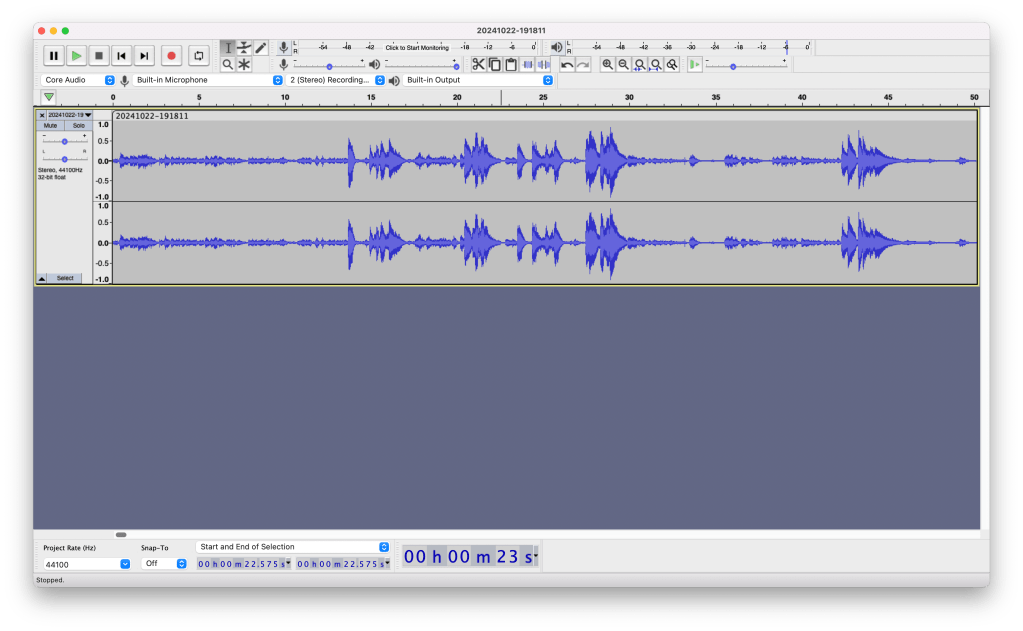
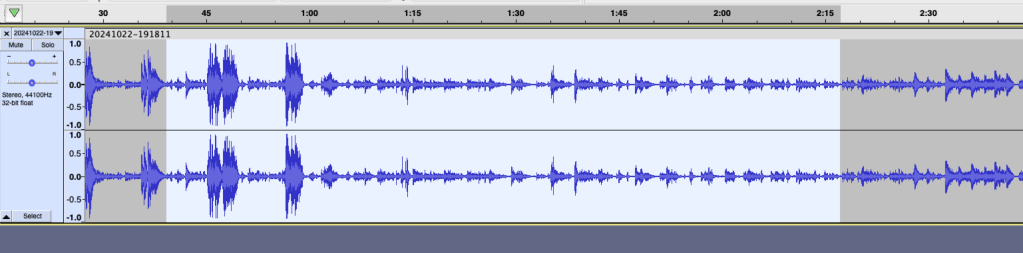
Audacity makes this very easy to do. After importing your audio, you’ll see something like this:

Be sure to “zoom in” so that you’re able to review the audio quite closely: the numbers across the top of the working area are seconds. I am sometimes trimming out individual seconds of audio (or less) while working on these recordings.

The areas where people are singing is usually easy to spot, as those are the places where you see the tall “spikes.” Areas of relative silence are also easy to see, as they’ll look like flat lines. Regular speech will fall somewhere in between these.

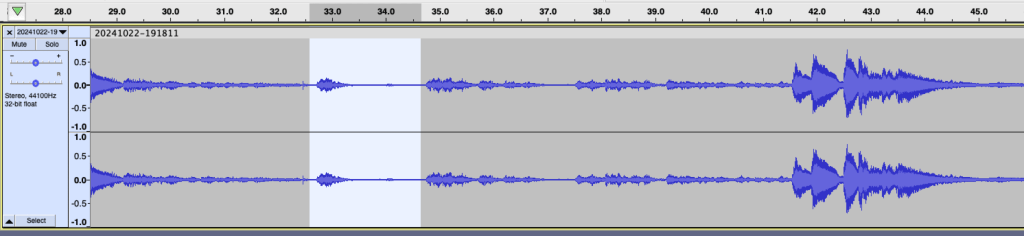
Listen to the recording and pause occasionally to cut out unnecessary parts. If you zoom in and watch closely, you’ll be able to “see” the words being said in Audacity. You can select where a word starts and ends by simply clicking and dragging, and delete that section by pressing the “delete” key.

In this picture, I’ve selected the music director saying “um” followed by a second of silence to cut it out of the recording. I played the recording and was able to easily “see” the um in the track, as well as the silence that followed– trimming it makes the recording just a little cleaner and more concise.

It’s not all that granular, though– here’s almost a minute and a half that I’m cutting. You can see there’s a bit of us singing at the beginning (just a repetition of something we’d done before) followed by a lot of talking. No need to keep that! Select it all and delete.

The downside here is that you pretty much have to listen to the whole recording while you’re editing it. It’s time consuming. The upside of that is that it helps you learn, though!

Ultimately, this is your recording to do with as you see fit. You can choose whether you want to keep all the voice parts, or only your own. You can decide how much chatter you want or how much repetition you want. I like to trim my recordings to be as neat as possible while keeping all the voice parts, so I can share the recording with the whole cast– I started doing this as a stage manager making rehearsal resources for my actors! I also like to keep at least one run of the entire song in the file.

I like doing this because you can hear how things sound with your cast. Unlike with canned practice tracks, you don’t have to worry about the recording not making sense to you based on what you experienced in rehearsal– it’s literally your rehearsal! You can also hear how your music director wants things done, and can get an ear for how your own soloists are choosing to time their choices.

There are certainly easier ways to record a music rehearsal, but I think my way has a lot of benefits!

Step 4: Export to your phone

Once your recording is freshly trimmed, give it a final “proof listen” and then export the file. You can save this as an .mp4 file for audio listening, or turn it into a .mov file so it can be uploaded to a cast page, such as a Facebook group. The idea, anyway, is to have the file somewhere you can use it easily.

Step 5: And practice

Your practice track is done! You should now have a track with which you can simply press play and review your music completely hands-free. This is perfect for reviewing in the car on the way to rehearsal– or work, school, or anywhere else you have to go. You can also, of course, sit down with your music and play this track while you practice at home.

Here’s an example of a practice track I made for our cast during a production of Legally Blonde.(Featuring a meme I made from a rehearsal pic… lol.)

I hope this is useful for other performers!

Guides and Tips, Theatre

5 Strategies for Practicing Lines with a Partner

Learning lines is one of the least fun parts of a rehearsal process. Nonetheless, it is necessary, and it is therefore necessary for actors to figure out ways to improve at it.

Working on lines with a partner can make the memorization process much more entertaining. Though we sometimes must inevitably practice alone, there are a variety of ways that we can work on lines with a partner… and a variety of ways that are much more beneficial than merely reading the scene back and forth a number of times.

Continue reading
Guides and Tips, Theatre

5 Strategies for Practicing Lines Alone

Have you ever heard a director say that “rehearsal isn’t for learning your lines, it’s for learning everybody else’s?” The adage is one of many actors’ least favorites, as it is often spoken by directors in the act of chastising actors for not knowing their part.

Acting requires a hefty amount of memorization. This is an intimidating element of the art for many. Thankfully, though, memorization is a skill, and all the average actor needs to get their memorization up to snuff for a show are a few memorization techniques that work for them.

You might not always have a partner around to practice lines with. Luckily, there are plenty of strategies for memorizing lines that one can work on privately.

Continue reading
Guides and Tips

20 Life Hacks for an Easier Tech Week

I’ll admit it: I enjoy tech week. I find the adrenaline rush of such a busy week absolutely thrilling.

One of the reasons I enjoy it so much is because I have learned a lot of tips and tricks over the years for making it the best experience it can be! Instead of spending the week bogged down in stress, try out these hacks:

1. Make sure you know your material before tech week starts

Tech week is not the time to be learning lines or blocking! Do all your cramming before tech week– tech week will be stressful enough without the added worry of feeling like you forgot to study for an important test.

2. Plan ahead with meal prepping

It’s a huge relief to know what you’re going to eat when you get home from the theater. This is doubly true if you’re juggling a hectic work-rehearsal balance. Make some food ahead and separate it into perfectly-sized, re-heatable portions. Depending on how busy the week is, you might need to plan both lunch and dinner. Pre-packaged frozen options that you can simply pop in the microwave are also a lifesaver.

If you don’t plan ahead, you’re more likely to wind up paying a lot of money for overpriced gas station or convenience store fare. Plan out your meals, and plan out your snacks, too!

3. Put together a “tech bag”

I like to keep a tote or duffle bag stocked with everything I need to make it through tech week. This will include any necessary items for the show, as well as anything I personally need to be healthy and prepared. I put this together before tech week begins, so I don’t have to worry about it later. Some suggestions:

  • My script/libretto
  • Necessary costume pieces
  • Bobby pins, hair ties
  • Makeup bag
  • Deodorant, hand sanitizer, wipes
  • Mouthwash and floss
  • Bandaids
  • Reusable water bottle

Depending on the needs of your production, your list will probably look quite different, but this is a good starting point.

4. Finish any important projects in advance

I’ve been the person who says “I can just finish this homework assignment during tech week.” Subsequently, I’ve also been the person who fails a class because they didn’t turn in a homework assignment that was due during tech week. (That’s a long story…)

If you have any big work or school projects coming up during tech, get them out of the way before tech week begins, or else get them as completed as possible. You really want to be able to dedicate as much time and energy as you can to tech week– I often find that tech week just demands so much of me, that trying to make time for much else rarely goes well. You never know what might come up.

5. Work on your sleep hygiene

It’s really hard to get proper sleep during tech week, I know. Try your best to get it anyway!

Sleep is very important for physical health, mental acuity, and emotional wellbeing. All of these will be taxed by the demands of tech week. Do the best you can to get enough sleep for your personal needs.

One thing I have found very helpful is to set aside a few minutes before bed to decompress. Lower the lights and read, journal, or meditate. Tech week stress can easily translate to a night of tossing and turning, so do whatever you need to sleep through the night.

6. Take care of your immune system

Getting sick during tech week sucks. ‘Nuff said.

Tech week is a great time to overcompensate for your immune system. Take your vitamins. Wear a mask when you’re around lots of people. Wash your hands regularly, and use hand sanitizer after interacting with high-touch surfaces.

Getting enough sleep and paying attention to your nutrition and hydration are also important facets of maintaining your health. These can all be challenging pursuits during tech week, but it’s for the best! Make every effort to keep up with these health needs.

7. Set aside some funds

Between gas money, snack money, and unexpected purchases of props or costuming needs, I always find tech week to be an expensive time. While planning can help mitigate this (see no. 2 on this list), it’s also helpful to plan for the worst and save some extra cash.

You never know what might arise during tech week. Spend mindfully, and prepare some emergency funds just in case.

8. Make personal hygiene as easy as possible

Obviously, maintaining your hygiene is important at baseline. The hack I offer you in this pursuit is to make taking care of hygiene needs as simple as you possibly can, so that you never find yourself “too tired” to shower or brush your teeth at the end of the day.

There are a lot of tiny barriers that can make following through on an important task just annoying enough that we lose our motivation. Your goal is to remove as many of these barriers as possible. Set out your face wash and skincare products for the morning/evening instead of putting them away in a closet or cabinet that you’ll have to dig them out of later. Make it a rule that you’ll shower before eating or getting into bed. If you find you’re wanting to spend too much time in bed in the morning to get up and wash your face or brush your teeth, take these hygiene products with you to work so you can do them a little later. Keep deodorant in your purse or in your desk at work so you can apply on the go.

And remember, a little is still better than nothing. It’s better to take quick shower and skip washing your hair than to skip showering altogether because you feel rushed. Do what you can!

9. Have a plan B for child or pet care

Having contingency plans is always helpful. If you have pets or children who need looked after while you’ll be away from the house, it’s not a bad idea to line up alternate babysitters in case of emergency. Finding emergency childcare can but a big source of stress and panic, so having some plans in place ahead of time can be a relief.

10. Consider renting a room

This one is a little niche. If you’re working at a venue that is far away from your home, booking an Airbnb or reserving a room in a hotel can save you a ton of hassle during tech week. This obviously costs a good chunk of money. If the venue is far enough away from your home or job, you may actually save by doing this instead of spending money on gas!

If it makes sense for your finances and personal sense of peace, give this a try. I’ve never done it myself, but I have friends who swear by it!

11. Time your caffeine well

I’m just going to assume that you’re going to end up drinking caffeine during this week. You’ll most likely need it.

Planning a good time to drink this caffeine can be beneficial, especially if you get acid reflux like me and have to limit your caffeine consumption as a result. If you drink your caffeine too early in the day, you might find your energy flagging by rehearsal time. If you drink it too late, it might negatively impact your sleep. If you drink it too close to show time, or too long after a meal, you might find yourself feeling jittery and anxious.

Plan your day accordingly. Caffeine consumption can absolutely make you feel a lot worse if you do it in an unwise manner. I’ve talked about my personal caffeine habits on this blog before.

12. Mind your nutrition

It’s hard to eat well when you’re in the middle of a busy tech week. Like I said before, pre-planning meals is really helpful for a variety of reasons, but it’s also helpful to think about what you’re eating and when.

I’m not going to guilt trip you about poor eating habits during an extremely chaotic time– that would be counterproductive. What I will remind you is that variety is really valuable in your diet. You don’t have to eat a salad every day, but finding time to fit in some different foods can do wonders for both your physical health and general mood. Eating the same stuff all the time gets boring! Mixing it up a little can help you eat just that much healthier.

Eat long enough before rehearsal that you won’t have issues with indigestion, but soon enough before that you won’t be hungry.

13. Keep some quality-of-life necessities at the theater

When you’re carting everything back and forth from the theatre to your home every night, it’s easy to forget something important, ESPECIALLY when you’re under the stress of tech week. For this reason, having some necessary tools and supplies that stay at the theater can help alleviate a lot of worries.

My top recommendation in this regard is to acquire a secondary phone/device charger and leave it in your dressing room. I’ve taken my bedside phone charger to the theater and forgotten it TOO many times. There are a number of other useful things to keep at the theater though, too, including show makeup and skincare products (if you can spare it/aren’t using your everyday supply), deodorant and mouthwash, and some securely wrapped snacks. If it’s an item that forgetting would prove catastrophic, keeping it (or a copy of it) at the theater saves a lot of heartache.

As long as you’ve got the space and resources (and permission, if necessary) for it, no “necessity” is too weird. I have a friend who brings a personal cooler full of Redbull to keep at the theater during tech week. Every time she brings it out, I’m always a little jealous.

14. Have some emergency-quick-fix materials on hand

Just in case of emergency, I like to bring a number of supplies that could be used to fix a costume or prop in a pinch. Generally, these include a sharpie, scissors, safety pins, body/garment tape, a mini sewing kit, a backup roll of mic tape, and a mini glue gun. These aren’t perfect solutions, but they aren’t meant to be– the idea is just to have something on hand in case, say, the zipper on your dress breaks 2 minutes before you’re supposed to enter.

Realistically, chances are, someone else at the theater will have this stuff. But why leave it up to chance? If you bring them, you’ll know exactly where they are so they can be available at a moment’s notice. Nothing’s worse than knowing someone backstage has a roll of mic tape but being completely unable to find it.

15. A tech week massage is a game-changer

A few years back, I cleaned out my wallet during tech week and found a gift card for a salon that did massage therapy. I was able to book an appointment before a dress rehearsal, and I have been dreaming about tech week massages ever since.

This is obviously an investment and wouldn’t be attainable for everyone. I haven’t had the disposable income to make it happen again ever since that first time. But if you can swing it… wow does this make you feel like a brand-new human.

16. Comfort is king

Staying as comfortable as you possibly can really helps make the long hours of tech week a lot more bearable.

I’ve taken a lot of tech-week comfort tips from actors I’ve known over the years. I know actors who bring comfy slippers and fluffy robes to wear backstage before they’ve put their costumes on. I personally like to bring a portable humidifier with me to any spaces that tend to be dry, and I’ve been known to haul my air purifier into particularly musty, dusty dressing rooms. If the space is usually too warm for you, bring in a fan!

Comfort in costume is also important. Insoles or heel liners can be a lifesaver when dealing with uncomfortable shoes.

17. Don’t be afraid to skip the cast parties

Going out after a performance is a traditional part of tech week for many. It’s been a long week, and a cast party helps blow off some steam.

But then again… it’s been a long week. Don’t let FOMO make you feel like you have to attend a post-performance outing! I’ve found saying goodbye to everyone and coming home for a relaxing, solitary bubble bath to be incredibly freeing.

If you want to party, absolutely go party! Just don’t feel pressured.

18. Candy makes everyone feel better

Something I’ve learned over the years is that tensions tend to run high during tech week. One thing that makes tensions run higher is hunger.

Picking up a variety bag of candy or chocolate bars at the dollar store and leaving it out for everyone to share boosts morale like you wouldn’t believe. It also makes you popular! Just don’t eat in costume.

19. Tidy as you go

Keeping your dressing room neat can be a challenge, but it’s absolutely worth it. If you notice that the situation is getting a little out of control in your corner of the dressing room, it pays off to do some intermittent cleaning when you have a chance. Otherwise, you’ll have to do all the cleaning at the very end of the process when you’re most exhausted. Maintain a level of organization so your future self, and your fellow dressing room partners, will thank you.

20. Don’t forget to breathe

I’ve said it several times in this article, but let me say it again: tech week is stressful! Taking time to unwind and be in the moment is important. Find space for a few calming deep breaths, even if only for a few seconds. Staying calm helps prevent issues born from panic, rushing, and lack of attention. If you feel yourself getting worked up or feeling out-of-control, you owe it to yourself and everyone around you to go take a breather.

Final Thoughts

Tech week can be whatever we make it. Don’t forget the importance of mindset, and definitely don’t forget to take care of yourself! If you play your cards right, you might find you even enjoy your next tech week.

If you’re looking for more tech week survival tips, check out my Ultimate Guide to Surviving Tech Week, or Do This, Not That: Tech Week Edition.

Guides and Tips, Theatre

20 Audition Do’s and Don’ts

Ask an actor what their least favorite part of performing is, and many of them will probably say “auditions.”

While auditions can be frightening and challenging, they don’t necessarily have to be! Approaching with the correct mindset and materials is key for a less harrowing experience.

Here are 20 miscellaneous tips to help make the process a little less rough!

Continue reading
Guides and Tips, Uncategorized

Feeling Sick During Tech Week? How to Deal

Let’s begin with a throwback.

My senior year of high school, I was cast as the Witch in Into the Woods. School theatre was my entire life, so I was stoked all through the rehearsal process. Inevitably, though, as we got closer and closer to tech week, I found my boundless, passionate energy beginning to flag. I felt run-down, fatigued, and eventually sick. My voice started to get scratchy, and then started failing altogether. After wrapping the show one night, I found I could barely speak.

This situation is obviously not ideal, and for a number of reasons– I was at risk of serious vocal injury and definitely in need of a good rest. Unfortunately, the nature of performing school or community theatre is that you sometimes don’t have that option.

Vocal strain and fatigue should be taken seriously, as should illness. Your vocal folds are delicate muscles, and pushing through injury and sickness can cause more serious and lasting problems. That said, if you don’t have the option of taking a break just yet, there are things you can do to keep yourself in as healthy shape as possible.

I ended up performing all four of my shows as the Witch without any significant issues. Here are some tips.

Read more: Feeling Sick During Tech Week? How to Deal

Please note that I am not a doctor and this is not medical advice. I am not a voice expert. I am merely a performer speaking from my own experiences. The following are my own opinions.

1. Seriously, take a break if you can

Before you read on, I’m going to double down on the riskiness of “just pushing through.” Hear me out: your voice is a part of you, and injury can potentially cause lifelong vocal problems. Unfortunately, a stressful tech week can be the “perfect storm” of conditions that make injury likely. Plain overuse over a single week isn’t necessarily that likely to lead to a lasting vocal disorder, but overuse isn’t the only factor contributing to vocal strain issues. Tech week likely involves long hours of using the voice, possibly coupled with illness or allergies, or poor air quality inside old, dusty theaters; it probably includes eating less-than-healthy meals and drinking caffeinated beverages that might cause acid reflux; it almost certainly presents a number of miscellaneous stressors that can lead to excessive muscular tension and all the associated complications. These many factors combine and create a situation where serious medical issues associated with the voice may develop.

It’s really worth assessing the options you have. Does your production have an understudy you can rely on– even if only for a single show to allow you some time to recover?

If there isn’t an understudy available to cover for you, I would recommend searching for a certified laryngologist in your area and getting your situation assessed. It may be worth specifically searching for one with experience working with singers and performers.

2. Consider seeing a doctor

A specialized throat doctor called a Laryngologist will be able to tell you how serious any vocal problems you may be experiencing actually are, and can provide suggestions for how to best move forward. If you are genuinely concerned about your voice, this is the best way to know your concerns will be adequately addressed.

If the doctor assesses your situation and finds that it’s not safe to continue performing at this time, they will be able to write a note to any teachers/professors/show staff who may want written record of your condition.

If you are feeling sick (don’t we all inevitably get that terrifying cold halfway through tech week?), you may want to see a doctor to treat that sickness, or take OTC medications as directed. Keeping your immune system in good shape is important, as sickness can make any inflammation, pain, or fatigue you’re experiencing feel worse.

3. Use vocal rest periods to reduce fatigue

Think of your vocal capabilities over the course of the day like a glass of water. There is only so much water in the glass: you’ll want to save some for when you really need it.

When your voice is strained, even speaking can be additional stress for overworked muscles. Periods of vocal rest, where you don’t speak at all, can be very helpful for allowing the voice time to recover. Obviously, this can be hard to achieve, especially if you have a job that requires speaking or are a student who has to attend school during the day, but even staying silent for an hour or two at a time is better than nothing. When you’re not vocal resting, be sure to use your voice mindfully and carefully.

I’ve written another article about vocal rest that goes into further detail. You can read it here.

And if you find the idea of being quiet for hours at a time daunting, I have an article with tips for getting through it here!

4. Hydrate, hydrate, hydrate

You should be drinking plenty of water throughout the day already as a singer, but this is doubly important when you are dealing with vocal issues. Plain water is king when it comes to hydration– avoid sugary sports drinks, as the sugar can possibly cause further irritation.

Vocal phonation occurs when the vocal folds vibrate together, and those vocal folds are covered in mucosal membranes. Keeping those mucous membranes hydrated is key for easy production of sound.

5. Get plenty of rest

Sleep is a critical bodily function! Sleep is especially important for maintaining and recovering good health. If you’re not feeling your best, rest is absolutely crucial.

Sleep can be hard to get during tech week. If you’re feeling sick, don’t feel guilty about calling out of work or school to get some much-needed extra sleep. If your cast usually goes out after shows, consider skipping this and putting yourself right to bed instead.

6. Use pain relievers mindfully

Remember that treating the pain of a sore throat is not the same as curing it. Taking pain medication (or using a more natural method of pain relief, such as hot tea) will temporarily lessen the pain, but it won’t resolve the underlying issue itself… and resolving that underlying issue is key!

At worst, taking pain relievers can be counterproductive for healing. They can make you think you’re feeling better, so you go on stage and belt your face off, only to feel much worse later that night. Absolutely take medications or your preferred natural remedies as needed– but don’t let the temporary relief lull you into a false sense of security!

7. Communicate with show staff

This one is last because it is MOST IMPORTANT!

Communication is always key in an art form as collaborative as theatre. If you are feeling sick or strained, you must mention this to your stage manager and/or director, music director, voice coaches, or any other relevant staff. This is important for multiple reasons.

First, if you’re feeling sick in rehearsal, it’s a good idea to take it easy so you don’t hurt or exhaust yourself. If you do this, you must communicate with staff. Staff will always understand if you say, “hey, I need to dial it back tonight, my throat is killing me.” If you don’t say anything, they might mistake your gentle choices for lack of effort or care.

Second, it’s just never good to surprise your staff. People both on and offstage depend on audible cue lines. Sound balancing will be shaped around your work in rehearsals. Failing to communicate can lead to unnecessary confusion and frustration.

It also lets your staff know how you’re doing. If you’re feeling so sick that you’re worried you might not make it to the end of the weekend’s performances, your staff needs to know that. They may be able to make plans to help support you, or may even have to make plans to replace you in case of emergency.

The bottom line is that communication is a MUST– even when everyone is feeling healthy!

Final Thoughts

There’s no shame in getting sick or feeling strained during a busy production process, but taking care of yourself to prevent further problems is absolutely necessary. You, and your entire production, will be in much worse shape if your situation goes from bad (a sore, fatigued throat) to really bad (being unable to speak or sing at all) to catastrophe (medical emergency or persistent issues stemming from misuse).

If you don’t do anything else on this list, the most important thing is that you communicate. Always keep your production staff un the loop. You’ll feel better if you make feeling better a priority!

Looking for more tech week tips? Read my ULTIMATE tech week guide here.

Actor Life, Guides and Tips, Theatre

The Secret to Success in Performing Arts: Mastering 3 Vital Traits

I’ve been around a lot of performers in a lot of different settings. I’ve directed, I’ve taught, I’ve acted, I’ve watched from both the audience and the stage manager’s booth. Every performer is unique, and everyone has their own strengths and weaknesses. Yet, in all of the actors, dancers, and musicians I’ve worked with, I have found that there are exactly three traits every truly excellent performer has in common.

These traits are instrumental to success in the performing arts. You won’t get very far without them, and having them can put you on top in close auditions.

If you can honestly say you have these three traits, then pat yourself on the back! If you’re not so sure, read over this article closely and do what you can to pick them up immediately.

Continue reading

Guides and Tips

How to be Useful at your Required Set Strike when you have no Technical Abilities

Post-production set strikes are easiest when many people lend their hands to the cause. Unfortunately, many actors dread strike. The reality is that many actors simply don’t know how to help. While technical skills are of benefit to every performer, and I heartily recommend every actor get the gist of as many backstage skills as possible, many times the root of the anxiety is simply “what can I even do besides stand around the whole time?”

Here is a set of suggestions for everyone, no matter their strength or skills, regarding making themselves useful at strike. The list starts with the least technically-inclined options, with the “hardest” options at the end.

Read more: How to be Useful at your Required Set Strike when you have no Technical Abilities
  • Don’t be afraid to ask where you can help. The director, stage manager, and technical director should all be able to help you find something to do, and many of your cast and crew will also happily accept help if you offer it. Of course, use your best judgement—asking for direction repeatedly while others are busy with their own work gets annoying and makes it seem like you lack initiative.
  • See if any painting needs done. Some pieces may need primed and repainted if such is practice in the theater. This is almost always one of the last steps of strike, but it’s one anyone can do!
  • Get on cleaning duty. Strike requires much more than tearing down sets and lights. The lobby, house, bathrooms, greenroom, and dressing rooms may all be part of strike. Find out what needs cleaned— anyone can take care of organizing, vacuuming, or wiping down surfaces. However, remember that strike is messy business! Don’t bother cleaning anything that is likely to be trashed again by the end of the process until all of the work is done.
  • Take out the trash. As the set gets ripped apart, a surplus trash will quickly accumulate. Gathering this and throwing it away keeps the space clear for other, more important work. Remember, though, that because something has been used doesn’t necessary mean it is garbage. Again, use your best judgement— Large sheets of plywood or bits of lumber at a reasonable length can be reused, as can most hardware like screws, casters, or handles. Anything broken, badly damaged, or under a reasonably useful size should be trashed, while re-usable materials can be cleared away and re-organized. If you’re unclear on what is trash and what is useful, check in with someone first.
  • Assist with costumes, props, or furniture. Returning these pieces to their homes in theater storage is often relatively light work. On the other hand, if you have the muscle, lifting furniture into trucks or up and down stairs can be very helpful at this step— the “heavy” muscle is often assisting with the technical work at this time.
  • Remove hardware from set pieces and lumber. Before any lumber or stock structures get taken to storage, any extruding nails or staples should be removed. If they can’t be removed, you can sometimes use a hammer to pound them flat. The goal is to be certain that no one will be impaled the next time they lift that object. Using pliers or a hammer to remove these pointy bits of hardware is a very helpful activity that can be quite time consuming (in other words, if you have no idea what to do all day, this is a GREAT job to sign yourself up for).
  • Return reusable lumber and hardware to storage. Make sure you are clear on what should be trashed and what should be kept. If there are no organizational rules about where these things should go, strike may be a good time to do some organizing! Sorting like objects into their own bins or shelves is incredibly useful for future productions.
  • Be ready to help lift, lower, and store structures. There’s generally a wealth of group lifting to be done. “Stock” structures like legs and flats can be taken to storage. Often, large structures like platforms need to be lowered onto one side or moved in order to be taken apart. Even if you lack muscle, lifting as a group effort is easiest, and more hands are always beneficial. If you see people struggling to lift something, don’t take the time to worry about if you’re strong enough to help— just jump in!
  • Don’t be afraid of the power tools. Even if you’ve never used certain tools before, there will likely be someone willing to show you what to do with them.

Now that you have some suggestions for how to make yourself useful, here are some friendly reminders of what isn’t useful:

  • Don’t get in harm’s way. If you feel unsafe with something, leave it to those better equipped to handle it. Everyone would rather you pass off the job to someone else than be injured. Further, if you’re waiting for a job or for instruction, make sure you’re not, say, in the path of a light rail coming in, or underfoot when people are lifting heavy objects. Stay aware of your surroundings.
  • Don’t play supervisor. Regardless of how poorly you feel others may be doing their jobs, nothing is worse than watching someone simply stand back and tell others what to do. If you feel you must give direction to someone, do it, and then return to your own work. However, make sure you ask yourself, Am I a reliable authority on this issue? If the answer is no, keep your advice to yourself.
  • Don’t hide. This is a popular pastime for those who don’t know what to do with themselves at strike. Yes, we have noticed you’ve been mysteriously missing for the last three hours. No, it’s not a good look.
  • Don’t leave. Even if you have to leave early for any reason, try to be helpful in some way before you go. It’s better for everyone (yourself included) if you do a little rather than nothing.

Ultimately, what is important is that you find something to do. Almost anything you can find to do is helpful, so pitch in wherever you can. If you really can’t find some way to help, just ask!

Directors, if you’re looking for tips to make your set strikes more organized, check out my post here!

Guides and Tips, Theatre

How to Make it Through Vocal Rest Successfully

If you’ve been experiencing serious voice problems, you may elect to go on or have an expert prescribe vocal rest. It’s exactly what it sounds like: resting the voice and resisting any urge to use it until the muscles have time to recover. Just like you need to rest an arm or leg after an injury, you need to rest your vocal folds and the other muscles involved in vocalizing if your voice starts to hurt. (If you’re unfamiliar with the concept of vocal rest, read my primer on the subject here to get a better understanding first.)

Vocal rest is a simple enough concept, but accomplishing it may prove daunting. Our society is not conducive to operating without a voice. You probably don’t realize how active your voice is throughout the day! Making it through days or even weeks without speaking is surprisingly difficult. A day at work or school typically requires a lot of talking, but even if you’re only resting at home, the urge to talk to friends, roommates, family, even pets or yourself can sometimes be overwhelming!

Operating daily in silence is not something most of us are used to. Therefore, it’s helpful to have some advice before you get started! 

If you’re embarking on a journey of vocal rest, here are some tips to help you stay silent and ensure a full recovery!

Find ways to stop yourself from vocalizing absent-mindedly.

Easier said than done! If you’re someone who likes to sing, hum, or talk to yourself, you’ll find that vocal rest can be very difficult to stick with. Keeping your brain and mouth busy are two key objectives: when your brain is occupied, you’ll be less likely to start vocalizing on autopilot, and even if that fails, keeping your mouth occupied will help stop autopilot from turning into a performance.

Here are a few tips for avoiding an accidental slip-up:

  • Try sucking on lozenges or hard candies, or chewing gum to keep the mouth and jaw busy.
  • Possibly rethink your music choices for the time being. Instead of listening to favorite songs, listen to albums you’ve never heard before. While it’s easy to fall into the trap of singing along to a song you know well, can hardly sing a piece you don’t know! Alternatively, ditch song altogether and try instrumental music or podcasts.
  • When listening to music, focus on the instruments behind the singer. Paying attention to the lyrics or sung melody may prove infectious. Listening intently to what’s happening in the music keeps your brain occupied with the interesting things the instruments are doing, and may help you understand the song better overall.
  • Consider silent singing. Instead of vocalizing, listen to a karaoke track of a song and sing the song in your mind. Imagine there’s a music player in your brain supplying the vocals– you should not be making any sound aloud! Try to get the rhythms and pitches as accurate as possible. This requires a lot of concentration, but can be almost as beneficial for learning or practicing a song as actually singing it aloud.

This may prove one of the most difficult parts of vocal rest. Stay mindful!

Explain what’s going on to friends and family.

Send out a mass text or email to coworkers, peers, teachers, and friends so everyone is in the loop. Let them know you have an injury that needs repair, requiring adequate rest— which can only happen with understanding from others! Remember that a vocal injury is nothing to be ashamed of, and anyone who shames you for needing to go on vocal rest not only doesn’t know what they’re talking about, but is also quite rude. (Vocal injuries are not necessarily the result of misusing the voice or of faulty technique. Typically they are the result of a “perfect storm” of bad conditions, including air moisture and quality, dehydration, illness, menstruation, stress, and possibly use, so there’s 0 reason for anyone to judge your technique or health.) 

Spread the message so others understand why you need to stay silent and can therefore work with and around your needs. Once people understand that it’s a health issue, most will happily work to assist in keeping you healthy. 

Use nonverbal methods of communication where possible.

Texts, emails, or handwritten notes can pick up slack where basic hand signals can’t quite do your thoughts justice. It may take you slightly longer to express yourself than you’re usually used to, but nonverbal communication is possible! If you want to be heard, you can use assistive apps on your phone to type messages and then read them out loud for you.

One of the very small halos of light around the horrible dark void that is COVID-19 is that it has become much easier to operate in society without having to interact with strangers. It’s much easier now to order groceries, meals, or other necessities online without ever having to speak. If you have errands that need done while you’re resting your voice, these options are a big help. 

If you know some form of sign language, this is a great time to use it! Unfortunately not everyone around you will be able to communicate in this way, but it can help in certain instances. 

If you absolutely must use your voice, use it with extreme caution.

If you’re in a position where you simply need to speak, try to choose your words efficiently and speak gently. Avoid whispering or shouting, as these are two extremes usages of the voice that are both stressful to your vocal folds. 

Ordinarily, it’s helpful to think of your vocal energy on any given day like a bucket of water— there’s only a limited amount of water in the bucket, and once it’s used up, it’s gone. While on vocal rest, your bucket is already gone. You have an emergency thimble should you absolutely need it. Don’t use up that thimble willy-nilly! 

If your doctor has expressly forbidden any vocalization, then forget what I’ve just said and avoid using the voice altogether!

Talk to your doctor about any special concerns.

A doctor who frequently works with singers will be every performer’s lifeline when something goes wrong with their instrument! If you have any serious performing aspirations, you should find a good fellowship-certified laryngologist or otolaryngologist to start building a professional relationship with ASAP. While resources on the internet like this article may be helpful (I sure hope this one is helpful), a doctor’s input will always be far more valuable!

If you have serious voice concerns, or if you’re unsure how to adapt a part of your life for vocal rest, ask your doctor about your options. They will be able to help you much more than any online resources can!

Be aware of what else could be damaging to your vocal folds.

Even if you’re not speaking or singing, other actions can put pressure on your vocal folds. Coughing and clearing your throat are big vocal stressors, so if you’re on vocal rest, you want to avoid these as much as possible. If you feel the urge to do either, try drinking water instead, or sucking on a hard candy. Furthermore, it’s not uncommon to strain and tighten the throat during daily activities, including lifting heavy objects, stretching, playing certain wind instruments, or even straining in the bathroom. You’ll want to avoid these as you would avoid singing or talking. 

Also, if you haven’t figured it out yet, smoking is very bad for your voice. Your vocal injury may be an eye-opener when it comes to the need to quit. Smoking will undo any of the efforts you make during vocal rest, so it’s best to quit altogether. Easier said than done, of course, but it is crucial you avoid smoking at least until your voice has fully recovered, and make every effort to quit as quickly as possible so you don’t cause yourself further harm in the future. 

Make sure you’re drinking plenty of water, getting plenty of rest, and eating plenty of good food.

Your body can only repair itself if you’ve taken care of your basic needs! Just as you wouldn’t expect to recover from a bad illness or bodily injury if you don’t take care of yourself, you can’t expect your voice to get better without giving it what it needs to thrive. Even if you wouldn’t normally consider yourself an especially healthy person, now is a great time to fake it ‘till you make it. Act like you’ve got this healthy living thing down pat while you’re on vocal rest so you can recover. Afterwards, your less-than-desirable habits will be a little less high-stakes. 

Take note of the air quality in your home, workplace, and general environment.

Is the air you breathe daily very dry? Is it full of allergens or pollutants? If possible, you may want to take action to fix these problems. An air purifier and/or humidifier (or dehumidifier is moisture is a problem rather than a solution in your case) could help you in recovery, and might help maintain your health going forward. Dehydration can contribute to voice problems, so keeping the air at a comfortable level of humidity (around 50%) is beneficial. If you wake up with a very dry mouth, throat, eyes, or sinuses, that may be a sign your air is too dry or full of allergens.

Pro tip: The human nose is designed to help filter the air we breathe. If you have a habit of breathing through your mouth, you’re not letting the nose do its job and breathing allergens and pollutants right into the lungs! That’s a poor habit to kick ASAP.

Watch out for acid reflux. 

Acid reflux is a danger for the throat even when your voice is in good shape. When facing a voice injury, it poses an especial threat. Stomach acid creeping up the esophagus can irritate the throat and threaten recovery. As a singer, you should be taking steps to combat the causes of acid reflux already— but again, if this is an area where you typically struggle, vocal rest is a great time to simply play-act that you’ve gotten the healthy habits down. Avoid fatty and acidic foods, eat well before it’s time to sleep, and take antacid medications as needed. 

If vocal rest at work/school is impossible, consider taking some time off.

Though this of course isn’t possible for everyone, if you are able to take some sick or personal days to cover your rest period, you may find this to your advantage. Time off can also allow you extra time to sleep in and focus on health instead of other responsibilities! 

Remember what’s at stake.

You probably need no reminders, but it’s helpful to keep in mind what you’re going through all this hassle for. Stay mindful about the risks so you can reap the rewards! Failure to follow through with vocal rest can result in more serious injury that may require surgery to repair, or could permanently damage your voice. Don’t beat yourself up (excess stress is counterproductive for recovery), but keep your goals in mind when you’re struggling to make it work. 

Don’t forget to ease yourself back into singing GENTLY!

Once your prescribed period of vocal rest is over, that doesn’t mean your voice is necessarily fully recovered. Pay close attention to any signs of pain or fatigue as you resume vocalizing. Resume speaking and singing as if you’re an athlete going through physical therapy on an injured limb. Take it one step at a time, and don’t try to bite off more than you can chew!

Try warming up gently for 5-10 minutes on your first days off of vocal rest. If you notice any pain or fatigue, stop immediately. If you feel like you can keep going, then continue with caution, but don’t push it! You’ll need to adjust your concept of your vocal stamina, and it may take some time before you’re able to return to previous capabilities. This also goes for the tone and quality of your voice— you probably won’t sound exactly the same as before, and definitely not without some rehab! Take it slowly and don’t rush yourself, or else you may injure yourself all over again.

Final Thoughts

Vocal rest is a useful tool for performers, but it can be difficult to execute. Stay as silent as possible, and be mindful of your health. Now is the time to use every possible tool in your arsenal to make sure you come out healthy and happy!

I hope this article was helpful, though I ask you keep in mind that I’m not a doctor or voice expert– merely a hobbyist performer who loves to share her expertise where she can! This article shouldn’t replace medical advice. If you’re sincerely worried about a vocal injury, please refer to a doctor instead of this post!

If you have further questions, please feel free to leave them in the comments!