Guides and Tips, Theatre

How to Find a Monologue for an Audition

Good audition monologues can be hard to find. They’re a staple for self-tape auditions and are a common element of community theater auditions as well. Having a few monologues for auditions prepared and kept in your audition book can ensure you’re ready just in case you need one.

Whether you’re preparing for upcoming audition or class, or just want to practice your acting skills, this guide will help you figure out how to find good audition monologues easily!

What Makes a Good Audition Monologue?

As we’ll examine in a moment, it’s simple enough to find a monologue. Finding good monologues that show off your acting talents well is a whole other ballgame.

A good monologue…

  • Will be an appropriate length for the audition
    • Pay attention to what the audition notice asks for. Generally, this will be 1-2 minutes in length.
  • Will be an appropriate style for the audition
    • A good rule of thumb is to bring a contemporary comedy monologue for a contemporary comedy production, and so on– there could be exceptions to this rule, but this will be standard.
  • Contains strong, varied acting beats
    • Avoid monologues that are too “one-note”– look for ones with a good “switch,” so you can show different moods and acting abilities in one monologue
  • Is well-prepared and well-memorized
    • Don’t fret about finding the “perfect” monologue that you’ll have to cram the night before the audition. A monologue that you have in your back pocket, that isn’t necessarily stylistically ideal for the audition, will be better than one that isn’t ready for an audience. We’ll talk a little more about prep later in this guide!

Note: A good monologue does not have to be well-known. In fact, picking a lesser-known monologue may provide the opportunity to surprise the audition panel and pique their interest with something new.

Now that we have a basic idea of what to look for– something of adequate length and style, that isn’t too one-note and that we are ready to thoroughly prepare and perfectly memorize– we can talk about how to find monologues for auditions.

How to Find a Monologue Online

You don’t need to know a lot of famous soliloquies from classic plays to find a good audition piece. There are a wealth of resources online to assist you in your search.

Backstage has a robust catalogue of monologues and a handy search tool to help you find options suitable for you.

MonologueGenie is another good choice. While it lacks the search functionality of Backstage’s catalogue, the site is somewhat easier to browse, and you can see more options at one time. Select pages for gender, length, or genre.

DailyActor‘s monologue database includes monologues from TV and Film, which may be appropriate for your needs, depending on what you’re auditioning for. More options are always valuable, anyway– some theatre monologues are dreadfully overdone for stage auditions.

Generally, however, I have found finding monologues online to be rather tedious and not especially satisfying. This is why I heartily recommend the next option instead…

How to Find a Monologue From a Play

The obvious drawback of this method is that it requires you to read plays in order to find your monologues– it’s not exactly time efficient.

However, assembling a passive library of monologues by keeping track of potential moments in plays you’re reading is one of the best ways to find monologues that speak to you. Some of the best monologues come from plays!

Here’s a step-by-step process for how to turn play dialogue into a monologue:

  1. Read a play. I know that step is pretty self-explanatory, but it’s the hardest part of this process.
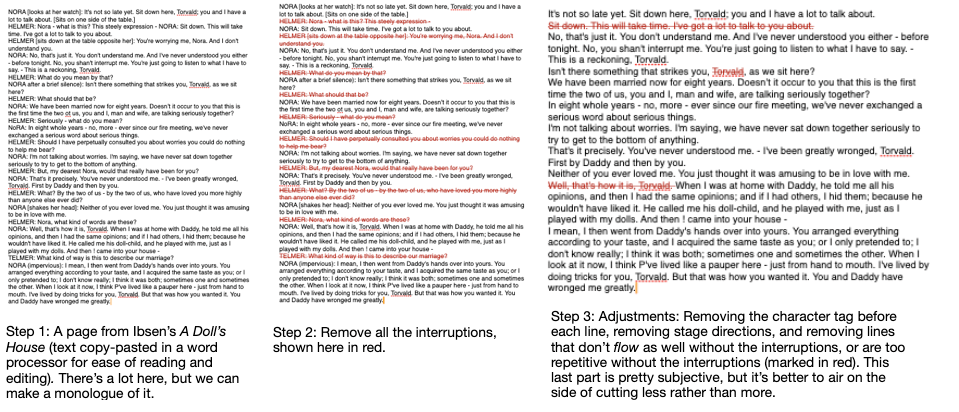
  2. Find a scene where a character has either a long, uninterrupted chunk of text, or several long lines in a row with some interruption. The latter can be a little tricky to spot, but practice helps.
  3. Remove any interruptions or unnecessary stage directions. You may have to tweak some lines just slightly to make what’s left make sense.
  4. Copy/paste this to a fresh Word document, or print a copy of the page from the script.

Done! In case this isn’t super clear, here are two examples to better illustrate what I’m talking about.

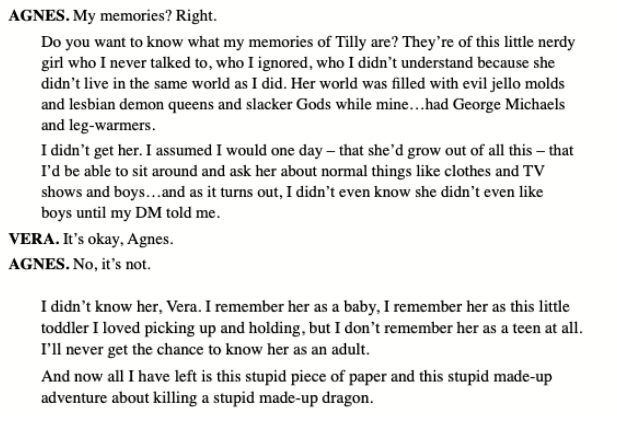
This first example (From Qui Nguyen’s She Kills Monsters) requires essentially no adjustments. There’s one interruption, but this can be easily remedied by removing the interruption and adding a word so Agnes says “no, it’s not okay” instead of just “no, it’s not.” (You don’t actually need someone to say Vera’s line– your audience will understand why your character is proclaiming “no, it’s not fine!” seemingly out of nowhere.)
Here’s another example of a scene that requires slightly more finesse to turn into a monologue, but it still works just as well:
Once you start looking for monologues from plays, you’ll find that you have a lot of options! Hopefully this provides a good excuse for you to revisit your favorite plays– or read some new ones– and look for scenes you can adapt.

Monologue Books?

It’s true that there is a veritable mountain of published books containing nothing but audition monologues. You may have good luck with these, and keeping a few in your actor’s library may be helpful for you. Generally, though, these are unnecessary to actually find a good monologue, and the offerings tend to be stale. If you really want to plumb this resource, consider checking your local library first rather than purchasing them. Getting your monologues online or directly from plays will probably serve you better nonetheless.

How to Memorize a Monologue

There’s really no getting away from repetition when it comes to memorization. For more in depth tips, consider looking at guide to memorization for actors.

Some quick and dirty suggestions to get you started:

  • Read it many times, both silently and out loud. If it’s from a play, read the whole play, if you can.
  • Break down the monologue into smaller chunks to make memorization easier. Work on a section at a time.
  • Practice in many different places, in many different ways, and in front of many different people, if at all possible. The variety is good for your memory and helps prepare you for reading in an unfamiliar audition environment.
  • Try recording yourself reading the monologue (video or audio recording) and watch or listen back to it. Listening to the audio can be a handy way to refresh yourself on the words even when your hands and eyes are busy, like while you’re driving or cooking.

Once you’ve found a great monologue and it’s memorized and well-practiced, you’re ready for your audition!

Read more plays, or scour the sites provided above, and see what options you can find! When you find a good one, save a copy to your computer or print it out and keep a physical copy, so you’ll always have some monologues in your back pocket!

Actor Life, Theatre

Why Was My Kid Cut From The School Play?: For Parents Dealing with Disappointed Kiddos

Around school theatre audition season every year, I see a swarm of posts in the theatre communities I’m in online, all asking the same question: why was my kid cut?

It’s completely understandable that both you and your child might be heartbroken when an audition doesn’t go their way. Getting cut from a production can be hard for even experienced, adult actors to deal with, let alone children, and parents without adequate understanding of how the theatrical process works or how to support their child through it can be at a loss to deal with those difficult emotions.

This is a brief guide for parents to better understand exactly what goes into casting a school theatre production and why a casting rejection isn’t the end of the world. We’ll also talk about how to discuss the rejection with your child to build resiliency and a positive growth mindset, as well as tips to help your chances improve for next time.

Why was my kid cut from the school play?

There might be any number of reasons why, but please hear me when I say this: The “why” is not important.

It’s a natural human tendency to look for information about why things didn’t work out the way we wanted them to. In a situation as subjective and sometimes random as theatre auditions, though, that search for information (where no objective, solid answers can often be found) is likely only to frustrate and confuse you.

It certainly could be possible that the director has a vendetta against your kid. It also could be possible (and this is much more likely) that the director really likes your kid, and really liked their audition, but just didn’t have a spot in this show for that actor.

Casting is like a puzzle. Some roles require stronger actors, some require stronger singers. Sometimes directors have two actors who are equally suited for a part, and the decision comes down to “who would be able to play this other part better?” Sometimes a really good dancer who had her heart set on a lead role gets cast as the villain instead, because the villain has to do more dancing and the director thinks the dancer will fit better there. Sometimes the best choice for a romantic lead looks too young or too old next to the best choice for the other romantic lead, and since they won’t work well together, someone has to be fit in somewhere else.

It really is that variable and impossible to predict. Sometimes, the “best kid” in the room in terms of talent and skill is not the one who gets the part. This is a boon, though, because it means sometimes the “best kid” in terms of attitude and conscientiousness does. Remember that auditions are random, and that also means it can go your way randomly, too.

I know you think you want answers about why your kid is disappointed. You don’t, though. Those answers won’t be helpful, if they ever really exist at all. This is the nature of theatre: it’s often very disappointing, but sometimes, if you’re lucky, it works out in your favor.

There are a limited number of roles. Not every kid can be the pitcher on the baseball team or the quarterback on the football team, and not every kid can play the lead in the school play, either. You also can’t have 100 kids on the wrestling team– nor can you have 100 kids in the musical cast. This is a good thing! Casting more children than a program can adequately supervise and guide is both unsafe and unsatisfying for the kids in the long run.

This is really hard to swallow, even for adult actors. There’s a reason professional acting is known as such a heartbreaking and hard-to-break-into career. While school theatre’s a far cry from professional theatre, to some extent, there’s just no way to circumvent the way theatre works. Not everyone can get the result they want at every audition.

Remember:

  • There’s no way to know why it didn’t go your way; the “why” is not important.
  • It probably isn’t personal, casting is complicated, subjective, and often very random.
  • Cast sizes are limited for the sake of safety, and this is ultimately a good thing, even if it’s frustrating in the moment.

So what do I tell my kid?

This answer is also hard, because there’s no one right thing to say.

They’ll likely want answers just as much as you do, and it can be helpful to remind them of the things I reminded you in the last section: it’s not about you. Sometimes it’s just random. We can always try again and hope it’ll be better next time.

I advise against contacting the director to ask for answers, and I would advise your child the same. The “why” is not important. If the student is genuinely interested in audition feedback, so they can learn how to improve next time, I would recommend waiting a week or two after the posting of the cast list before drafting a message to the director, to let the emotions settle. Note that this email should be strictly in service of getting feedback– it’s not a good time or place to vent your frustrations.

This casting rejection is an opportunity to teach the extremely valuable skill of handling rejection and disappointment with grace.

Job searches won’t always go your kid’s way, either. Neither will dating, college applications, or navigating friendships. Childhood, thankfully, is one of the lowest-stakes times to begin internalizing that one rejection needn’t be the end of the world, and that getting up and trying again will always be more valuable than getting it right the first time. It’s true that this is a difficult and heartbreaking message to learn at any age, but when you’re young, you have a robust support network around you to help you work through those emotions.

Having volunteered in school theatre for years, I think one of the most valuable conversations a parent can have with a kid after a rejection is that they can always try again. Yes, it’s very disappointing when you don’t get the part you want; yes, it’s frustrating and defeating and you might feel embarrassed for having tried at all. You’re allowed to feel all of those feelings– but they are just feelings, and not reality. You aren’t defeated: you can audition again! There’s always another school show. There’s always a community theatre production coming up, too. It didn’t go your way this time, but next time, it might.

Remember, kids are resilient. Sometimes it can be helpful to take a second to check in with yourself– who’s more disappointed here, me or my kid? When your kid faces rejection, it can sometimes feel like you’re facing rejection, too; but pushing past this is necessary to best support your child.

  • Don’t contact the director about casting frustrations. If you want feedback, wait a week or two for emotions to settle before asking.
  • Remind your child that they can always try again, and that trying again says more about them than one rejection.
  • Consider looking into other local productions your child can audition for instead.

What do I do now?

More than anything else, what you can do is be there for your kid and model what handling rejection well looks like. Have conversations with them about how they’re feeling. If they want to lash out, redirect them to healthier outlets. If they express bitterness, point out that others worked hard, too. If they’re feeling insecure, look for outlets to illustrate that temporary rejections don’t determine who they are.

It’s important to redirect expressions of entitlement and defeatism. Think of how damaging these attitudes can be in the future, when your child is navigating the adult world that is so much more prone to frustration and rejection: this opportunity to address them now is priceless.

If you play your cards right, getting cut from the school musical might be a formative experience for all the right reasons.

Actor Life

You Don’t Need to go to That Audition for “Practice”– Do This Instead

Maybe you’ve fallen into the same trap as me. It seems like a smart idea: auditions are nerve-wracking barriers of entry to every production, so why not attend more auditions for the sake of getting used to them? Auditioning is a very different skillset in some ways than actually performing, and hands-on practice is always the best method of improvement, right?

Not necessarily, I’ve come to realize. Maybe it’s more appropriate to say not all hands-on practice is created equal, and going to auditions for the sake of practicing auditions isn’t always beneficial.

Let me explain.

Continue reading