Guides and Tips, Theatre

Does a Community Theatre Production Need an Intimacy Coordinator?

“Intimacy coordinator” is a relatively new title for a job many actors, directors, stage managers, and choreographers have found themselves taking on for many years, in pursuit of solving a problem theatre folk have always faced: the potential discomfort involved in rehearsing and performing sexual content on stage.

Intimacy coordinators are becoming steadily more mainstream in the theatre and film industries, and in the performing arts at large. That said, many question the need for the profession– if actors have figured this stuff out since long before the advent of the first official intimacy coordinators in the early 2000s, why should a film production or theatre company pay someone to insert themselves into the process?

The answer is simple: it’s true that the art of acting has made do without intimacy coordinators for hundreds of years, and it’s also true that actors have often had adverse experiences with sexual harassment and abuse, as well as plain old discomfort and embarrassment, stemming from working on sexual content without adequate safeguards. Intimacy coordination provides actors, directors, and everyone else in the room with tools to help navigate potential pitfalls associated with working on sensitive material.

As the profession becomes more mainstream in professional theatre, community theatre artists may find themselves itching for the same assistance. This article explores when and where an intimacy coordinator may be helpful in community theatre settings, and will hopefully help directors and theatre managers navigate whether or not the investment is right for them.

Benefits of Intimacy Coordinators for Community Theatre

If you’re not familiar with what intimacy coordinators do, it might be helpful to start by exploring the benefits of intimacy coordinators and bringing in an intimacy professional.

Intimacy coordinators…

  • Take pressure off of actors and staff alike by providing tools and advice for dealing with intimate material
  • Provide working vocabulary and practical tips to minimize discomfort during the process, even when working on potentially awkward or uncomfortable scenes
  • Serve as valuable sounding boards or consultants during rehearsal, or step in and play a more active role in choreographing moments of intimacy
  • Are well-versed in trauma and mental health practices (but are not therapists), and can provide resources or guidance to assist artists struggling with challenging content
  • Help tell the story on stage, while making sure those telling the story are also attended to
  • In general, help protect everyone in the room, without being the “sex police,” by making sure everyone’s on the same page and that expectations are being clearly communicated and fulfilled

In short, intimacy professionals can make navigating theatrical intimacy safer and less uncomfortable for everyone involved. Whether a team has specific concerns, or actors are just a little nervous about getting sexy in front of their fellow cast members, intimacy coordinators can help ease the tension and steer the room towards happier and more productive conversations and practices.

Signs You May Want an Intimacy Coordinator for Your Production

Now that we’ve examined some of the benefits of intimacy coordination, let’s examine some signs that you may need an intimacy professional on your project:

The Show Contains Particularly Sexual, Sensitive, or “Heavy” Content

Some shows contain more mature content than others. Productions that deal with highly charged and potentially triggering material can often benefit from an intimacy coordinator. Not only can an intimacy professional provide tools for the actors to advocate for and safeguard themselves, they also provide tools and insight for the good of the theatre company as a whole. They should be able to advise on best practices regarding auditioning, casting, and creating content warnings in addition to assisting in the rehearsal process. This kind of input can head off potential issues before they arise, and keep the cast and crew safe and comfortable during the entire process.

The Production Team or Theatre Managers are Wary About Handling the Material Properly

Directors or choreographers may be uncomfortable attempting to block or choreograph moments of intimacy. Lighting designers may be uncertain of best practices for lighting scenes with nudity, and costume departments or backstage dressers may need help navigating these scenes as well. At any step of the process, there can be many points where a staff discovers they don’t feel adequately equipped to deal with intimate content, and having an intimacy professional on hand to guide them can be invaluable. Besides making the process easier and the learning curve smoother overall, it can also provide production teams and theatre administrators with useful tools they can keep in mind for future productions.

The Show Contains Sexual Content the Production Staff Lacks Knowledge Of

For example, if your show is about sex work, or perhaps contains depictions of BDSM culture, but the director and other leading creatives are not secure in their understandings of these communities, it may be beneficial to call in someone who is. You may research intimacy coordinators who specialize in niche subject areas, like kink, group dynamics, or scenes of non-consent. Even if you aren’t looking to hire a specialist outright, consulting on a production or providing resources for the team to do their own research is a common service many intimacy professionals offer.

You Have Actors (or Staff) Asking for One

If anyone working on the production is uncomfortable with the material, or is simply searching for more guidance as to how to explore sexual material in the least uncomfortable way possible, consider reaching out to an intimacy professional. This can help prevent further issues down the line and covers your bases just in case. If someone is asking about bringing in an intimacy professional, it’s probably a sign that having one will be helpful.

You may also consider checking out Evelyn Fogleman’s article, “Understanding Intimacy Coordinators: A Guide To Knowing When You Need One.”

How to Find and Hire an Intimacy Coordinator

If you feel like an intimacy professional would benefit your production, your next step is to look into hiring an intimacy coordinator.

Theatrical Intimacy Education offers a useful checklist for navigating who best fits your production’s needs.

Intimacy Directors and Coordinators International hosts a database of professionals certified through their training program. Note that certification is not necessary to work as a theatrical intimacy professional!

You should also explore the intimacy professionals working in your area: if funding is a concern as a community theatre operation, finding someone close to home is likely to be more cost effective. You can try Googling “intimacy coordinators in [city name],” but an easy approach is to find program information for regional theaters in your area and look for the names of the professionals they work with.

If hiring a professional is not right for you at this moment, you still have options: there are lots of ways to learn more!

Resources for Navigating Theatrical Intimacy

One of the great things about theatrical intimacy tools is that they can be used by more than just intimacy professionals. Actors, directors, choreographers, and everyone else “in the room” can benefit from learning more about theatrical intimacy best practices, so they can bring these useful tools into the rehearsal room, and even pass them on to others.

Even if you don’t need an intimacy coordinator for your next production, you may find the following resources helpful:

Book: Staging Sex by Chelsea Pace and Laura Rikard

Staging Sex is full of best practices and no-nonsense tips for handling stage intimacy. Written by the co-founders of Theatrical Intimacy Education, this book is an excellent starting point for learning about intimacy, or a solid refresher for those with some training.

Book: The Intimacy Coordinator’s Guidebook edited by Brooke M. Haney

Brooke M. Haney gathers contributions from a variety of intimacy professionals in the field to create a diverse collection of viewpoints. The book explores various specialty considerations and best practices for intimacy coordinators, and makes a useful companion to Staging Sex by providing additional context and perspectives.

Live Workshops: via Theatrical Intimacy Education

Theatrical Intimacy Education (TIE) hosts workshops year-round via Zoom, with occasional in-person weekend intensives across the United States and internationally. Workshops cover a variety of topics and are designed for a variety of backgrounds and levels of understanding, so there are options for everyone, whether you’re just dipping your toes in or interested in more advanced training.

Live and Pre-Recorded Workshops: via Open Intimacy Creatives

Open Intimacy Creatives also offers workshops, however Open also provides the option to purchase pre-recorded workshops for on-demand viewing. If you have pressing questions or need training on your own time, consider browsing their library. If you are interested in more structured training, consider checking out their cohort programs.
Guides and Tips

The Ultimate Guide to Surviving Tech Week (Updated for 2026)

I have a sickness of the mind, and it is that I kind of get a kick out of tech week. The idea of 12-hour rehearsals gets me sort of jazzed. The head-down, one-foot-in-front-of-the-othergrind of tech week is very fulfilling to me. It’s a week to throw the entirety of my energy squarely at two targets: put on a good show and don’t die. It’s like a week of wilderness survival but for a theatre kid. It’s exhilarating and when it’s done you get to show off all your cool scars (some figurative, most literal).

I’m a dweeb about tech week preparation, it’s true. If tech week is wilderness survival, I am your overenthusiastic survival guide. I will get through it and I will get you through it, too. Just heed my advice.

Continue reading

Guides and Tips, Theatre

How Do Actors Learn Their Lines?: A Guide to Memorization for Acting

When I tell people that I’m an actor, one of the responses I often get is how do you memorize all that? Memorizing your lines is a necessary part of performing in theatre or film, but a deceptively difficult one that you usually won’t be taught how to do in acting courses or textbooks. The assumption is that actors already know how to memorize a script quickly: but if you’re just starting out, this can be a huge hurdle.

This article will examine how to memorize lines fast from a theoretical perspective and provide some practical tips and exercises to try. By the end, you should have all the tools you need to memorize a monologue, scene, or song, so you can find more success in rehearsal.

How Do Actors Learn Their Lines?

The short answer to this question is it varies, and there are as many different ways to memorize your lines as there are actors on planet earth.

The even shorter answer is just one word: repetition. But there are lots of different ways to practice repetition, so even this short answer requires much longer explanation!

If you’ve ever done community theater, or maybe participated in school theatre, then you know that much of the rehearsal process is spent learning and running (and re-running) show material, both to prepare and perfect it for the final performance and to help the actors remember everything. Repetition over the course of the rehearsal process helps actors keep track of lines and blocking.

But in professional theatre and film, actors are often expected (not always, but often) to have the full material memorized at the start of the process. Professional theatre rehearsal processes are usually only a few short weeks long, so quick memorization is key; TV and film actors often have rather minimal rehearsal before getting in front of a camera. In these cases, actors must get their repetition by practicing at home. (Practicing at home is also necessary in long rehearsal processes– don’t think you’re off the hook just because your school’s rehearsal process is 3 months long!)

Memorization is largely the process of making connections between neurons and strengthening those connections with repeated exposure to stimuli— hence the importance of repetition. Repeated exposure to lines, blocking, or music helps solidify the neural pathway in the brain, leading to faster and easier recall.

So that’s easy enough, right? Just repeat it a lot and you’re good to go?

In theory, yes, that’s all there is to it; but that’s easier said than done. Let’s look at some tips to help turn that theory into practice.

Memorization Tips for Actors

Here are some tried-and-true techniques for actor memorization:

  • Getting very familiar with the script is a necessary step one. Reading and re-reading the script isn’t a super efficient technique for memorization, but plan to do it at least a few times on your own outside of rehearsal.
  • Running lines with a partner is a classic option. Try this with and without your script in hand to quiz yourself. Speaking the lines aloud with someone else can be more helpful for memorization than just reading them alone.
  • Learn a little bit at a time. Don’t try to memorize the whole show in one sitting. Pick a page or two per day, or more if your rehearsal period is short. The next day, review the previous section, then go on to the next. Periodically review in larger chunks (like all of act one, or the first 20 pages, etc).
  • If you don’t have anyone to run lines with you, you can make an audio recording of your lines. Try making two copies: one where you say your lines out loud, along with other people’s cue lines, and one where you only say the cue lines. This way, you can listen to the “full” copy when you need to remind yourself of the lines, or the copy with only the cue lines when you want to test your recall.
  • Some actors like to make line flashcards with the cue line on the front and their line in response on the back. If you make these flashcards with pen and paper, you get the added benefit of writing the lines out longhand, which can also be helpful for memory.
  • As you get further into the rehearsal process and get your blocking or choreography, practice your lines and your blocking (or your lyrics and your choreography) together. Connecting the motions to the words can help both stick in your mind.
  • Space out your line-study sessions. Information sticks better in your memory when you practice it over time, rather than trying to cram it all in one big chunk. This can be as simple as studying for 30 mins, eating dinner, and then coming back to study for another 30 mins– a little distance where you start to forget, but then jog your memory soon after, can be beneficial.
  • The human brain loves variety, so trying it many different ways can help information stick. For instance, try reading or reciting lines very fast, or very slow. Try reading them as you plan to on stage, and then try reading them as much unlike how you plan to read them on stage as possible. Study in different places and using different methods.

Experiment with these and see what works best for you. Now that we’ve taken a look at the basic memorization methods actors use, let’s look at how you can use them in specific situations.

How to Memorize a Monologue

Figuring out how to memorize a monologue is a real challenge. Whether you’re preparing for an audition, or have a lengthy chunk of text to remember for a performance, monologues are difficult because you don’t have anyone else to work off of.

To memorize a monologue, make sure you have a good sense of how the whole thing flows. Since it’s much shorter than a full play, there’s no reason not to read the full text several times. Then, break it down into sections. It may help to paraphrase or quickly summarize each section to cement them in your head: “First, my character arrives at the house and opens the door. Then she talks to the person who opened the door. Then she realizes the person behind the door isn’t who she expected. Then…”

It may also be helpful to look for landmarks in the text to help you keep track of what’s next. For instance, if your character is telling a story about her birthday party, where she got a pet cat, but her mom didn’t want her to have the cat, so her mom drove it to the shelter, but then her dad brought it back, you might remember just a few key words: party-cat-mom-shelter-dad. This way, even if you forget a few words here or there, you’ll remember the general direction you need to go in.

Spaced repetitions are especially useful for memorizing monologues. Read the whole thing, then set a timer for 15 minutes. Do something else, and when the timer goes off, recite the whole thing again. Rinse and repeat. By getting busy with something else and almost forgetting what you’ve worked on, then reminding yourself just as you memory is starting to flag, you strengthen your memory much more than repeated recitations over a shorter window of time would.

It’s important not to underestimate a monologue. Don’t try to cram and learn it all the night before your audition: it won’t go well!

How to Memorize a Scene

It’s easier in some ways to memorize a scene than a monologue, since you have other people in the scene with you to help you stay on track. Of course, there’s always the possibility that they might mess their lines up, so it’s critical to make sure you know yours even if they don’t know theirs.

It’s very important to memorize the cue lines that come before your lines. You may know all your lines, but if you don’t know when to say them, you’ll be lost. Line flashcards can be helpful for this.

Practicing as a group or with a friend is great when working on scenes. Try running lines together before or after rehearsal, or whenever there’s downtime during rehearsal. The benefit of practicing with others is that you’ll start to pick up on their quirks of characterization or delivery, and those emotions can help your brain strengthen the memory of the lines.

If your friends are too busy to practice with you, you can try recording your lines on an audio recording app to practice them by yourself.

How to Memorize Song Lyrics

Memorizing song lyrics is usually easier than lines because you’ll have the music to keep you on track. If you’re struggling, though, or need to memorize song lyrics fast, there are a lot of little tricks you can try.

One technique for memorizing song lyrics is to write out the last word of each line, or the rhyming word of each line (these are usually one in the same, but not always). For instance, for the first stanza of the song “Safer” from First Date is as follows:

I know that I have issues,
I face them, I swear
Think I overcome them
then turn, they're still there
Wish that I was different
I'd like to let go
But when I try to change
There's my past saying "no"

If you’re having a hard time remembering these, you might write out, issues/swear, them/there, different/go, change/no. Listening for the rhymes can help you remember what comes next: if you know the next line has to end in a word that rhymes with go, you might be closer to remembering “no.”

Another tip for memorizing song lyrics is to listen to the music behind the words. You may find little musical flourishes that help you remember what the words are. When performing the song, you’ll also have an easier time following the accompanist or orchestra (or pre-recorded track) if you’ve been paying attention to exactly how the music sounds at each line.

How To Memorize a Script Fast

If you need to memorize a whole script quickly, you’ll want to work in sections to make the full text more approachable. Work on a chunk of a page or two at a time, and only add more pages when you feel decently confident about what you did before. Work your way through the script section by section, periodically going back to review the section before your current section. Don’t try to start from the beginning every single time– you’ll find that the start will be really solid, but you’ll forget everything else!

Much like I suggested in the how to memorize a monologue section, it might be helpful to paraphrase or summarize each section of the script. If you know “on this page, I tell him off for talking to my girlfriend” and “on the next, I punch him for it,” then you’ll be able to follow the general flow of the plot even if you misremember a line or two.

Making an audio recording of your lines is really helpful for rapid memorization, because 1) you can listen and rehearse hands-free while cooking, driving, or applying makeup, and 2) you can physically speed up the recording to go play more quickly if time is short.

Ultimately, though, the best way to memorize a script is to take it slow and steady: practice a little every day, and review regularly. Cramming a script at the last minute isn’t very effective.

Famous Actor Memorization Techniques

Everyone learns differently, so examining different techniques for memorizing lines can be helpful. What works for one person may not work for you, and that memorization tool you use for every single production might be useless to a friend. I have my own personal methods I like to use. Trying out a lot of ideas and seeing which ones stick can be very useful.

Here are some techniques famous actors use to memorize their lines:

  • Robert Downey Jr. writes out the first letter of every word he has to memorize. In an interview with Today, he gave the example T-N-S-I-M-G, which he says stands for, “there’s no shame in my game.”
  • Terry Crews uses a method I suggested earlier in this article: he records his lines using a voice recording app and listens to them on a loop. This way, he can work on memorizing lines even while exercising. Michael Barra similarly records lines so he can work on them without asking a friend or family member to read the scene with him.
  • Anthony Hopkins said he read his scripts over 200 times in order to memorize them. Like I said before, this probably isn’t the most time-effective option, but who am I to argue with Anthony Hopkins? Repetition is a necessity for learning any new material.
  • Tom Holland says he waits to learn his lines until the day of filming, which probably isn’t the best advice for new actors– but he claims it helps him stay flexible and take direction in the moment. He says that all lines fall into three categories: “asking a question,” “answering a question,” or “telling a story,” and that remembering when your character is doing which can help you remember what you’re supposed to say.
  • John C McGinley writes out his lines longhand and annotates the page with actionable verbs. He also practices his lines while juggling (yes, literally, that’s not a metaphor) to test his knowledge and ensure he’s ready.
  • Sarah Paulson also writes out her lines, and sometimes records them, and also suggests getting up and moving around while practicing. Like McGinley, she likes to test herself: “If you can do all your lines while making dinner, you probably know them pretty well.”
  • Brittany Snow also advocates getting up and moving, saying she’ll pace around her apartment while running lines with her husband.

This really illustrates that everyone is unique when it comes to memorization. Experiment and try lots of different methods so you can figure out the ones you like best!

Final Thoughts

Learning how to memorize lines is only a small part of learning to act, but it’s an extremely crucial one. There are a million ways to answer the question how do actors learn their lines?, which is both reassuring and frightening. On the one hand, it means there really is no wrong way to do it. On the other, it means there are many ways to try it, and that requires experimentation.

If you have any favorite methods of memorization for acting, drop them in the comments so we can try them out!

Guides and Tips, Theatre

Auditioning for the First Time? Start Here

The start of a new year is a perfect time to try new things! If your resolution is to give acting a try, you’ve made a good choice. Theatre, however, comes with a lot of unwritten rules, and if you’ve never done it before, you might be at a loss where to start.

This is a quick-and-dirty guide to get you started on auditions. It’s not an in-depth audition guide, but it will guide you through what you need to know as simply and directly as possible.

Finding Your First Audition

If you’re unsure how to find auditions in the first place, maybe start with this guide: How to Find Auditions for Theatre and Film

The answer needn’t be long and complicated, though. Auditions are easier than ever to find thanks to online tools.

Many community theatre auditions are posted on social media, so consider checking Facebook for Events happening near you, or look for a Facebook group for local performing arts events and auditions (many areas have one of these).

You can also search for theaters near you via Google and browse their website for audition information.

Ideally, your first audition shouldn’t be one that’s a day or two away. Try to find one that’s not too soon, so you have time to prepare!

Planning Your First Audition

Once you’ve found an audition opportunity near you, you should closely analyze the audition notice, that is, all the information the company provides about where you need to be, what you need to do, and how you need to do it.

Here’s an edited audition notice I found on Facebook, as an example.

☎️AUDITIONS: 
Dial M for Murder
By Frederick Knott, Adapted by Jeffrey Hatcher
Directed by [DIRECTOR NAME]

[THEATRE NAME] is holding auditions for Dial M for Murder, the suspenseful thriller made famous by Hitchcock. If you love twists, psychological tension, and smart storytelling, this one’s for you!

🗓 AUDITION DATES:
Tuesday, January 13
6:30–10:00 PM
Sunday, January 18
11:00 AM–7:00 PM

CALLBACKS:
Saturday, January 24
11:00 AM–2:00 PM

CAST BREAKDOWN:
• Tony Wendice (he/him): 30s–40s, British. Charming, calculating, and dangerous.
• Margot Wendice (she/her): 30s–40s, British. Intelligent, kind, and trapped in a loveless marriage.
• Maxine (she/her): American. A bold, rising crime novelist with a sharp mind and a protective heart.
• Lesgate (he/him): 30s–40s, British. A desperate con with a criminal past.
• Inspector Hubbard (he/him): 40s–50s. A methodical detective determined to uncover the truth.

WHAT TO PREPARE:
Actors may prepare one monologue from the play or a monologue of their choosing.
You may also be asked to read from sides.
📲: SIGN UP HERE: [insert link]
📂 AUDITION MATERIALS (schedule, sides, monologues): [insert link]

This audition notice provides a lot of information, and that information is valuable for preparing your audition.

Perhaps first to note is the cast breakdown. Are you potentially appropriate for any of the parts? This play seems to have roles primary for actors in their 30s to 50s, so if that’s not you, you’ll probably want to audition for something else. (Note that an actor’s playing age may not be their real age– if you can pass for the age of the character, that’s good enough.)

Then, double check the essentials like time and place. Can you make it to auditions, or do you have other plans that evening? Where is this theatre, is it close enough for you to consider driving there multiple nights a week for rehearsal? This particular notice also provides a rehearsal schedule, listed in the link at the bottom. This won’t always be provided, but since it is this time, you should review that and make sure you can be at the majority of rehearsals.

With all of the essentials clear, you can look at the real meat of the audition notice: what you need to prepare.

This notice says you need to prepare a monologue, and provides a link for you to access monologues from the play. (It says you can provide your own monologue if you’d like, but for your first audition, picking one of theirs would likely be easier.) The notice also says you may read from “sides,” which are brief, selected scenes from the play that you’ll read with others.

Note that this audition notice is just a sample. Audition notices can vary in plenty of ways. Here are some other things you may see or want to take note of:

  • Notice that this audition listing advertises a day for callbacks. These are a round of invite-only secondary auditions, used to narrow down actors for specific parts. You can get a part without being called back, but it’s still good to note when callbacks are and whether or not you’d be able to attend, just in case you are offered one.
  • If you’re auditioning for a musical, the notice will also include directions for your vocal audition. Usually they will ask for a 32- or 16-bar cut (that is, for 32 or 16 measures of music– 32 bars is often approximately 1 minute of music). They will also usually request a certain style of song, eg, “Please prepare 32 bars of a contemporary musical theatre selection.” If you’re not sure what this means, you can always Google it and find examples!
  • Musical auditions will also frequently (but not always) include dance portions. Make sure to read carefully: if you need to dance at an audition, you’ll want to plan your wardrobe accordingly. At a dance audition, you’ll follow the choreographer through a brief combination.
  • This audition notice asks you to sign up for a time slot. Not all will– sometimes you’re welcome to show up at any time. If there is a sign-up, though, you should definitely fill out the provided form.
  • Some audition notices may request “two contrasting pieces.” This is maybe most common with musical theatre auditions asking for two song cuts, usually one upbeat and one slower song to give a fuller idea of your vocal ability, but you’ll sometimes be asked for contrasting monologues, too. Make sure you read carefully so you don’t miss important info like this.
  • Some notices may mention headshots and resumes. If you don’t have an acting resume or a headshot– which you almost certainly won’t as a beginner– just don’t worry about these. You can get them later.

Reviewing all of this information makes your next steps clear. Let’s talk about these now.

Preparing Your First Audition

Now that you know what you need to prepare, we can talk about how to prepare it. This section is divided into subsections for common audition components.

Preparing a Monologue

Step one is selecting a monologue. For the sample audition notice I provided, all you need to select is a monologue, and they make it easy by providing some to choose from. For others, you may need to find your own. I have an in-depth guide on finding monologues for auditions, but here are the basic principles:

  • You can find monologues on monologue websites (find them easily by Googling “audition monologues [for men/women/all ages/child actors, etc]”). You can “make your own” monologues by lightly adapting scenes from plays, but this probably isn’t the best option for beginners. Start by preparing a tried and true monologue!
  • Pick a monologue that is of an appropriate length (generally around a minute, and definitely under 2, but pay attention to if the audition notice requests a specific length)
  • Pick a monologue that fits with the style of the play (ie, don’t audition for a contemporary comedy with monologue from a Shakespearean tragedy. You want to pick something from a similar time period, and in a similar genre: comedy for comedy, drama for drama, etc)
  • Pick something you LIKE! You’ll have to spend a lot of time preparing and memorizing the monologue, so make sure you can stand to do so!

Once you’ve made your selection, you can begin working on and learning the material.

There are a million ways to do this. An easy start for beginners is to print out the monologue. Read through and with a pencil mark anything you want to emphasize: key words, moments of emotional intensity, places where you want to speak quickly or slowly. You could mark moods, like “say this angrily,” but a more actorly way to approach it is to mark intentions, like “I want to make the listener feel stupid for saying whatever he just said to me,” or “I want to let everyone know what a jerk my character’s son is for what he did.” It doesn’t have to be perfect– feel free to play with different intentions until you find ones that feel good.

There’s a whole wild world of acting technique out there that will help you refine your approach to monologues, but this is a good standard baseline to begin with.

Practice performing the monologue frequently, on different days, at different times, and maybe even in front of some friends and family. Make sure you practice reading it aloud, not just in your head! The more you practice it, the more it will stick in your memory. Audition monologues should be memorized, so repetition is key! I have a separate in-depth guide to help you memorize your monologue, but there really is no cheat code for skipping many, many repetitions.

There’s no need to bring a physical copy of your monologue to the audition, but you may want to, just in case you want to review in the lobby before the audition.

Preparing for Cold Reads

Cold reads are a common element of auditions– that is, picking up a scene you most likely haven’t seen before and performing it cold (with no preparation). Sometimes you’ll read the scene with other auditioning actors, and sometimes you’ll read with a member of the production staff. Cold read auditions are somewhat more common than monologue auditions these days, especially for community theatre.

The point of cold reads, generally, is that they require no prep: the idea is to see how the actor works and adapts on the fly. Still, some audition notices (like the one I provided above) will supply you with the scenes that will be used for cold reads. If it’s possible to view the sides ahead, it’s generally highly encouraged to do so. You don’t have to explicitly prepare them or memorize them (unless otherwise suggested in the audition notice), but building a passing familiarity with each is beneficial. Try reading them all aloud, to reduce the risk of tripping over your tongue in the audition room.

If sides aren’t provided in advance (and even if they are), consider finding the full script of the show you’re auditioning for and reading it ahead of time, if at all possible. Familiarity with the plot and characters will help you make better acting decisions in the audition.

Preparing a Vocal Audition

Much like with a monologue, step one is selecting your song(s). I have a more in-depth guide for this on my site, but here’s the quick and dirty:

  • When picking a song, pay close attention to what the audition notice is asking for. Do you need to prepare a specific style of song? Of what length? Do you need one cut or two? Especially note whether there will be an accompanist in the room, or if you’ll need to find a backing track to sing with.
  • An easy way to start finding audition songs is to simply Google “audition songs for tenors/men/mezzo sopranos/children/etc.” You can also try Googling “audition songs for [show name]” or “audition songs for [character name].” Almost any song can work as an audition song, but finding really good ones requires some more audition know-how, so sticking with suggestions from others is a good starting point.
  • Make sure whatever you pick is right for your voice part and not too hard to sing. If you have trouble singing it while relaxed at home, you’ll definitely struggle to sing it in the higher-stress environment of the audition room.
  • Occasionally you may go to an audition where you’re allowed and even encouraged to sing a song from the show: this can make finding songs and materials much easier, but it’s rather uncommon.

Once you’ve chosen your song, you’ll need to prepare your materials:

  • If the audition notice asks for a backing track, you’ll have to track one down, and your song options may be slightly limited by what you can find. Search on YouTube and maybe Google for karaoke tracks for your song. Appcompanist is a fantastic app that I highly recommend for auditions, as you can tweak the key and tempo and many other settings as you like, though there is a paid subscription.
  • Note, too, that if you need a backing track, you need a way to play that backing track. Auditions that ask for backing tracks will generally provide a Bluetooth speaker, so ensure you have a device capable of connecting via Bluetooth. This also means keeping your device charged and potentially downloading your materials to your device so you don’t have to worry about spotty internet or cell service.
  • Sheet music will be required if your audition will have a piano accompanist, and it’s useful to have even if the audition won’t have one. The easiest way to ensure your music is in the right key and written legibly for a pianist is to buy sheet music from a site like MusicNotes, though you can have luck tracking down sheet music PDFs for free. For a beginner, I’d recommend buying from a reputable site to be safe.
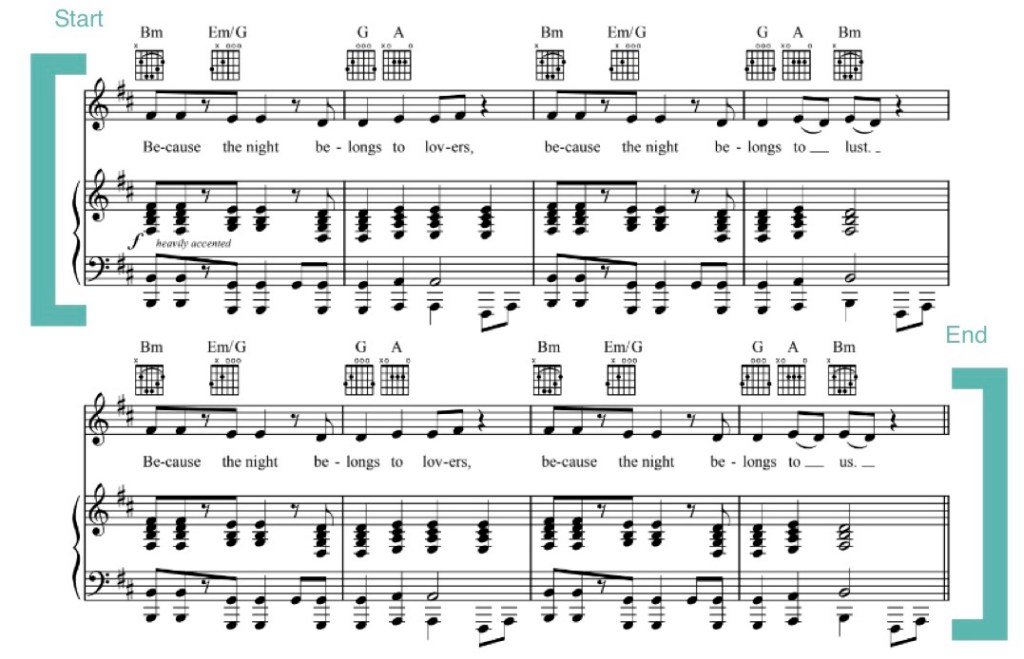
  • Preparing your sheet music for the accompanist is key. It helps them play their best for you without worrying about page turns, and it also looks more professional. You should:
    • Print out your sheet music, preferably double-sided. If you can’t print double-sided, tape pages together back-to-front, to effectively create double-sided pages.
    • 3-hole punch your sheet music.
    • Put your sheet music in a 3-ring binder, so the accompanist can easily turn the pages. Don’t bother with lamination or page protectors, these often have a shiny glare that can get in the accompanist’s way while playing.
    • Mark where in the music your cut will start and end. Here’s an example of how that might look:

Finally, you can begin the work of practicing your song!

Like preparing a monologue, practice the song in many different ways, places, and times of day. Your song will need to be memorized. Repetition is key. It’s useful to print out a second “scratch” copy of your music and use this to take notes on, similar to what I suggested in the monologue section.

One of the most beneficial things a beginner can do ahead of a musical theatre audition is to find a voice teacher you can take a few lessons with to work on your song. This way, you can practice singing it with an accompanist, and they can give you plenty of tips on preparation and auditioning. This is maybe the best thing you can do to prepare, so I HIGHLY recommend it if you can swing it.

Preparing for Dance Calls

There’s not much to do to prepare for a dance audition, short of selecting appropriate clothing. You may want to stretch before the audition. Overall, remember that a big part of this portion of the audition is seeing actors’ personalities and attitudes, so just be prepared to bring your best self.

Performing Your First Audition

You may find my article What to Expect in Your First Audition handy.

On the day of the audition, you’ll want to arrive 10-15 minutes early to the theatre. Generally, there will be someone at a desk checking people in and handing out audition forms. These are brief applications that provide the team with more information about you. Fill this out, have a seat, and wait for your turn.

Remember that you’re always auditioning. Once you get on the premises, remember to be polite and respectful at all times. Making a bad impression never bodes well for casting.

You will eventually be called into the audition room to perform your selections. You may be in the room alone with the show staff, or there may be other actors in a group with you.

When it’s your turn, you can hand off your music binder to the accompanist, or hook up your device to the speaker to play your backing track, or simply take the stage for your monologue/cold read. Before you sing or read a monologue, you should slate, that is, state your name and what you’re performing: “Hi, my name is Bobby Smith, I am singing “Chip on Your Shoulder” from Legally Blonde,” or “Hi, my name is Susie Gonzalez, I will be reading a monologue from John Cariani’s Almost, Maine.” (Make sure you know the name and author/source of your piece to be able to slate!)

Auditioning for the first time can be scary, but remember that the production team just wants to see you do your best. No sweat. Auditions can be a lot of fun, too! If you relax and appreciate the short opportunity to perform, you may find that you enjoyed yourself more than you expected.

After your audition, it’s best to put the whole thing out of your mind: you’ll probably have to wait a while to hear about the cast list. Planning some activities with friends immediately following the audition can help take your mind off it, but really, the waiting is always the hardest part.

Remember, even if you aren’t cast, putting yourself out there is always worthwhile! Sometimes a director needs to see your face and your talents more than once before you start booking roles. The more auditions you go to, the better your chances of being cast.

Final Audition Tips

  • Auditioning doesn’t have to be complicated to start with. It’s one of those things that can be simple to start, but can take a lifetime to master. The more auditions you do, the more you’ll learn!
  • Always remember to stay cool and calm. Even if things go wrong, try to keep your emotions in check. People will want to cast folks who seem pleasant and friendly over people who are extremely talented but seem like nightmares to work with.
  • There are a lot of very good books out there about auditioning, such as Michael Shurtleff’s Audition and Michael Kostroff’s Audition Psych 101. Consider picking one of these up if you want to learn more, or browse further resources on this blog.
Guides and Tips

How to Find Auditions for Theatre and Film in 2026

Whether you are a professional actor with years of experience or a hobbyist who’s just getting started, figuring out where to find auditions can be a big stumbling block. Consider this article your ultimate guide: we’ll examine a number of painless ways to find theatre and film audition opportunities quickly and successfully.

How to Find Local Auditions for Theatre and Film

Here’s an easy way to get started: take stock of the companies who are putting on local and regional productions you’re already seeing. They must be having auditions for those productions– visit their websites to find how you can audition for them.

Your friends are also an invaluable resource here. Ask around: Where are you auditioning this week? Where did you hear about that audition? What’s the next opportunity you’re auditioning for? You can hear about a ton of opportunities just by keeping your ear to the ground.

How to Find Auditions on Social Media

Since you’re likely already on it, why not try using it to get some parts? One of the more useful applications of social media for actors is to use it to search for opportunities. Maybe think twice before ditching your Meta accounts just yet…

A simple start is to follow as many local companies and artists as you can. Audition notices are often posted on social media pages, and following ensures they’re likely to cross your feed. Actors you befriend on Facebook or Instagram are also likely to put other audition opportunities on your radar– on Facebook, for instance, a friend marking themselves “interested” or “going” to an audition event will often show up on your feed, showing an opportunity you may not have realized you had. Local casting agents, if you know any, are great to follow as well.

Another helpful option is to look for a local or regional audition group or page where many companies share notices. This way, even companies that you or your friends don’t follow– maybe even brand-new companies!– can make their way to your feed. For me, locally, this is the Pittsburgh-area Auditions An’at group on Facebook. A cursory search on that site also brought up groups for many major metropolitan areas, so check to see what’s available in your region. There are also groups that share casting calls or open audition notices for national tours, or big film opportunities. Join whatever is useful for you, and if you find the group unhelpful, you can always remove yourself from it later.

Note that groups and pages of this sort will often be unique to a particular medium. If you’re looking for theatre auditions, join groups that cater to that. If you’re looking for film auditions, join those groups. You may also find groups for companies hiring dancers, musicians, or party actors (think Princess Parties, etc), and groups specifically for extras for film. Be sure you’re exploring all your options!

Of course, it doesn’t hurt to periodically search for keywords like auditions or casting call in the search bar on Facebook or Instagram, and use search tools to tailor the query to your local area. You may find some surprises!

How to Find Auditions on the Web

For professional theatre and film auditions especially, you’ll want to check out casting sites like Backstage, Playbill, and more. Not all of these sites are created equal, so make sure you’re using the ones that are most relevant and effective for you.

Playbill‘s job search is completely free, which makes it a valuable starter option. Their search is also robust, allowing you to filter through lots of options easily.

Backstage is a paid option, but it’s a gold standard for a reason. If you can swing the funds, it’s a great resource– it may just not be the most beginner-friendly. The yearly subscription is about $120.

Actor’s Access is free to join, but you have to pay for a subscription in order to submit to any listings. This can still be a useful tool to see what’s out there, even if you’re not willing to pay yet. The yearly free is about $68.

Casting Networks is another free-to-join, pay-to-use option that offers a 14-day-free trial. There are a lot of opportunities on this site, but it is one of the more expensive ones at $30/month.

Members of the actor’s union can also use the search via Actor’s Equity member portal. It’s free for union members.

Non-union members may find the Non-Equity Theatre List useful: it’s a free resource that catalogues 300+ non-equity theaters you can search for opportunities. Purchase with a one-time $25 payment, and pay $5 to access future upgrades to the list as desired.

This video is a good resource that compares some of the above options and also explores some new ones. If you’re interested in more info about each, give it a watch:

As I said above, too, you may find good results just by looking at the websites of theatre companies who are producing shows you’re already going to see. Keep an eye out, too, for companies doing local improv-heavy pop-ups (think themed bar events) or Princess Parties and jot down their names so you can look for their Hiring or Audition pages later. Search around, pay attention, and see what you can find!

An Agent will help you Look, too

If you are at the appropriate stage in your career, consider searching for an agent. One of the benefits of an agent is that they are searching for you— so you don’t have to waste your own time combing through pages and pages of options, and they’ll send you opportunities you’re a good fit for. A good agent can save you a lot of time and help you get booked faster, but of course, not everyone is ready to make this move. This article can help you examine if it’s the right move for you.

Closing Thoughts

How do I find auditions? is one of the first questions every actor must ask. Finding audition opportunities for theatre and film is half the battle of landing roles and jobs.

Attending more auditions, broadly speaking, tends to boost your chances of being cast, so having as many opportunities as possible on your radar is beneficial. It’s also important to do your best work in the audition, though. If this article helped you find some auditions, consider checking out my Ultimate Audition Guide next, to help you nail it and get booked!

If you have any tried-and-true methods for finding auditions to share, please drop them in the comments below.