Actor Life, Theatre

Story Time: Let That Caffeine Kick In

A couple years ago, I had the opportunity to play Miss Honey in a community theater production of Matilda. The show was a blast, and I have a lot of great memories from the production, some of which I have previously shared on this blog. There is a cautionary tale from the experience that I like to share when I hear someone talk about their caffeine dependence during tech week.

I was never someone who drank a lot of caffeine growing up. I had never liked the taste of coffee or tea.  We didn’t drink much soda in my house. My mother had always hated energy drinks, so they were always a sort of forbidden fruit to me.

Early in my college career, though, I discovered the joys of popping the tab on a can of Monster and slamming out an essay due at 10 AM the next morning in he small hours between midnight and 4 AM. Energy drinks were a way for me to get more done, even when I was exhausted… especially when I was exhausted.

The side effect of having never drank much caffeine, however, was that I hadn’t quite figured out where my tolerance for it sat. I seemed invincible. I was 21 and dumb, and the acid and sugar didn’t give me reflux yet, so the world was my oyster.

I had especially taken to consuming energy drinks during tech weeks and before performances. It felt like a good way to get my energy up for a show after working a long shift or staying up late completing homework. It became such a habit that, for a long time, I mentally related the taste of the Pipeline Punch flavor of Monster with the experience of putting my make up on in the dressing room of my local community theater. Tasting my traditional pre-show flavor of Monster had me feeling like the critic in that scene from Ratatouille.

So, enter Matilda. This high-energy show had a huge cast, most of them children. I made the truly bad decision of accepting daytime shifts before every one of our shows: a shift before the Thursday show, a shift before the Friday show, and a shift before the Saturday show… having gone out with the cast after each of those shows, too. Suffice to say, I was tired.

No matter. On the way in to the Saturday show, I picked up my usual can of monster from a gas station, and I also picked up a second can in preparation for the Sunday show. I started drinking my monster on the rest of the drive to the theater. 

But I was just so tired that day. Really tired. After finishing the can, I realized it had not energized me as much as I had hoped. I still felt miserably drawn.

I kept thinking the feeling would get better as I spent time chatting in the green room and warming up my body and my voice. But the closer we got to showtime, the clearer it was that I might just have to perform the show exhausted. I didn’t want to do this though– it was the second to last show, and I had a lot of family coming that night!

The line of logic was sound, and the conclusion inevitable: I popped the top on my second can of Monster. I could hear my mother’s voice screaming in my head. She always hated that stuff, but I had never experienced any adverse effects from it. And, well, I was 21 and invincible and dumb.

I finished the second can before the top of the show, and I was feeling pretty good. However, my character had a bit of a wait before she first came on stage. And it wasn’t until around then that the full effect of both of these Monsters finally kicked in. 

I suppose it’s a good thing that Miss honey is an anxious character with an emotional story arc… Because I spent that show visibly vibrating with caffeine jitters, my heart pounding, my brain operating at double time. I was shivering like it was freezing cold. It was the middle of summer, in a building that had very old (read: effectively nonexistent) AC . At a certain point in the show, it hit me that the “stage fright” I was feeling was actually the physical and mental anxiety produced by drinking 300 mg of caffeine in the span of 2-3 hours, and that it wasn’t going away.

At that point, there was nothing to do but to lean into it. I embraced the anxious twitching and elevated heart rate as a character choice. I can’t say it served me well the whole show, but, well, at least I was really in character for those scary scenes with Mrs. Trunchbull.

The moral of the story is: take care of yourself during your tech week/show run, don’t try to fix the problem with caffeine, and definitely don’t try to fix it with double your standard caffeine dosage.

Teaching Theatre, Theatre

In Defense of Cutting Kids from the School Musical

It’s not a popular position to take, but the fact remains: most school drama departments should not cast every single student who auditions.

It’s not fun to cut people from a show– no one wants to do do it. But I would argue this “necessary evil,” while necessary, isn’t evil in the least. Far from it, this is actually a position borne out of compassion for everyone involved. You might think it callous or heartless, but at the end of the day, cutting some people is beneficial for a number of reasons.

The most obvious benefit is practical, and in this case, the practical is also the compassionate.

Continue reading
Guides and Tips, Theatre

How to Make Your Own Hands-Free Practice Tracks from your Musical Rehearsals

Practicing outside of rehearsal is necessary in order to do your best work in a musical. Many actors take recordings during music rehearsals so that they can practice on their own later. This is great, but as a busy person, and I often find that I don’t have time to review those recordings I made with such conscientious aims. Those recordings end up going un-reviewed, and so they mostly just clog up space on my phone.

What I have discovered as a busy person who is often on-the-go is that my commute is a great time to review. To use this time, however, I need a rehearsal track that I can use hands-free while driving. If I were to sit at home and practice, I could just search through the recording manually to find the parts I need– but I obviously can’t do that and drive at the same time.

Enter my preferred new method! It takes some time, but it’s worth it, and I learn my parts well. I also end up with a resource that is easy to share with my whole cast!

Here is how I make my own practice tracks in Audacity:

  • Step 1: Record your music rehearsal
  • Step 2: Import the recording to Audacity
  • Step 3: Cut out everything but the voice parts
  • Step 4: Export to your phone
  • Step 5: And practice

Step 1: Record your music rehearsal

You can either use a built-in audio recording function on your phone (iOS comes with the “Voice Memos” app), or download something special. I use the app “Voice Record Pro.”

Be sure to place your phone somewhere neutral, where it won’t pick up a lot of background noise– for instance, you don’t want it in your lap if it’s going to catch a lot of sound from you picking up and putting down your music or turning pages. I usually just put it on the floor under my chair, away from my feet so I won’t step on it.

Record the entire rehearsal. Feel free to pause the recording during any breaks, but just don’t forget to restart it when you start singing again!

Step 2: Import the recording to Audacity

You can use a different program if you’d like, but Audacity is my preferred. It’s free and quite easy to use. For this step, I send the recording from my phone to my laptop (usually I AirDrop it, but you could also use any number of cloud or messaging routes), but you could also edit the audio right on your phone if you wanted. Voice Record Pro has the ability to do this, I just find it easiest to do the editing on a computer where I have finer control.

Step 3: Cut out everything but the voice parts

Comb through your recording in your audio editor. You want to delete any idle chatter and silent “dead space” to create a recording that is concise and straight to the point. Think of it like making a “highlight reel” of the rehearsal, keeping only the important parts. I like to keep some of the music director’s instructions so that the audio makes sense in context: Ie, I’ll keep things like “Look at page 53… at measure 37, altos sing…”

You can also edit out repetitions. If the music director plays the alto part 3 times to teach it, maybe only keep one. You can always simply replay that section of the audio if you need to review. I even cut out extraneous words for brevity. If the director says “Okay, um, next the altos come in here, uh, and they sing…”, I will cut it down to “Next the altos come in, they sing…”

You can be as granular or basic about this as you want. The point is to take the long rehearsal and cut it down so that it is short and easy to review and understand. I have edited 3-hour rehearsals down to only 15 minutes before.

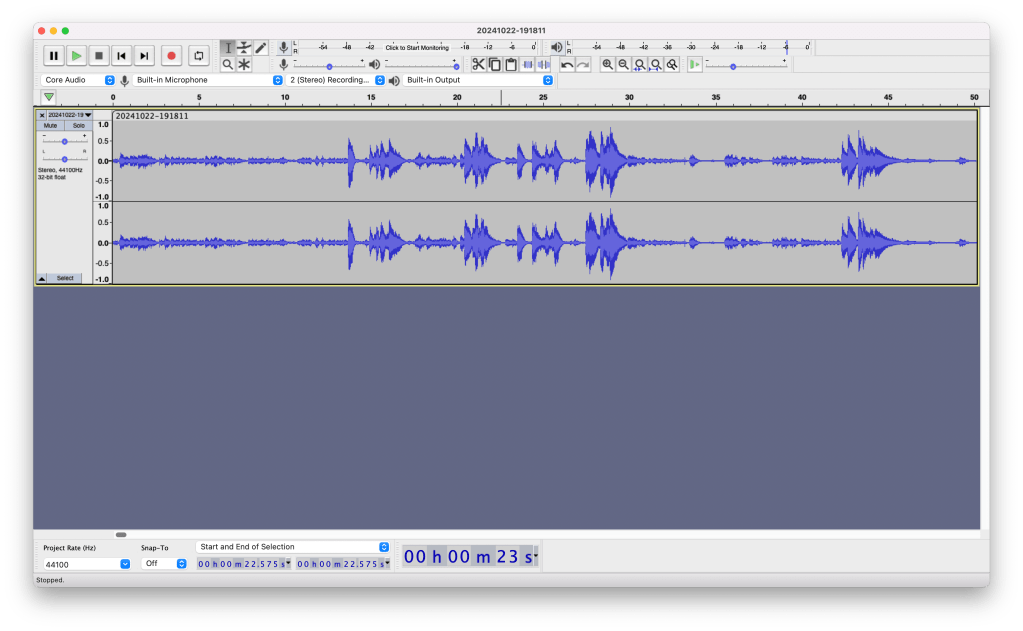
Audacity makes this very easy to do. After importing your audio, you’ll see something like this:

Be sure to “zoom in” so that you’re able to review the audio quite closely: the numbers across the top of the working area are seconds. I am sometimes trimming out individual seconds of audio (or less) while working on these recordings.

The areas where people are singing is usually easy to spot, as those are the places where you see the tall “spikes.” Areas of relative silence are also easy to see, as they’ll look like flat lines. Regular speech will fall somewhere in between these.

Listen to the recording and pause occasionally to cut out unnecessary parts. If you zoom in and watch closely, you’ll be able to “see” the words being said in Audacity. You can select where a word starts and ends by simply clicking and dragging, and delete that section by pressing the “delete” key.

In this picture, I’ve selected the music director saying “um” followed by a second of silence to cut it out of the recording. I played the recording and was able to easily “see” the um in the track, as well as the silence that followed– trimming it makes the recording just a little cleaner and more concise.

It’s not all that granular, though– here’s almost a minute and a half that I’m cutting. You can see there’s a bit of us singing at the beginning (just a repetition of something we’d done before) followed by a lot of talking. No need to keep that! Select it all and delete.

The downside here is that you pretty much have to listen to the whole recording while you’re editing it. It’s time consuming. The upside of that is that it helps you learn, though!

Ultimately, this is your recording to do with as you see fit. You can choose whether you want to keep all the voice parts, or only your own. You can decide how much chatter you want or how much repetition you want. I like to trim my recordings to be as neat as possible while keeping all the voice parts, so I can share the recording with the whole cast– I started doing this as a stage manager making rehearsal resources for my actors! I also like to keep at least one run of the entire song in the file.

I like doing this because you can hear how things sound with your cast. Unlike with canned practice tracks, you don’t have to worry about the recording not making sense to you based on what you experienced in rehearsal– it’s literally your rehearsal! You can also hear how your music director wants things done, and can get an ear for how your own soloists are choosing to time their choices.

There are certainly easier ways to record a music rehearsal, but I think my way has a lot of benefits!

Step 4: Export to your phone

Once your recording is freshly trimmed, give it a final “proof listen” and then export the file. You can save this as an .mp4 file for audio listening, or turn it into a .mov file so it can be uploaded to a cast page, such as a Facebook group. The idea, anyway, is to have the file somewhere you can use it easily.

Step 5: And practice

Your practice track is done! You should now have a track with which you can simply press play and review your music completely hands-free. This is perfect for reviewing in the car on the way to rehearsal– or work, school, or anywhere else you have to go. You can also, of course, sit down with your music and play this track while you practice at home.

Here’s an example of a practice track I made for our cast during a production of Legally Blonde.(Featuring a meme I made from a rehearsal pic… lol.)

I hope this is useful for other performers!

Analysis, Theatre

“Dear Evan Hansen” is Good, Moral Ambiguity is Lost, and Media Literacy is Dead

The following is a slightly edited version of a Facebook post I wrote after seeing the show live for the first time in early 2023. This post is a different style than many of the analyses posted on this blog– because it wasn’t originally written for this blog. Read the exaggerated tone with a touch of humor… it was a late-night Facebook ramble. 🙂

Tonight, I saw Dear Evan Hansen, and instead of having a normal person’s response of, “yeah that was good,” I have written an essay.

Dear Evan Hansen gets a lot of shit because the entire story is centered on a kid who lies, and in the worst possible way. To quickly summarize the plot: Evan is a teenage boy who working through ongoing mental health difficulties. His therapist gives him an assignment to write a pep-talk letter to himself each day, reminding himself that the day is going to be a great one. One day, he writes a letter to himself about how, actually, the day is awful, and he’s really depressed. But this letter is misplaced and found by Connor Murphy, a troubled teen, who walks off with it. Connor kills himself shortly later. When the letter addressed to “Dear Evan Hansen” is found on his person, the family assumes this letter was his suicide note addressed to his good friend Evan. The complication is that Evan has never really met Connor– they are not friends. But seeing the comfort Connor’s parents take in the idea that Connor had any friends, Evan quickly fabricates the lie that they were BEST FRIENDS. Naturally, the lie spirals out of control, getting bigger and bigger until Evan inevitably has to come clean. The drama of the plot hinges on Evan maintaining this lie through higher and higher stakes.

This show has pivoted from being quite popular act its initial release to being pretty popularly hated. The complaint is always “this show sucks because the main character is a completely unlikeable dickbag who tells a humongous lie to win a girl.

The problem with that argument is this: the fact that Evan is not totally likeable is the point.

How do I know that? Because NEITHER IS ANY OTHER CHARACTER IN THE SHOW.

Every character in this show is seriously flawed. Every single one is incredibly selfish.

Evan’s “friend” Jared is only nice to him because his parents and Evan’s parents are friends, and Jared’s parents threatened to stop paying for his car insurance if Jared was mean to Evan. Jared is a total asshole who says some really shitty things throughout the first act (but we’ll come back to him later).

Evan’s other friend Alana is explicitly capitalizing on Connor’s suicide for attention. The plot very openly acknowledges this. She very explicitly acts like she knew him personally and that his death was deeply affecting to her, when in reality, Alana did not know Connor at all.

Evan’s mother, Heidi, is often emotionally immature and seeks validation from her son. (We’ll come back to her, don’t think this is the last word here!)

Connor’s family are all also selfish, we see many shades of this in their grieving process— his mother selfishly seeks comfort from Evan, who she also believes to be grieving; Connor’s dad selfishly believed he could do no wrong as a parent as long as he provided for Connor’s survival needs; Connor’s sister Zoe selfishly refuses to think of her brother as anything but a horrible person even when confronted with the evidence that he is not.

And yes, Evan is selfish. I hardly have to explain the ways how— the entire plot does a pretty good job illustrating this.

The selfishness is not accidental. These characters were written this way on purpose.

Why? What purpose would the authors have in making all of their awful? Wouldn’t that run the risk of their show going misinterpreted?

It must be that these writers are so out of touch with audiences that they just didn’t know that these characters would be taken this way. Or… they are written this way intentionally to send a message.

What message might that be? Let’s look at what else these characters have in common. All of these characters are also similar in that they are not doing very well. Alana is depressed and has contemplated suicide, Jared “has no friends” according to Evan, Evan’s mom is working as hard as she possibly can and still knows she’s not doing enough, Connor’s family is all obviously grieving in their own ways. It’s the old adage, “everyone is fighting a battle you know nothing about.” 

Each of these characters is struggling to get through life the best they can. They are dealing with each other poorly. Barely any character gets through this show without hurting everyone else’s feelings— literally the only ones who do not directly hurt EACH OTHER are Alana and the Murphys and Jared and the Murphys… and that’s only because their sole interaction occurs in one very short scene.

This similarity is also purposeful. I think it’s crucial, in fact. Evan is not the only one hurting anybody. Everyone else is causing everyone else pain. 

Why is everyone selfish? Why is everyone struggling? Why is everyone hurting everyone else? 

Drum roll…

BECAUSE THAT IS WHAT LIFE IS!

Dear Evan Hansen is not about a lie, Dear Evan Hansen is about the ways life is complicated. Relationships with people you love are complicated– especially when these relationships hurt you.

It isn’t so simple as “these characters hurt each other, guess they all better stay away from each other”— all of these characters are IMPORTANT to each other, so they do not have that luxury. Jared is mean to Evan but Evan is his “only friend.” Alana is taking advantage of Connor’s death, but she’s doing so because she has been exactly where Connor was and relates to it on a personal level. Evan’s mom is insecure and this complicated her relationship with her son, but she cares deeply for him and is doing everything for him (even to an occasionally unhelpful extent). 

Dear Evan Hansen is about the ways nothing is easy. Blame and condemnation is easy, but it’s also senseless in real life. You cannot simply say “Connor Murphy was a monster and it’s good he’s dead”— that’s what “Requiem” is about! You cannot simply say “social media is making the youth suicidal!”— while “Waving Through a Window” highlights the ways it is damaging, “You Will Be Found” very explicitly highlights the ways it brings us together. You cannot simply say “lying is bad!”, because while “For Forever” is entirely a lie, it makes connor’s family feel better, and in case you missed that the show is saying “LIES THAT MAKE PEOPLE FEEL GOOD ARE NOT INHERENTLY BAD,” the show explicitly states this in the final scene. Paraphrasing (because I obviously don’t have the script in front of me), Evan says, “I lied, I did a bad thing,” and Zoe replies, “it helped my parents, didn’t it?”

Saying “EVAN IS A BAD PERSON! LYING IS BAD! THE SHOW IS BAD!” so willfully ignores the entire text of the show. The show is about how “bad people” do not exist. “Good people” do not exist! Flat moral categories without room for gray area are unrealistic and nonexistent in the real world!

Not a one of these characters is “good” or “bad.” That must be intentional, because otherwise why would Jared of all characters end up being the voice of reason in Act 2?

Jared is an asshole in act one. He’s really not that likeable at all. He’s consistently a jerk who says mean and crass things that are only sometimes funny. But he is the first person in act 2 to call Evan out for what he is doing. 

“Fine, fine,” you might be saying– “But Evan faces no repercussions for what he did!”

Evan Hansen is a child. He is a senior in high school who is suicidally depressed. Does this excuse his behavior? Say it with me: NO! But his behavior is not excused! By the end of the show, Evan has lost his “adoptive family” and his girlfriend, and the final scene is very clear that he does not get Zoe back (and won’t be getting her back going forward, either).

Evan Hansen did a seriously awful and fucked up thing. And despite this, it is crucial to the story being told that Evan is not alone in the end. After Evan admits his horrible lie in “Words Fail,” the song “So Big, So Small” follows, leaving us with the message that, in spite of everything, Evan can still rely on his mother. He is not hopelessly damaged for eternity. He is not condemned to Hell for being an awful horrible liar. Even though he has done a terrible thing, and even though his mother is a flawed parent by her own admission, he still needs her to be there for him.

In the final scene (which is the scene immediately following “So Big, So Small”), we see Evan is becoming a better person and things are getting better for him— whereas it was strongly implied that Evan was debating killing himself as the lie started to fall apart (see the scene where Evan talks to Connor’s “ghost” towards the end of act 2).

The most common argument against this show that I see is “Dear Evan Hansen is about a kid who tells a horrible lie and gets off scot-free.” But that isn’t what happens. Even lied and lost everything. And– I think this is what the show is all about– he is able to come back from it. Because life is weird and complicated, and because doing bad things doesn’t make you a bad person eternally incapable of redemption.

In an era known for performative moral purity for social media, this show is a hard sell. Social media is a sphere where we rush to judge and label others. The fact that this cycle is destructive hardly needs reiterated, as even most internet users denigrate the “callout culture” that has arisen in recent years. (Keep in mind that social media is a heavy element of the show’s design and plot– this certainly wasn’t an accidental connection.)

It bears mentioning that terms like “virtue signaling” and “cancel culture” have been co-opted by a variety of far-right goons, and that to call their usage of these terms dishonest is putting it extremely lightly. This show critiques the truest sense of virtue signaling and cancel culture by highlighting the fact that morality is not simple enough to put into a small, simple box. People are complicated, as is morality itself; therefore, a gray area must be left between the shades of black and white.

Crucially: Evan’s lie was not entirely a net negative. Despite how he takes advantage of it, Evan also does right by Connor’s memory. The Conor Project is an unequivocal success! The show ends with Evan sitting in the memorial orchard he helped raise money to plant in honor of Connor: The orchard that Zoe says her family is now coming to for weekly picnics, allowing them to grow closer and work through their grief together!

In short: It’s not as easy as “lies are bad!” It is not as easy as “Evan is a bad person!” Every person does good and bad things, and every action has good and bad outcomes! 

People are allowed to just not like this show. I’m not the Evan Hansen police. But if your argument is that people SHOULDN’T like the show because it’s about a kid who lies— are you honestly arguing that everyone who lies is a bad person? Would you honestly argue there’s no value in lying if it can help someone feel better?

Do you actually truly think all lies are bad… or is this position just a false moral high ground you have placed yourself on instead of meaningfully engaging with the text of this show? Which is it, huh?

TL;DR: media literacy is dead, moral ambiguity is lost, this show is good, you’re all just mean.