Actor Life, Theatre

What to Expect When Your Kid Decides to Try Theatre

When a kid makes the decision to try theatre for the first time, it can be a surprising experience for both the child and the parent! Having some ideas of what to expect can be helpful. Whether you have any theatrical experience or not, here are some tips to help you understand what you might see over the next few months:

It’s a commitment! (But a beneficial one)

When your child is cast and you see the rehearsal schedule for the first time, you may be taken aback. Being in a show is a big commitment, and as a parent, it often means a commitment on your part, too. Rehearsal schedules can be quite demanding– even as an adult actor with lots of experience, I am sometimes surprised by just how big of a commitment a show can be.

Remember, though, that the commitment is the point. Mounting a show is a huge endeavor, and rehearsal is required to make that happen! Consider your volunteer time an investment in the program. You’re not just supporting your own child, but also everyone’s kids by donating time and energy to the program, even if the least you do is make sure your kid gets there on time.

Theatre is a really wonderful growth opportunity for kids, but that growth is very dependent on parents being able to physically get their kids there! It can be annoying, but that doesn’t mean it’s not worth it.

Some pro tips for dealing with the time (and gas!) commitment:

  • A carpool setup can absolutely save your life. If your kid has any existing friends in the cast, see if you (or your kid!) can set one up with one of these friends. Fingers crossed, your child will also make new friends who can one day be part of this carpool.
  • Pay close attention to the rehearsal schedule you receive. It’s possible that your kid is not called to every rehearsal, meaning they’re not needed every single night. Many rehearsal schedules will include a “call list” listing either the actor or character names of all required to come to rehearsal. How often your child is called is heavily dependent on the role your child has and the nature of the show they’re in, and dependent on the director’s plan. Not every director organizes their rehearsal schedules this way, either. It’s important to pay attention to all communications from the director to make sure you’re understanding who is needed each day and who isn’t.
  • Ultimately, though, remember that your child’s attendance all rehearsals they are called for is critically important to their success. It is frustrating to have to drive to the theater every day, I know– even as an adult actor driving myself to my own rehearsals, I often quibble about this– but it’s worth it. Your child will get more out of the process, make stronger connections, and stand out in a good way with the director if they are always present and prepared for rehearsal.
  • If there is a night where it is simply not possible to get your kid to rehearsal– something has come up, or your transportation has fallen through– be sure to reach out to either the director or stage manager (the information given to parents at the start of the show should explain who to contact and how to reach them) as soon as possible so the director knows your child will be absent. Think of it like calling off of work– a no-call, no-show is never appreciated.
  • If you’re struggling to find time during production week (the week of the show, where rehearsals tend to run late each night), consider reading my Ultimate Guide to Surviving Tech Week.

They will grow in many ways

It’s impossible to overstate how many opportunities for growth theatre supplies. Since every child is different, every child will take different things from their theatrical experiences. Sure, they’ll learn the show itself, but they’ll also develop a number of hard and soft skills.

Naturally, kids may develop better social skills, and gain a new appreciation for collaboration and teamwork. Theatre is also a fun, low-stakes outlet for improving reading and public speaking skills. By exploring technical theatre or theatrical design opportunities, kids can discover and cultivate diverse interests and skillsets through art, technology, and mathematics. They’ll become better connected with their peers and community at large, and will likely make some new friends! Hopefully, they will also become more independent and disciplined. 

Some tips for supporting that growth:

  • Take an interest in what they’re learning and doing! Properly encoding and understanding the material learned in rehearsal requires some “homework.” Asking your kid about what they did in rehearsal can be a good way to prompt some at-home practice.
  • Exactly what your child needs will depend on the child. For me, theatre helped me learn to be more independently disciplined and assess my own understanding of materials I’m studying. Some kids might learn best when allowed to explore on their own, and some might learn best when scaffolded more directly. Staying in tune with how rehearsals are going can help you gauge how you can best support your kid in the process.
  • Remember, the more committed they are to the process, the more they will learn and grow. It’s important to make sure your child can make it to rehearsals so they can learn what they need to learn!

They’ll Make new Friends… And you Might, Too

Your child will be spending rehearsal time bonding with their cast mates. These bonds can be super strong, and can form very quickly! Don’t worry that your kid won’t make friends in the show: it’s almost inevitable that they will, at some point of the process or another. The actors just spend too much time together to not form some kind of connections.

Meanwhile, you may find that in the time spent picking them up and dropping them off, participating as needed in parent meetings or volunteer sessions, or attending shows and recitals, you may just develop some new friends of your own! Many school theatre departments request volunteer assistance from parents, and  community theaters are always in need of extra assistance. If you’re looking for a new social hobby that allows you to practice some new skills, your child’s theatre participation may help you out!

  • Theatre friendships can be really great for young actors! Making friends with other actors encourages kids to continually assess and better their skills. Just make sure that the friendly competition that arises between theatre peers remains friendly– don’t let your kid talk badly about their own skills, or about other actors!
  • Keep an eye out for any calls for parent volunteers. This is a valuable opportunity to support the program directly. Just remember that volunteering your time doesn’t guarantee anything in return… some parents think volunteer hours can be bartered for better roles for their children, which is definitely not the case.
  • There are a variety of ways to volunteer, and volunteers are needed at all different stages of the rehearsal process. Regardless of your skillset, there’s almost always something for you! Even if you don’t have free time to contribute, some donations are almost always welcomed, whether monetary or physical goods.

It might be frustrating at times… for both of you

Theatre, especially for young actors, is definitely not always sunshine and happiness. There will inevitably be complications throughout the process. Your child might start to feel burnt out through the process, and you might start getting sick of driving them to rehearsal every night! Remember that the process offers a lot of great opportunities, and keep your eyes on those when you both start to feel the pressure.

  • It’s important for both young actors and their parents to keep their emotions in check when feeling burnt out. If you’re tired from all the rehearsal time, the show staff are certainly tired, too! Being temperamental with them may ultimately hurt your chances of participating in future shows.
  • Remember that any learning process is going to be frustrating at times. In fact, some frustration is a sign that your child is learning and growing. Allowing space for a little productive struggle is key to developing resilience and a positive work ethic!

They Might Face Some Heartbreak

As in any activity, theatre provides the invaluable opportunity for children to lose with grace. The nature of performance is such that not every child can get the role they want every time. Your kid might be a dancing fork when they really wanted to play Belle, or they might be cut from a performance altogether. Remember that this is an opportunity for growth and learning in itself, and that learning how to get back on the horse is as important as learning not to fall off it.

They Will Exceed Your Expectations

When a kid makes a decision to participate in theatre, it can be an opportunity for both the kid and the parent to grow and learn new things. Ultimately, if you invest in your kid’s interest by ensuring they’re at rehearsals when they need to be, practicing at home as needed, and talking to them to support them through their frustrations, you’ll find that your child will grow more than you expected!

Support your kids, and you may just find the very expectations set by this article smashed.

Actor Life, Theatre

10 Reasons you Should Accept that Role you Didn’t Want… and 5 Reasons you Shouldn’t

Sometimes, casting doesn’t go the way you want it to. In fact, maybe it’s most of the time.

Auditions are a numbers game, and the numbers are, unfortunately, rarely in your favor. Some auditions will see hundreds of people auditioning for the same role. Inevitably, the competition will be fierce, and sometimes you just won’t get the role you want.

You may be offered a different role. Maybe it’s a supporting role, or a spot in the ensemble. Regardless, it isn’t what you wanted, and it can be tempting to decline the offer. Missing out on the part you had your heart set on is upsetting, of course! But there are real reasons to resist the urge and capitalize on the opportunity to be in the show.

That said, staying in the show might not always be the best answer. There are a few situations where sticking around might be a mistake.

Let’s look at 10 reasons to stick it out… and 5 reasons not to.

10 Reasons to Accept the Part you Didn’t Want

1. It’s good practice

People often say, “good luck is about being in the right place at the right time.” In the theatre world, however, I have sometimes heard the adage, “it’s about being in the right place, at the right time, with the right training.”

Getting more performance experience is excellent practice for your next audition. Performing in front of people more frequently will help you kick audition nerves and gain confidence. You also get to practice all the hard and soft skills that casting panels are looking for in the audition room: vocal ability, pitch, sight reading, acting chops, multitasking, focus under pressure…

In short, getting all the performance experience you can may help you get more experience in the future!

2. It’s a chance to make new connections

Theatre is often about who you know as much as it is what you know. Making connections is critical in an industry where personality is so important.

To be clear, this isn’t saying you should do the show just to suck up to people! Treat the process as an opportunity to make some genuine new friends. If you approach the process earnestly and openly, your social circles may grow in both personal and professional ways. You might meet the person who will cast you in your next show… or you might just meet some really good friends. Both are worth sticking around for!

3. The role might be more fun than you think

I almost always end up having fun in a production, even– and sometimes especially– if I was initially unhappy about the casting initially.

When you pin all your hopes on playing “The Lead,” you sometimes fail to see the rest of the forest for the one tree you’re focusing on. Getting cast as a role besides the one you initially wanted can open your eyes to just how exciting the other roles can be! You may find that your character is an opportunity for some huge, ridiculous acting, or an opportunity to be in all the best songs, or an opportunity for one big dramatic moment that you never realized was so awesome before.

If you can weather the initial disappointment, you may be surprised to discover just how much you love that part you didn’t want!

4. It may be a lower commitment

Something frequently seen with young actors in particular is a desire to be the lead in every production, and a dismissal of any role they declare “not big enough.” A lot of adult actors will tell you, though: sometimes, those “smaller” roles are the place to be.

The truth is that some rules demand slightly less of a time investment than others. There, I said it. This isn’t an invitation to slack off if you’re cast as ensemble, or an admission that some cast members are less important than others. It’s just simply a fact that if you’re playing a dance lead who never leaves the stage, you will necessarily have to put in more time and energy than a cameo role who comes on stage twice. Of course that cameo role also requires energy and research and preparation… and of course that actor should still do all the work necessary to present their role with depth and creative integrity… but you cannot deny that the two roles require different efforts, if not quite different levels of effort.

Whether you’re a busy working adult or someone with lots of extra time to dedicate to a production, getting a role that demands slightly less time can be a blessing (maybe in disguise). It may be beneficial to your social life or to your homework scores if you’re not called to every single rehearsal, as the lead would be. It might be nice if you had free time to assist the production in other ways– like prop-making or scenic artistry– while the leads are busy cramming lines and blocking.

In short, try to see the other opportunities getting cast in a “small” role can provide. I have sometimes found that being completely cut from shows I auditioned for during busy times of my life ended up being a relief.

5. You might share the scene with new partners

In addition to making new connections, you might share the stage with some people you’ve previous performed with countless times, but never quite so closely. Some of my favorite theatre experiences have come from getting cast in “small” roles alongside people I previously considered friendly acquaintances, but nothing more– only for us to end up having a blast together and becoming close friends!

You may initially be sad to discover that you’re cast in a role that with never interact on stage with your existing friends. Remember, the other people you’re cast alongside can become your friends, too! You may even learn some new things by watching and working with them.

6. You could discover skills you didn’t know you had

Okay, so you wanted the Romantic Ingenue Lead… and you’ve been cast as the Funny Best Friend. NOW WHAT?!

Not getting cast in the role you had your heart set on can be more than disappointing: it can be daunting. You might not understand how you fit this role. You may feel like you’re not the right person for the part. Remember, though, that if the production staff cast you in this role, they must have seen something that makes them think you’re the right choice. Trust them!

If you lean into it and use this casting as an opportunity to explore your range and abilities, you might find that you have the capacity to perform in ways you never knew you could. Try looking at the experience as a learning opportunity. The opportunity to learn is certainly there, if you’re willing to embrace it.

7. You might discover some new favorite material

Being in shows is a great way to find new songs and monologues to include in your audition book. Hearing and seeing it rehearsed (or rehearsing it yourself) during a show process is a great way to memorize it for future auditions!

You may also discover that you just love the show itself more than you realized!

8. Quitting could send a bad message

We can debate about whether or not this is fair, but the fact remains: If you clearly had your heart set on a lead, and you quit the show when you don’t get that lead, people are likely to interpret this as entitlement or a bad attitude.

To be honest, I think this is a really reductive and unfair accusation to throw at someone– production staffs cannot read actors’ minds and certainly don’t know everything that goes into the decision to accept or decline a role. My opinion doesn’t change this reality, though. Declining a role you are offered can be taken as an insult by some production staffs.

Before you decline a role, it may be worth weighing whether or not this matters to you. Is this a director you really want to work with in the future? If this decision would negatively impact your chances of being cast in the future, are you willing to live with those consequences?

Think it over carefully. Preferably, take a little time to cool off and properly consider it. (Just don’t leave the production staff hanging too long waiting for an answer.)

9. It could be a good addition to your resume

This might be a small consolation, but remember that any credit on your resume could be a standout. There might be a niche in your resume that this production could fill. Plus, theatre is an industry where knowing people is very helpful– having a resume that shows you’ve worked with a lot of different directors and in a lot of different theaters can be beneficial.

Again, it’s up to you to decide whether or not this is worth it. Think things over carefully.

10. You’d be missing out on a lot, otherwise

The majority of my readers come from community and school theatre backgrounds, where the primary focus of most productions is simply to have fun. If you quit the show because you didn’t get the part you wanted, you will miss out on all that fun!

FOMO probably isn’t the best reason to accept a role… but it’s not a bad one. If what you’re looking for from this production is a fun way to spend your evenings, consider accepting the part. Any role can be fun if you make it fun!

… And 5 Reasons Not To

Generally, the list above is encouraging you to set aside your negative feelings and give the show a chance. But is there a time where this is counterproductive? Absolutely.

There are situations where doing the show can make the situation worse. In these cases, I would encourage someone to decline the role– remembering that declining a role can reflect poorly on you, and that most of these reasons are controllable. In other words, most of the reasons not to do the show listed below are only reasons if you let them be.

1. If you ONLY have negative feelings about it

If you feel overwhelmingly bitter and betrayed about the cast list, and you sincerely don’t think all the reasons I listed above are reasons to set that upset aside and enter the rehearsal process with an open mind: you’re allowed. Seriously, you can be upset as you want, no one can make you feel differently! But if those negative feelings are going to be too powerful to allow you to enjoy yourself, you may run the risk of making the process tense for others.

I know actors who have “powered through” after getting offered a role they didn’t want. They complained about how bitter they were the entire process and were petty and impolite towards much of the cast. Generally, they didn’t make friends, and the production staff didn’t appreciate the behavior. Had they asked me my opinion, I would have told them they were better off quitting the show and freeing up the spots in the cast to actors who were willing to invest some positive energy.

2. If you won’t be able to control your emotions

Similarly to the previous point, if you truly can’t find any positive feelings to muster up about the idea of participating in the show, and you don’t feel good about masking your misgivings: then yes, you should quit the production.

Really measure whether or not you think this is an impossibility for you. Trust me, you are likely much more emotionally resilient than you think you are. And besides, the show will likely be more enjoyable than you think it will be, too: if you quit now, you really might be missing out! But if you genuinely feel that you’ll be too unhappy to avoid lashing out, then yes, please, stay away.

3. If you’re too busy to commit properly

You may genuinely have too much on your plate and feel like committing to this show after the disappointing result is going to be too much to swing. We could argue about whether or not you should audition for shows you’re too busy to commit to… but ultimately, if you feel like you don’t have the time to spare for the production, then it is better to decline the offer and let the opportunity pass you by. Being overbooked will ultimately burn you out, and that probably won’t be fun for you or your cast mates to deal with.

4. If it’s JUST to check a box on your resume

I have known actors who participate in shows after being disappointed by the casting only because they think the show will be an important stepping-stone for them, or that it will look good on their resume. This is fine, but remember that committing to a production is, well, a commitment! If you don’t have any interest in actually being in the production, your lack of investment is likely to show.

As I acknowledged in the section above, there are times where it’s genuinely worth doing a production for the padding on your resume. But if that’s the only benefit you can see, it will probably become obvious to your cast mates pretty quickly– and that isn’t usually a good look.

5. If you truly have a bad feeling about the production

This is a very genuine reason to not partake in a rehearsal process. If you feel uncomfortable about something that happened during the casting process– if you felt some red flags or general bad vibes— these can be worth listening to. I’m not talking about “I didn’t get the part I want and that’s obviously bogus,” I mean things like a disorganized environment, rude treatment by staff, or even behavior that makes you feel uncomfortable or unsafe.

I once auditioned for a show where a member of staff tried to ask me out while casting was actively still happening. In other words, I didn’t know if turning him down meant I would be eliminated from the running. I ended up being offered a part… but suffice to say, I didn’t feel bad about turning that offer (both offers, actually!) down.

Ultimately, the only person who can decide whether or not it’s worth being in a production is you. But consider your choice carefully– there are a host of good reasons to stick it out! If one of those latter five reasons resonate with you, though, maybe declining is your best option after all.

Actor Life, Theatre

The ONLY Reason Anyone Ever Gets on a Cast List is…

… because someone on the audition panel said “I want this person in the cast.”

This is the stone-cold truth. Think about the implications.

This means:

  • It doesn’t really matter what experience you have… you might be the most experienced person in the room, but lose out on the part to someone who has never done theatre before.
  • Practicing until your audition is perfect might be helpful, and it’s definitely better than being unprepared… but it doesn’t really make the difference, does it? You could have a flawless audition and still not make the cut.
  • Having natural, inborn talent is great and all, but that doesn’t matter much when the production staff could just decide they want someone else more.
  • Professional connections are always invaluable… but if the production staff just can’t see you working in this project, then they won’t help much.
  • You could be not wanted for any random reason: What if you remind a director of their mean ex-girlfriend? You might have made a funny face that made the choreographer think you were making fun of them. You could have included your birth date on a resume and handed it to a casting agent who noticed your zodiac sign and decided it was a poor fit for the project.

Are you lost in hopeless despair yet? Don’t be.

Yes, all those things are true. Casting is weird and random and unpredictable, and the reality is that you may be perfectly qualified, prepared, and well-suited for a part and still not get it

But don’t give up yet, because that means it’s also true that:

  • You might be the least experienced person in a room… the other people might have flashy professional credits! You could go toe-to-toe with a Broadway star in an audition… and still get cast, because the audition panel just wants you.
  • You might practice and practice and practice and then forget every single word when you enter your audition. You leave and think “that was the most miserable failure I’ve ever experienced in my life…” and the production staff calls you back, because they just loved your energy.
  • Imagine sitting in a lobby before an audition and your worst fear walks in: that ultra-talented freak of nature with perfect pitch who can sing whistle tones while walking on her hands and performing ventriloquism. And also she has perfect hair. There’s no way you can beat someone that talented!! … but then she’s the one who gets cut, and you get the part, because the production staff just think you’re a perfect fit.
  • You don’t know a single person at the audition. Or at this organization. You’ve never even stepped foot in this venue. But the casting agent just wants to work with you, and suddenly you’re making plenty of new connections!
  • You could be not wanted for any random reason… but you can also be wanted for any reason! Maybe the director liked your sweater and remembered “that cardigan girl” when it came time to make the callback list. Maybe the casting agent saw you make a mistake that they thought was charming and decided they liked your vibe. Maybe you told a silly joke and the staff laughed so much about it at the casting table that they decided they just had to include you somewhere.

So don’t despair. Yes, auditions are nightmares of entropy, and every audition you go to and don’t make the cut can feel like a colossal embarrassment and waste of time… but just remember that it could randomly go your way as much as it might randomly not.

The only way you’ll ever get cast is if you show up. If you show up, someone might just decide they want you. Or they might not… but that’s the coin flip you’ll just have to accept.

Guides and Tips, Theatre

5 Strategies for Practicing Lines with a Partner

Learning lines is one of the least fun parts of a rehearsal process. Nonetheless, it is necessary, and it is therefore necessary for actors to figure out ways to improve at it.

Working on lines with a partner can make the memorization process much more entertaining. Though we sometimes must inevitably practice alone, there are a variety of ways that we can work on lines with a partner… and a variety of ways that are much more beneficial than merely reading the scene back and forth a number of times.

Continue reading
Guides and Tips, Theatre

5 Strategies for Practicing Lines Alone

Have you ever heard a director say that “rehearsal isn’t for learning your lines, it’s for learning everybody else’s?” The adage is one of many actors’ least favorites, as it is often spoken by directors in the act of chastising actors for not knowing their part.

Acting requires a hefty amount of memorization. This is an intimidating element of the art for many. Thankfully, though, memorization is a skill, and all the average actor needs to get their memorization up to snuff for a show are a few memorization techniques that work for them.

You might not always have a partner around to practice lines with. Luckily, there are plenty of strategies for memorizing lines that one can work on privately.

Continue reading
Theatre

Making a Donkey Head for “Midsummer,” with an “Equus” meets “Blair Witch” Twist

In September, I was in a production of A Midsummer Night’s Dream at a community theater. I was also the tech director, and I made the Nick Bottom donkey head: it was a busy time.

The director’s theme for the production was “90s Whimsigoth,” an edgy, feminine style that inspired the design of the set and costumes. This theme also inspired my approach for the donkey head. Holding some experience making masks and working with fur, I knew I could easily build a classic fuzzy donkey head and leave it at that. This felt a bit too simple, though, so I decided to think about less conventional options and leave this as a plan B.

In thinking about alternative options, I kept thinking about the play Equus. If you don’t know it (you should totally read it), it features a number of horses, traditionally presented by ensemble members wearing “masks” made of metal bars or wire.

Read more: Making a Donkey Head for “Midsummer,” with an “Equus” meets “Blair Witch” Twist

Image from Curio Theatre Company, 2013, photo by J.R. Blackwell.

I really liked this style, but wasn’t sure how to achieve this look. I didn’t have the tools on hand to shape metal, nor did I have the materials. Looking at some inspiration photos on Google, I just kept saying to myself, “it’s just… a suggestion of a horse head… out of sticks.” And then I thought, well, hey, sticks are a free and accessible resource that I can find plenty of in almost anyone’s backyard.

I ended up pulling my car off the side of the road in a wooded area and gathering a few downed branches of various sizes. Perks of living in rural western Pennsylvania: free craft supplies!

Actually making the head shape was an intimidating idea, so I decided to simplify by borrowing. I went to Wintercroft to look for a donkey or horse head. The closest they had was this unicorn, which I figured would work just fine. At this point, I am an old pro at assembling Wintercroft masks (see my post about making a ton of them for She Kills Monsters), so I won’t go through the details of assembling that mask here. It didn’t take me long before I had an approximation of an equine head to work with.

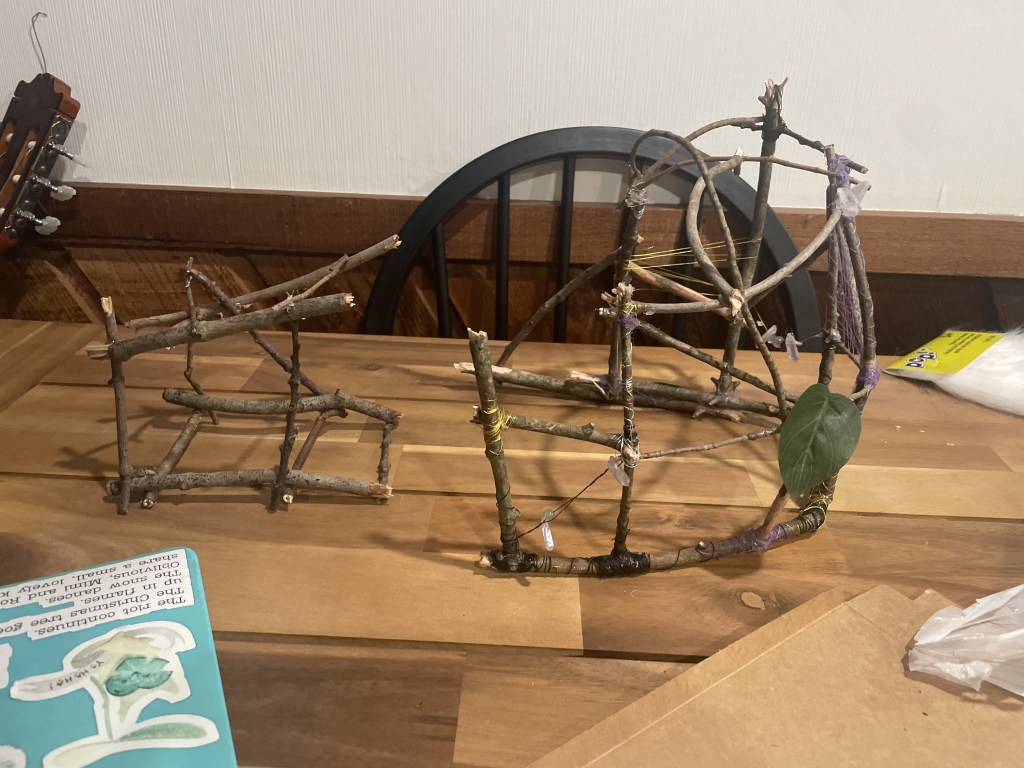
I used the Wintercroft head as a guide to figure out where to place my sticks. I selected a stick with a curve to be the lower part of the head. Using hot glue, I attached other sticks to that one, using the convex edges of the Wintercroft mask as a reference.

Can’t tell if my explanation is making any sense, so here’s a side-by-side comparison of the Wintercroft mask, and a photo of my in-progress stick-sculpture.

To hide the hot glue at the joints between sticks, I added some embroidery thread in a few thematic colors. This actually ended up serving a structural purpose, too: the thread helped hold the sticks in place and make the entire thing much more sturdy. Win, win!

Along with string, I also added some fake foliage and some crystal beads from the jewelry-making section of the craft store.

This was the basic process I followed for completing the head shape: I eyeballed the Wintercroft mask and selected a stick of an appropriate size and shape, or partially/fully break a stick to achieve the shape I wanted. I could also, if the stick was flexible, merely bend it into shape, which created some structural tension in the mask that also helped make it much more sturdy, depending on where the bent stick was placed.

Selecting the right stick ended up being a large part of the task, and a rewarding one: for example, if the stick had a notch at the end, you could fit that notch so it was snug up against another stick in the mask construction and glue it down there for extra solidity. Cover the joints with thread, decorate, rinse & repeat– the process was time-consuming but genuinely fun.

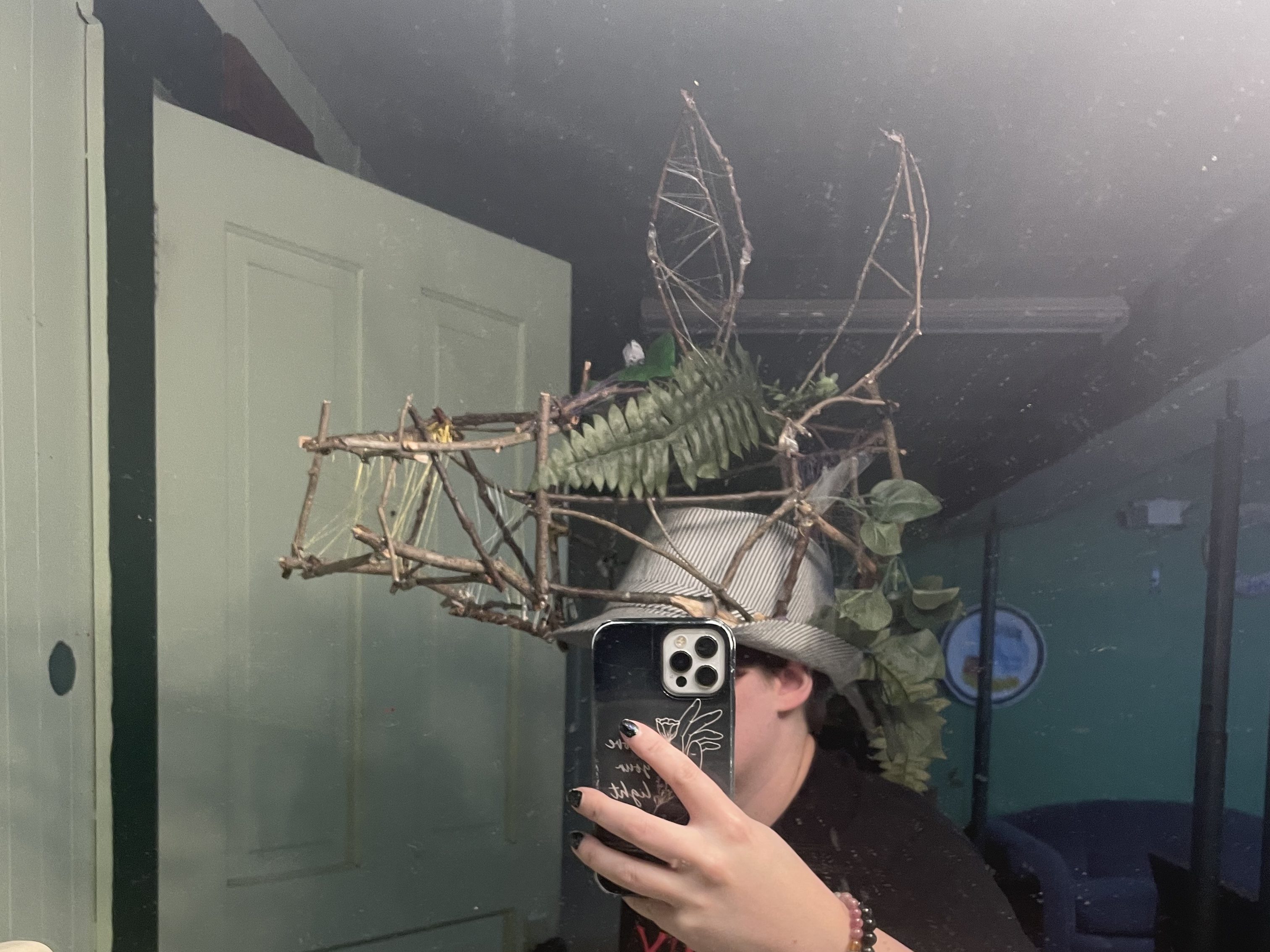
To make this a wearable costume piece, I acquired a fedora from a friend and mounted the bottom part of the donkey head to the rim of the fedora. I used more hot glue for this– there was probably a more elegant solution, but hot glue worked, too!

The fedora was primarily white, which could have worked, but I decided to use acrylic paint to make it black instead.

The head was a bit front-heavy, so I hot glued some miscellaneous nuts and washers into the back brim to help counterweight it. The result was honestly pretty stable, but I also added a chin strap for good measure. I hot glued this into the hat (hot glue really saved the day on this project!) after measuring using the actor’s proportions. All I had on hand was white elastic, so I went back and added some acrylic paint to darken it up.

I had planned to add a few more finishing touches– some more foliage, additional crystals, more thread– but I honestly ran out of time! The product ended up being pretty close to my initial vision, though, so I don’t regret the result.

(Show photos by Kelly Tunney, KGTunney Photography.)

(A closer look at the final product.)

This was a very “trust the process” process, and for the longest time I had no idea how it was going to end up. Adding the ears was a critical moment– for a long time, I wasn’t even sure that it looked much like a donkey! Once the ears were on, it finally began looking a lot more animal and a lot less weird amalgam of wood. Adding the fake fern as a “mane” also really helped!

The result was perfect for our needs: slightly spooky, a little witchy, very woodsy, and cheap. The most expensive part were the crystal beads, but I only used a couple of them, and I planned to keep the rest for other crafts, anyway. I did have to buy a new hot glue gun, because mine broke halfway though. The thread cost maybe $6. Otherwise, this project didn’t cost anything– almost every material was reclaimed and/or borrowed without intent of returning (but with permission).

This process was actually a lot of fun, and I’m excited to try more craft projects with sticks in the future!

Actor Life, Theatre

Everyone Else has Sh*t Taste, and Why That Matters as a Performer

A few years ago, I saw a production that was so bad that when it was over, I texted my friends and said, “it should be illegal for a director to misappropriate funds like this in order to put on this poor of a production.” I honestly felt upset that it was allowed to be put to stage. How many hours of rehearsal and how many thousands of dollars were spent mounting this shocking production?

A few months later, that show came up in conversation with someone I knew from that theater. They asked if I’d seen the show, and I began trying to formulate some polite comments about it to sustain a conversation. The other party then told me that they thought it was the best show they had seen all year.

I had a sort of out-of-body experience… and suddenly, something that I’ve always been told but had never quite internalized made complete sense.

Read more: Everyone Else has Sh*t Taste, and Why That Matters as a Performer

People always say, “you can’t please everyone

It’s an obvious truth. There are just too many other people on this planet to try to appeal to everyone. Tastes are complex, personal, cultural, and often based on myriad subconscious impulses we aren’t even fully aware of. Why would you bother trying to please everyone? It simply can’t be done, you’d go crazy trying.

We say things like “not everyone has to like us,” “sometimes we have to agree to disagree”– many of these sayings ultimately mean the same thing, don’t they? The idea is simple: trying to please everyone is futile. You just can’t always get other people on the same page, and you have to be okay with that.

I understand that part. An element of that conversation that I think is often missing is the fact that other people by and large are not worth impressing.

I don’t say this to be a misanthrope. Other people can be great! Other people are some of my favorite people.

As an exercise, though, think about the worst influencer you know, or your least favorite actor or author, and remember: those people have an audience. There are people who follow them, people who consider them their favorites, people who would be willing to sit and argue with you about how excellent their content and artistry are.

In one sense, this is a ringing reminder that there’s no reason to get down on yourself for feeling untalented, or unlikeable, or unmarketable. Also, it’s a reminder that a lot of people do not share your sense of taste. In fact, their taste is the exact opposite of yours.

And they’re not alone. There are a lot of people out there who will vehemently insist that the worst thing you’ve ever seen in your life is the best thing they’ve ever seen in theirs.

When you participate in the arts, inevitably, you will encounter people who simply will not like your art, and no amount of self-improvement or artistic diligence will change that. You could practice your art and master your craft until the product is, to your eye, absolutely flawless, and others would still hate it.

Instead of letting this get you down, instead of sighing and thinking “well, I can’t please everyone”– remember that some people just have sh*t taste.

In fact, maybe even most people have sh*t taste. After all, since you can’t please them all, the only person whose taste should matter to you is you.

Let them be happy with their sh*t taste. You can make your art without them.

Actor Life

Your First Audition Ever Might be Scary. But it Will be Worth It

So you’re thinking about auditioning for theatre for the first time ever.

I won’t sugarcoat it for you. Auditions are scary.

I am a seasoned performer. I have a lot of shows under my belt. Despite participating in theater for over 15 years now, I am still nervous about auditions. The process is still a great source of stress and fear for me.

So, bad news: Maybe that doesn’t completely go away. There’s a silver lining here, though, too: You don’t have to worry too much about it being scary. The good news is that we’re all scared.

It’s the truth! It’s everyone in the room. Even the people who look super confident. Especially the people who look super confident. I’ve heard it myself: I’ll be at an audition mentally ripping my hair out, and someone will walk up to tell me that I look so calm and collected… I am not!

When I say everyone, I mean everyone. Truth be told, even the show staff are nervous. They want to cast their show well. They have a lot of people to see and a lot of decisions to make. It’s scary for them, and in very similar ways that it’s scary for you. They’re also worried about embarrassing themselves or saying something stupid. They want to make a good impression just as much as you do!

So if we’re all scared, then why are we there?

It’s important to remember that question. Why are you auditioning? Really think about it.

At the end of the day, you don’t have to audition. You have free will! You’re welcome to skip the whole process. And when you’re waiting before your audition, sitting in the lobby and sweating it out, it might reassure you a little to remind yourself that you could get right up and walk out that door, if you wanted to.

But you don’t want to. You want to audition, because… you want to try something new. You want to have fun with your friends. You want to make new friends. You love the show and want to be a part of it. You want to sing or dance or act. Whatever your reason is, remember it– it’s important!

When you find that reason, auditions can even be fun.

Yes, it’ll still be nerve-wracking– but it can be fun, too! It’s just another chance to sing or dance or act. It’s another chance to hang out with your friends, or make new ones. And you might just get to be in this show and enjoy this new experience, too!

And if nothing else, remember, once you get this audition out of the way… it’ll never be your first audition again. They’re all a little less scary after that. They’re still scary… but less.

So don’t stress too much. You’re allowed to be nervous. Everyone else is, too. You’re also allowed to have fun.

And no matter what the outcome, it will be worth it.

directing, Theatre

To Favor Helping Over Punishing: The Need for Less Disciplinarian Directors

Theatre people love to talk about how neurotic actors are. I had a boyfriend once who would always say, “everyone comes to theatre because there’s something wrong with them.” I disagree with the idea… but if we’re going to point fingers at who’s really neurotic, can we talk about directors?

I’ve now been on both sides of the table. All sides of the table, really. I’ve acted, directed, taught, stage managed, all of the above. I know how taxing and just plain difficult directing is. The level of organization, thoughtfulness, and artistry required to mount a full production really is something else. I think maybe you do have to be just a little neurotic to pull it all off. And man, I’ve met some neurotic directors in my day.

Case in point: If you spend enough time around directors, you’ll probably start to pick up on a recurring sentence. The million-dollar phrase: “I’ll never cast [xyz person] again.” This statement gets wildly misused and overused.

The fact is, a lot of (not very good) directors use directing as an excuse to go on a bit of a power trip.

It’s not that I can’t imagine circumstances for a director to blacklist an actor. If an actor is a genuine safety threat to those around them, for instance, a director absolutely should blacklist that actor. The thing is, this sentence rarely follows an explanation of such a circumstance. My issue with the phrase is that it’s often used in some very judgmental and even occasionally ableist or classist ways.

Continue reading